Feedback is New Scientist’s popular sideways look at the latest science and technology news. You can submit items you believe may amuse readers to Feedback by emailing [email protected]
Our expiry date
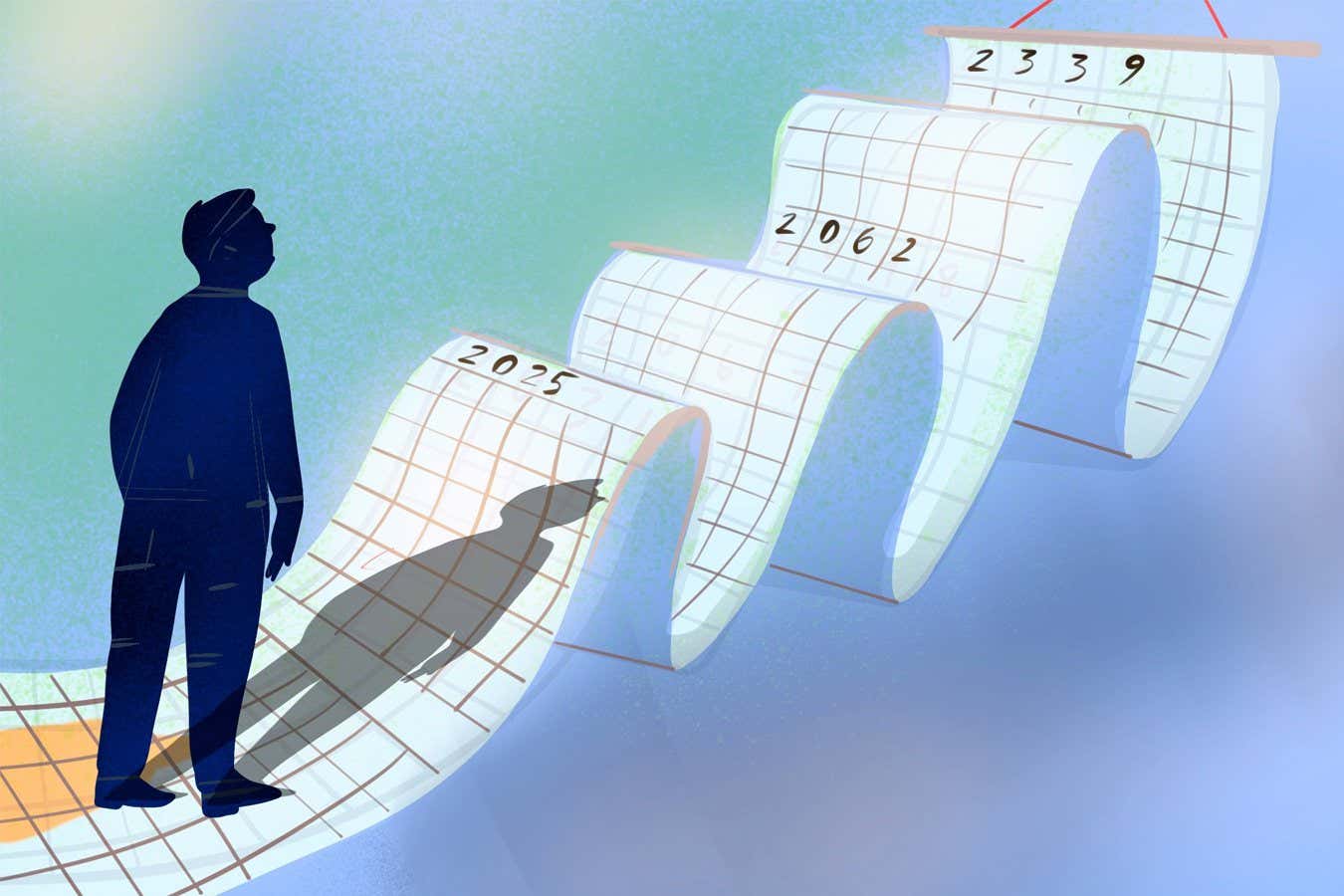
Bad news, everyone: our cards are marked. The human species will go extinct by the year 2339, so we have just a few centuries left (at time of writing).
News editor Jacob Aron shared this shattering revelation with us, which he spotted in a non-peer-reviewed paper on the social sciences preprint server SocArXiv. In it, demographers David Swanson and Jeff Tayman outline how the human population will go from its current 8.1 billion to zero.
Their argument is quite simple. “Given the decline in fertility between 2019 and 2024 and employing a probabilistic forecasting method,” they write, “by 2139 the world population will be between 1.55 billion and 1.81 billion… by 2339 there will be no humans.”
Swanson and Tayman note that this extinction date is “only 314 years from now”. Feedback feels that they could at least acknowledge the inevitable uncertainties in their forecast by rounding it down to 300, but full marks for unearned confidence.
Perhaps this is obvious, but you can’t extrapolate from a five-year period to the entirety of the next three-and-a-bit centuries – especially if the five-year period in question is 2019 to 2024, a stretch of time that included one or two major world events that might have affected fertility rates.
And it also doesn’t matter that the pair used three distinct approaches called the “Cohort Component Method”, the “Hamilton-Perry Method” and even the esteemed and eponymous “Espenshade-Tayman Method”. It’s still not a valid prediction. But we feel that Feedback’s readers might have already worked that out.
We briefly wondered if the paper might be a parody or joke, perhaps intended to bait unwary science journalists into credulous doom-laden coverage. But we don’t think so, because Swanson presented it at a conference in September. Apparently his presentation “was followed by a lively discussion“. Oh to have been a fly on that wall.
Maybe this is all the prelude to the launch of a new religion, with the apocalypse safely placed three centuries into the future so the founders can’t be embarrassed when it fails to occur.
Oh no, not again
Feedback notes with weary bemusement that US President Donald Trump has called climate change a “con job” and claimed that renewable energy sources like wind are “pathetic”.
This came after his government issued a report in July, authored by “independent researchers”, that was meant to offer a justification for halting efforts to mitigate climate change. The report was checked over by Carbon Brief and was found to contain “at least 100 false or misleading statements“. On the other side of the Atlantic, the UK’s Conservative party has pledged to repeal the Climate Change Act if they ever get back into power.
Feedback would point out that renewables overtook coal as the world’s largest source of electricity in the first half of 2025, which doesn’t sound especially pathetic, but we are too busy flashing back to that scene in Monty Python and the Holy Grail where the monks rhythmically smack themselves in the face with wooden boards. We can only assume these people read the Swanson/Tayman paper and decided that 2339 was too far off.
A brief thank you
One of the keys to being a great researcher is to think of a question that nobody else has ever considered. Hence the study published in the social science journal Socius in September: “‘This work would not have been possible without…’: The length of acknowledgements in sociology books”. Yes, you read that right: it’s an entire sociological paper about the acknowledgements sections at the end of sociology books.
The first thing to note, as the authors themselves do, is that they aren’t the first to ask this question. Someone called Kenneth Henry Mackintosh did a PhD thesis in 1972 on “Acknowledgment patterns in sociology“. Feedback tracked it down online and was dismayed to find it is over 300 pages long and, if the table of contents is to be trusted, doesn’t have an acknowledgements section.
What of the new study? The researchers compiled 411 books by 317 sociologists and totted up the words in the acknowledgements (apart from the 7 per cent of books that didn’t include any – rude). One of the strongest statistical trends was that female authors wrote longer acknowledgements than male authors.
Likewise, books published by university presses had longer acknowledgements than those from other publishers. In both cases, it’s not clear if they were thanking more people or just going about it at greater length.
Naturally, Feedback wondered what the paper’s own acknowledgements section was like, so down we scrolled. We were pleased to find that it was a 218-word brick of a paragraph, complete with a mention of “unwavering love and support”.
Then we learned that we aren’t at all original. Co-author Jeff Lockhart posted about the paper on Bluesky, and another researcher replied that they were “glad that the paper itself has a very long acknowledgment section“. To which Lockhart replied: “We felt obligated.”
Feedback would like to thank the cats for refraining from stepping on the laptop keyboard during the writing of this piece.
Got a story for Feedback?
You can send stories to Feedback by email at [email protected]. Please include your home address. This week’s and past Feedbacks can be seen on our website.
Source link : https://www.newscientist.com/article/mg26835652-300-is-it-really-likely-that-humans-will-go-extinct-in-exactly-314-years/?utm_campaign=RSS%7CNSNS&utm_source=NSNS&utm_medium=RSS&utm_content=home
Author :
Publish date : 2025-10-15 18:00:00
Copyright for syndicated content belongs to the linked Source.