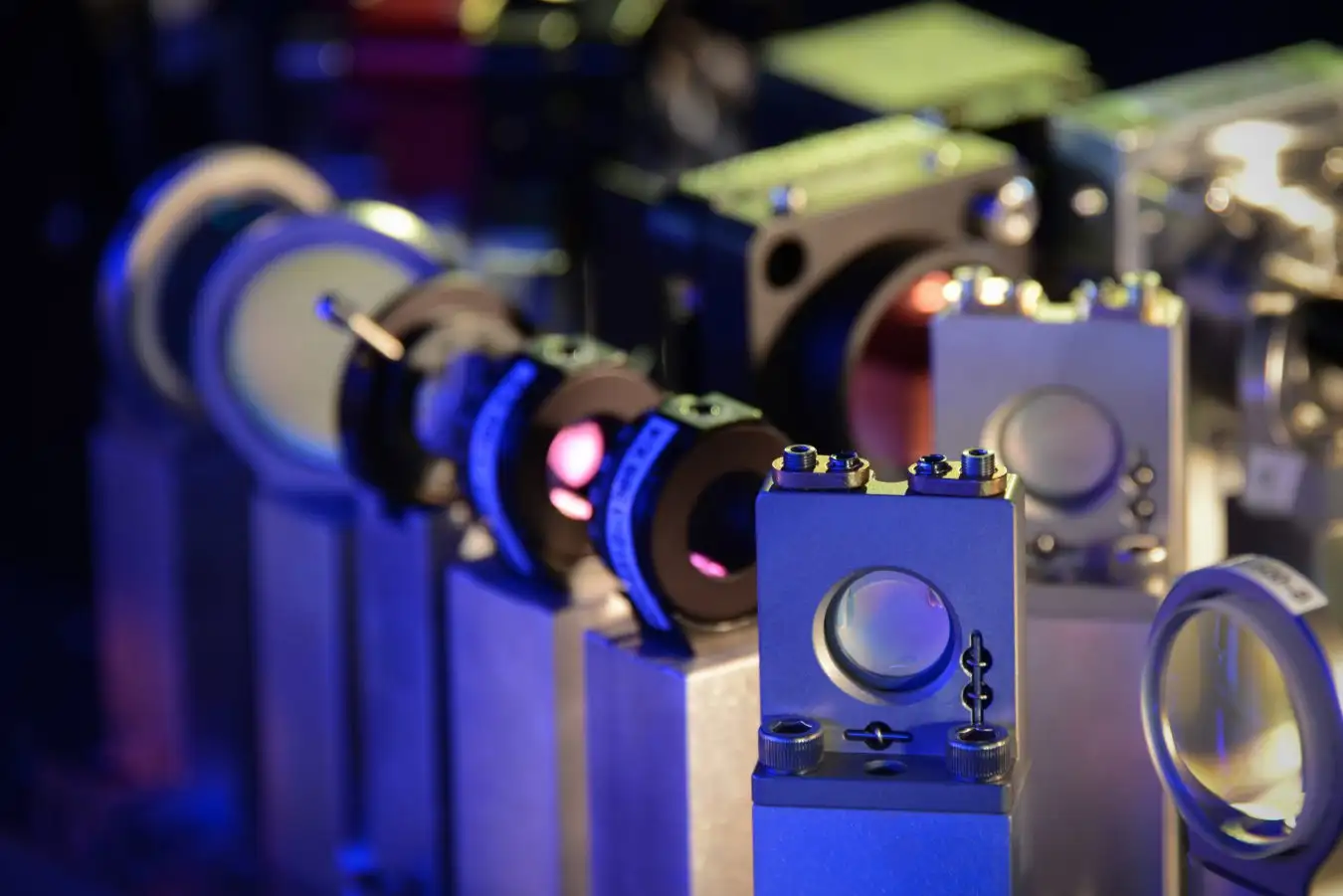
The internal optics of Atom Computing’s AC1000 system
Atom Computing
Quantum computers made from qubits based on extremely cold atoms have been getting larger at an impressive rate, which may soon make them computationally powerful – but errors arise at a rate that limits their usefulness. Now, researchers have worked out how to replenish and reuse those qubits to make their computations more practical and reliable.
All existing quantum computers are too error-prone to tackle computations that are both useful and give them an edge over traditional computers, but researchers have made great strides in developing error-correction schemes that could resolve this problem.
In one such scheme, a quantum computer’s building blocks, which are called qubits, are split into two key groups: qubits that are tasked with manipulating data and are used to run the computation, and others called “ancilla qubits”, which keep track of errors.
Creating many high-quality qubits for either purpose is a big technical challenge, so Matt Norcia at Atom Computing, a US firm, and his colleagues have devised a way to reuse or replace ancilla qubits, cutting down on the number they need to make. They have now shown that their error-tracking qubits can be recycled 41 times in a row.
“Any computation of use is likely to be a very long computation, so you’d have to do many rounds of measurements. Ideally, you want to be able to reuse the qubits throughout multiple rounds so that you don’t have to continue providing more qubits into the system,” says Norcia.
He and his colleagues used qubits made from electrically neutral ytterbium atoms cooled to temperatures very close to absolute zero with lasers and electromagnetic pulses. They could control the quantum state, and the quantum properties that encode information, for each atom with lasers configured into “optical tweezers”. The team used this technique to organise their quantum computer into three different zones.
In the first zone, 128 optical tweezers directed qubits to run computations, while in the second zone 80 tweezers held qubits that could be used for error measurements and swapped in place of any erroneous qubit. The third zone acted as storage, holding space for 75 more qubits that were just freshly put into a useful state. Having these last two zones enabled the researchers to either reset and reuse ancilla qubits or swap them out for new ones.
Norcia says making this arrangement work was difficult because any stray light from one laser that touches a nearby qubit can disturb its function. Because of this, the researchers had to develop precise control over their lasers, but also ways to tune the states of the data qubits so that they remain “hidden” from, or unbothered by, certain types of deleterious light, he says.
“Ancilla reuse is fundamentally important for quantum computing progress,” says Yuval Boger at the US quantum computing company QuEra. Without this capability, even very modest calculations would require millions or billions of qubits, and that is simply not plausible for any existing or soon-to-be-built quantum computing hardware, he says.
This problem has been recognised across the atom-based qubit research community. “I think everyone in the neutral atom [quantum computing] space understands the need to reset and reload atoms throughout a computation,” says Norcia.
For instance, Boger points out that a team of researchers at Harvard University and the Massachusetts Institute of Technology used a similar method to keep a quantum computer made from 3000 ultracold rubidium atoms running for several hours. Some quantum computers with qubits made from ions controlled by light, like the Helios machine that was recently debuted by Quantinuum, can reuse qubits as well.
Topics:
Source link : https://www.newscientist.com/article/2504988-quantum-computers-that-recycle-their-qubits-can-limit-errors/?utm_campaign=RSS%7CNSNS&utm_source=NSNS&utm_medium=RSS&utm_content=home
Author :
Publish date : 2025-11-19 15:00:00
Copyright for syndicated content belongs to the linked Source.