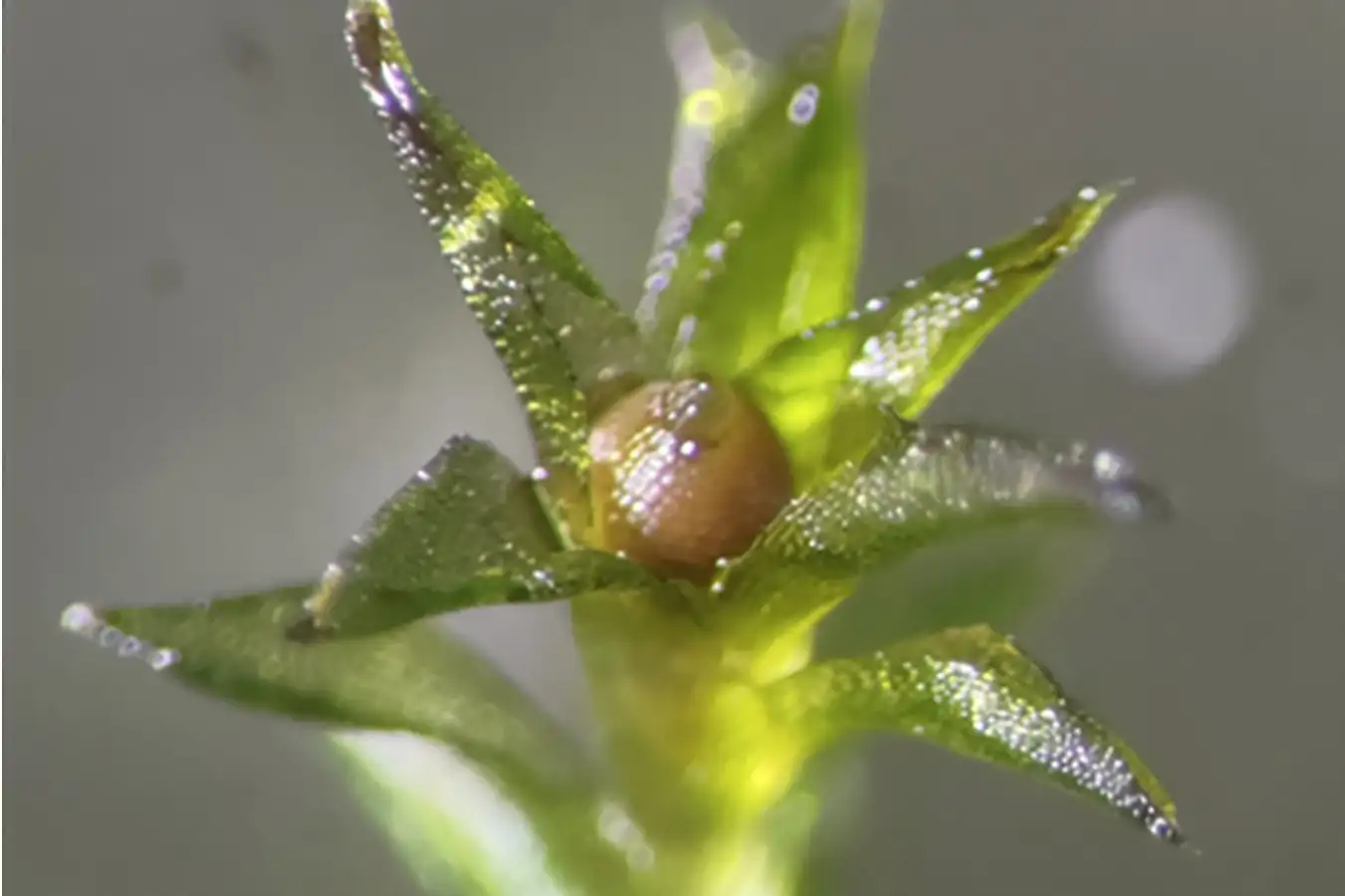
This moss grew from a spore exposed to space for nine months
Tomomichi Fujita
On 4 March 2022, astronauts locked 20,000 moss spores outside the International Space Station and left them exposed to the rigours of space for 283 days. They then rescued the spores and returned them to Earth on a SpaceX capsule so that scientists could attempt to germinate them. Surprisingly, these attempts were successful.
Mosses were among the earliest land plants and are well known for colonising some of the harshest environments on Earth – Antarctica, volcanic fields and deserts, says Tomomichi Fujita at Hokkaido University in Japan, who was on the team that ran the experiment.
“We wondered whether their spores might also survive exposure to outer space – one of the most extreme environments imaginable,” he says.
Numerous studies have already simulated whether various mosses and other plants can survive conditions beyond Earth, including what might be expected on Mars. But this is the first time researchers have tested whether a species of moss can cope with real space conditions. The spores came from the species Physcomitrium patens.
A control group of spores that had stayed on Earth had a germination rate of 97 per cent, as did another set of spores that were exposed to space but shielded from the damaging ultraviolet radiation found there.
Most astonishingly, over 80 per cent of the spores that were exposed to the full brunt of space – a vacuum, extreme temperatures, microgravity, UV and cosmic radiation – remained viable and germinated into normal plants. The team predicted it is possible that, based on the results of these experiments, some of the spores could remain viable in space for 15 years.
“Opening the samples felt like unlocking a biological time capsule: life that had endured the void of space and returned fully functional,” says Fujita.
Prior to the deployment, researchers had already tested other living parts of the moss, such as its filaments, in simulated conditions. They found that other life stages of the moss succumbed to UV radiation, freezing and heating, high salinity and dehydration within days to weeks.
But the spores seemed to be able to cope with all of these challenges. This is especially impressive for the spores that were locked outside the space station, since they were hit with everything at once while the Earth-based tests each involved testing just one stressor at a time.
Fujita says the multiple layers of spore walls that encase the reproductive tissue appear to offer “passive shielding against space stresses”.
He says it is as if the spores are inside their own spacecraft. This might have been an adaptive feature they developed to cope with the harsh environmental conditions that existed on land when life first moved out of the oceans hundreds of millions of years ago.
“Spores are essentially compact life capsules – dormant but ready to reactivate when conditions become favourable,” he says. “It’s as though evolution equipped them with their own tiny survival pods, built for dispersal across both space and time.”
Fujita says that while the research doesn’t in any way prove that extraterrestrial life exists, it strengthens the case that life, once it has emerged, can be incredibly robust. “The fact that terrestrial life forms can endure space-like conditions suggests that life’s building blocks may be more widespread and persistent than we often assume.”
David Eldridge at the University of New South Wales in Sydney says the true test isn’t whether the spores will germinate once back on Earth, but whether they can also germinate in space.
“The trick will be to check the growth rates of these taxa in space and see whether they can reproduce,” he says.
Topics:
Source link : https://www.newscientist.com/article/2505180-moss-spores-survive-and-germinate-after-283-day-space-walk/?utm_campaign=RSS%7CNSNS&utm_source=NSNS&utm_medium=RSS&utm_content=home
Author :
Publish date : 2025-11-20 16:00:00
Copyright for syndicated content belongs to the linked Source.