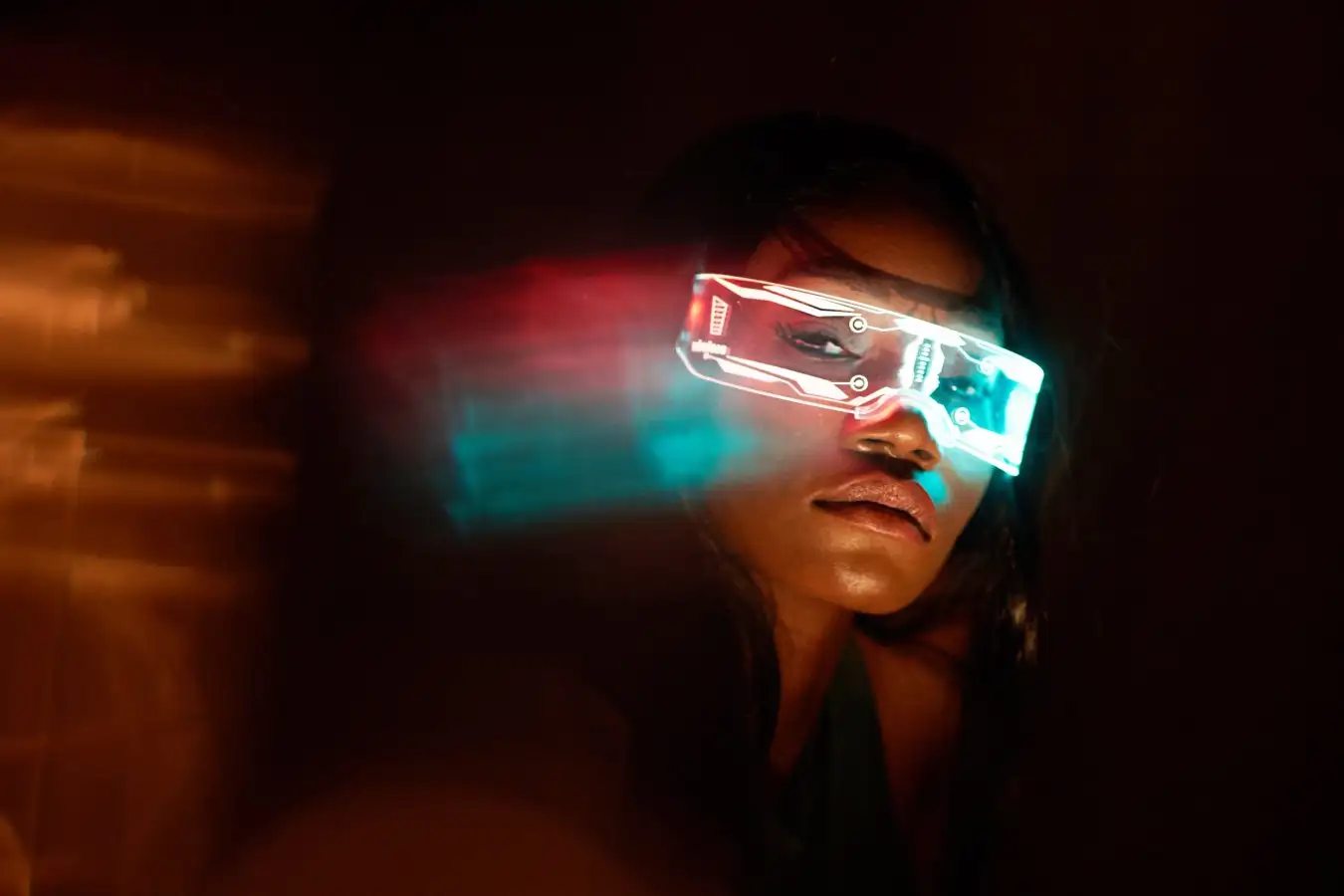
“Wearing the unsmart glasses created an entirely un-augmented reality…”
Ekaterina Goncharova/Getty Images
By the mid-2020s, the world was becoming swamped with “AI slop”. Whether images, video, music, emails, ads, speeches or TV shows, many people’s interactions were with asinine content generated by artificial intelligence. Sometimes the experience was fun and relatively harmless, but often it was tedious and brain-sapping. At worst, it could be dangerously misleading. Even engagements with other people became suspect – who knew if the person on the phone was real or not? Many people found it nauseating and insulting, and wished they could escape the slop.
There was no “Butlerian jihad” – the fictional overthrow of all thinking machines in the Dune books, named for Samuel Butler’s prescient 1863 letter on machine evolution, “Darwin among the machines”. In fact, the solution, ironically enough, came through a clever use of AI.
Tech companies had developed a range of smart glasses that provided augmented reality (AR) displays with inbuilt cameras, mics and headphones. In 2028, engineers at the Reclaim Reality Foundation took the tech in smart glasses and used a custom AI to detect and then remove anything that was AI-generated. Wearing the unsmart glasses acted as a sort of negative AR, creating an entirely un-augmented reality.
Walking in a city wearing these DumbGlasses, which became known as X-ray spex as they saw through everything, was akin to paying for an ad-free TV show or podcast. The glasses removed banners and posters that had been made using AI and seamlessly replaced them with a natural background. Any speech and songs you heard, you could be confident they were made by a traditional analogue process. People used X-ray spex to relax, to calm themselves, to detox from the waves of AI slop they otherwise had to negotiate. Some wearers celebrated their status with T-shirts and badges bearing slogans such as “AI Vegan”, “Real or Nothing” and “Slop-Free Zone”.
As technology improved in the 2030s, it became possible to wear electronic contact lenses and miniature ear implants that performed the same function.
The online world was a different matter. There it was much harder to escape the clutches of AI and the constant algorithmic profiling.
“
Engineers took the tech in smart glasses and used a custom AI to remove anything that was AI-generated
“
One method was to use a workaround to access search engines without triggering an AI summary. In the 2020s, one such option was startpage.com. Other hacks involved adding an expletive to your search prompt, which shut down AI-generated summaries. But workarounds didn’t help avoid AI profiling and targeting when using social media networks. Escaping that was easier said than done when social media, the tools of online navigation and the online world itself were utterly dominated by tech giants. And few people wanted to renounce everything the internet revolution had given us. They still wanted a digital world to explore and a rich online experience.
The answer was the rise of a third kind of network. There was the regular internet, and there was the dark web, accessible only with specific browsers and passcodes. Then there was the veriweb (from veritas, the Latin word for truth), made of content that was hallmarked as being AI-free. In collaboration with Reclaim Reality, artists, musicians and writers developed an unfakeable system – similar to the blockchain technology used to verify cryptocurrency transactions – that guaranteed the human provenance of any content. The veriweb, which was also known as the transparent web because you could see where the content came from, became the go-to place for guaranteed information and journalism. Wikipedia, plagued by AI-generated content for much of the 2020s, moved to the veriweb in 2029. News providers established outposts there and were soon followed by legacy news and media organisations keen to demonstrate their authenticity, trustworthiness and veracity. Moreover, on the veriweb, users weren’t tracked, profiled and targeted by AI algorithms.
What was gained, as millions and then billions made the move, was a return to human-to-human connection and a rise in creativity. Most still used AI in a personal capacity – in medical diagnoses, for example – but the atrophy of the human brain that had been under way since the 2020s, when more and more actions were outsourced to AI, was checked.
What was lost, as people tried to navigate the vastness of cyberspace without the aid of algorithms to point them in helpful directions, was the feeling that your online experience was curated and personalised. Also lost was the unprecedented amount of intimate data harvested by those megacompanies, and the vast profits generated by the targeted exploitation of that data. Few mourned this loss.
Rowan Hooper is New Scientist‘s podcast editor and the author of How to Spend a Trillion Dollars: The 10 global problems we can actually fix. Follow him on Bluesky @rowhoop.bsky.social
Topics:
- artificial intelligence/
- technology
Source link : https://www.newscientist.com/article/mg26835700-100-imagining-a-future-where-smart-glasses-allow-ai-slop-to-be-avoided/?utm_campaign=RSS%7CNSNS&utm_source=NSNS&utm_medium=RSS&utm_content=home
Author :
Publish date : 2025-11-19 18:00:00
Copyright for syndicated content belongs to the linked Source.