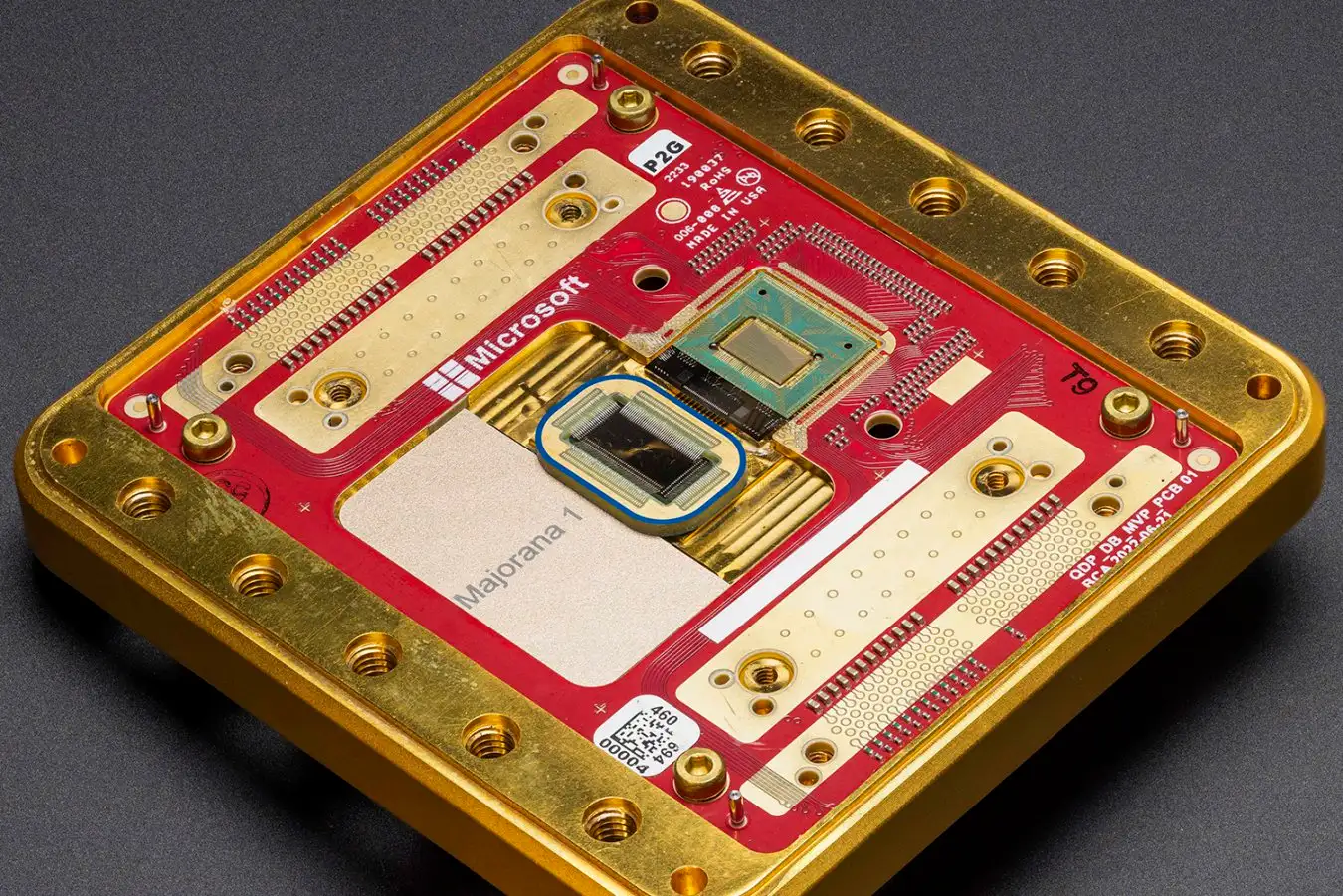
Microsoft’s Majorana 1 quantum chip
John Brecher/Microsoft
In February, Microsoft unveiled a new quantum computer called Majorana 1 and it quickly became one of the most controversial devices in quantum computing.
Majorana 1 caused controversy because it relies on a particular kind of quantum bit, or qubit, called a topological qubit. Theoretically, these are a lot more immune to errors than alternatives, making them an attractive proposition for building a largely error-proof quantum computer. For years, Microsoft has attempted to do just that, using elusive quasiparticles called Majorana zero modes (MZMs) as its basis for topological qubits – but its track record is mixed.
In 2021, a paper by a group of Microsoft researchers was retracted from the scientific journal Nature after independent experts identified a flaw in the analysis that had aimed to establish the basic building block of topological qubits. Then, in 2023, an experiment concerning a predecessor to Majorana 1 was heavily criticised by several experts.
As such, Microsoft’s 2025 Nature paper announcing Majorana 1 was always going to be heavily scrutinised. In an unusual move, the paper was published alongside a note from the Nature editorial team stating that “results in this manuscript do not represent evidence for the presence of Majorana zero modes in the reported devices”, while a press release from Microsoft stated the exact opposite.
Microsoft’s Chetan Nayak attempted to address concerns in a packed presentation at the American Physical Society Global Summit in Anaheim, California, in March. He shared details of new data, but critics remained unconvinced.
“The data they presented then and since simply does not show a functional topological qubit. It doesn’t even show the basic building blocks of a topological qubit,” says Henry Legg at the University of St Andrews in the UK, one such critic.
Nayak says that the response from the community this year has been enthusiastic and energising. “As anticipated, there has been thoughtful debate and inquisitive engagement around our recent discoveries and continued research.”
In July, the firm released more data, and Eun-Ah Kim at Cornell University in New York says that these measurements showed behaviour more indicative of a topological qubit than those presented previously. “[I am] very happy to see the progress,” she says.
Nayak and his colleagues are now confident that further progress is on the horizon and they are working on making their next quantum computer bigger than Majorana 1, which will, in theory, allow it to run complex computations in an error-proof way. The project has also been selected to advance to the final phase of the Quantum Benchmarking Initiative run by the US Defense Advanced Research Projects Agency, with the aim of rigorously identifying a feasible way to build useful quantum computers.
“This past year has been transformative for our quantum programme. The launch of the Majorana 1 chip marked a pivotal moment, not just for Microsoft, but for the field of quantum computing,” says Nayak.
But will 2026 be the year that Microsoft’s work satisfies its critics? Legg remains sceptical. “Fundamental physics does not respect the timelines set by big tech companies,” he says.
Topics:
Source link : https://www.newscientist.com/article/2508083-microsoft-made-a-splash-with-a-controversial-quantum-computer-in-2025/?utm_campaign=RSS%7CNSNS&utm_source=NSNS&utm_medium=RSS&utm_content=home
Author :
Publish date : 2025-12-29 11:00:00
Copyright for syndicated content belongs to the linked Source.