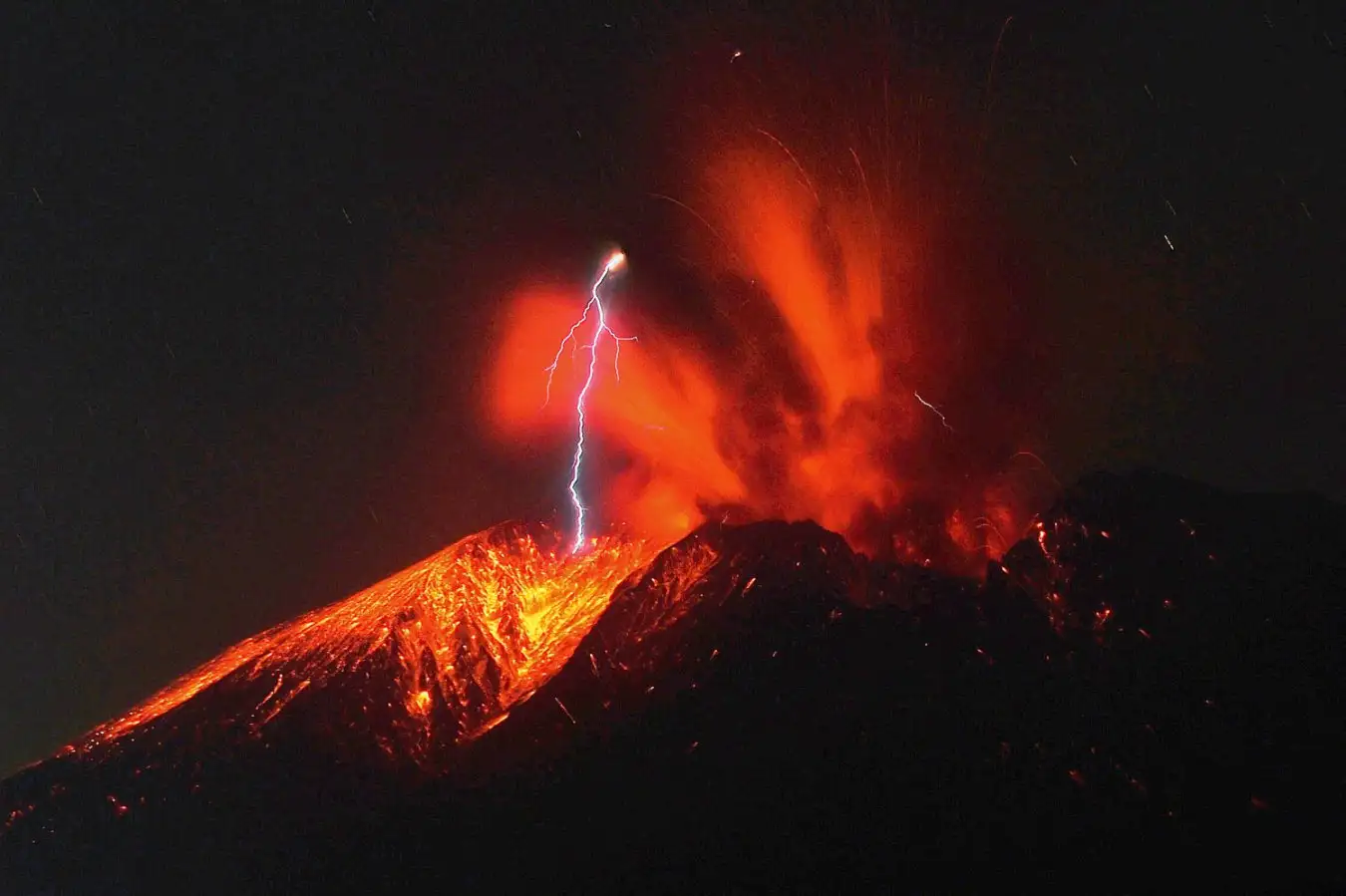
Arc volcanoes like Sakurajima in Japan release carbon dioxide from Earth’s interior
The Asahi Shimbun via Getty Images
The power of volcanoes to change Earth’s climate may not be as ancient as previously thought.
Throughout our planet’s history, the climate has fluctuated between “icehouse” and “greenhouse” conditions, largely determined by the levels of greenhouse gases, such as carbon dioxide, in the atmosphere.
Volcanic arcs, the giant chains of erupting peaks in places like Japan, can play a part in this by releasing CO2 from Earth’s interior. But modelling research led by Ben Mather at the University of Melbourne, Australia, suggests they only became the dominant source of carbon emissions towards the end of the age of the dinosaurs, around 100 million years ago.
This is because around 150 million years ago, phytoplankton with calcium carbonate scales emerged in the oceans. When these plankton die, they leave immense deposits of calcium carbonate on the deep-sea floor, says Mather.
As tectonic plates move and are recycled into Earth’s molten interior by slipping under each other, a process known as subduction, these huge reservoirs of stored carbon end up being pushed into the mantle.
“Most of the carbon from the plankton that leaves the subducting oceanic plate will get mixed into the molten interior, but a portion of that will get emitted via volcanic-arc volcanoes,” says Mather.
However, before 150 million years ago, the material being released by volcanic arcs was relatively low in CO2 because of the absence of these scaly plankton, says Mather.
He and his colleagues have modelled the past half-billion years of plate tectonics and its role in the carbon cycle. They found that through most of Earth’s history, much of the carbon locked inside the planet was released along fissures in Earth’s crust in a process called rifting, not by volcanic arcs.
Rifting is the process by which continents are torn apart on geological timescales and can happen on land, such as at the East African Rift, or along mid-ocean ridges.
“When tectonic plates are being spread apart, essentially, what you’re doing is ‘unroofing’ some of the molten interior of the Earth,” says Mather. “When that happens, you get new crust being formed at mid-ocean ridges and emission of carbon.”
The amount of carbon released into the atmosphere from continental rifts and mid-ocean ridges is a product of the length of the rift and how fast they pull apart, says Mather, but the proportion of carbon released previously stayed comparatively steady. “But the emissions from volcanic arcs have significantly increased in the last 100 million years thanks to this new reservoir of carbon on the seafloor from these plankton calcium carbonate suppliers,” he says. “Compared to 150 million years ago, volcanic arcs now emit two-thirds more carbon.”
Earth is currently in a short, warm period known as an interglacial within a much longer ice age that began 34 million years ago. One factor contributing to the ongoing cool spell is that these phytoplankton take so much carbon out of the ocean and lock it into the sea floor. While the amount of carbon in volcanic arc eruptions has increased, it is still less than what the phytoplankton store on the sea floor and what gets pulled into Earth’s interior by tectonic movement.
Alan Collins at the University of Adelaide, Australia, says modelling work such as this study is vital to understanding how the impact of volcanism and tectonic activity on the climate has changed through time.
“The composition of ocean sediments has changed as different creatures evolve that use different elements in their composition, such as the evolution and progressive dominance of calcium carbonate zooplankton,” says Collins.
Journal reference: Nature Communications Earth and Environment, DOI TK
Land of fire and ice: Iceland
Join an unforgettable tour of Iceland’s incredible landscapes, with days filled with volcanic and geological adventure, and evening opportunities to see the aurora borealis (October)
Topics:
Source link : https://www.newscientist.com/article/2511960-volcanoes-had-lower-greenhouse-gas-emissions-in-earths-past/?utm_campaign=RSS%7CNSNS&utm_source=NSNS&utm_medium=RSS&utm_content=home
Author :
Publish date : 2026-01-19 10:00:00
Copyright for syndicated content belongs to the linked Source.