Mars has a surprisingly large influence on Earth’s climate
NASA/JPL/Malin Space Science Systems
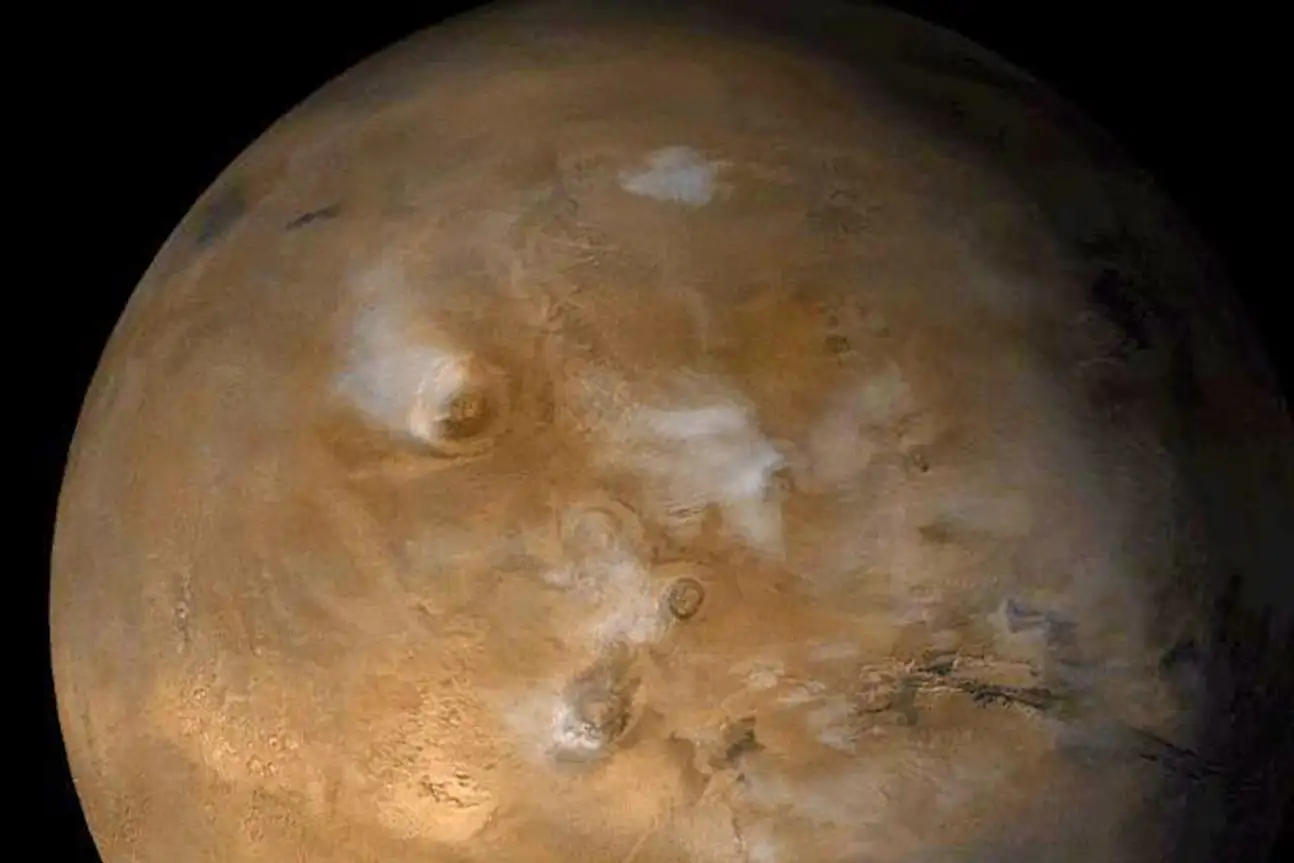
Compared with Earth, Mars is tiny, yet it seems to have an outsized effect on our planet’s climate cycles. Similar small planets could affect the climates of worlds beyond our solar system, which we must begin to take into account when evaluating their potential habitability.
Stephen Kane at the University of California, Riverside, and his colleagues found this effect by running simulations of the influence Mars would have on Earth’s orbit if it were a different mass, from 100 times its actual mass to if it were gone entirely. “I came to this from a perspective of scepticism, actually, because I had trouble believing that Mars, which is only a tenth the mass of Earth, could have such a profound effect on Earth’s cycles, so that’s what motivated this study to turn that knob of Mars’s mass and see what happens,” says Kane.
Earth’s climate has many long-scale cycles based on the eccentricity of its orbit – how stretched out its path around the sun is – and the tilt of its axis. These orbits, governed by the gravity of the sun and the other planets in the solar system, govern such crucial events as the timing of ice ages and the intensity of seasonal changes.
One of the most influential is known as the grand cycle: over the course of 2.4 million years, the ellipse of Earth’s orbit around the sun elongates and shortens again. This affects how much sunlight Earth’s surface gets at any given time, regulating the timing of long-term changes in climate.
The researchers found that when Mars was removed entirely, the grand cycle disappeared, along with another cycle in Earth’s eccentricity that lasts about 100,000 years. “It’s not to say that if we removed Mars then Earth wouldn’t have ice ages, but it would change that whole landscape of the frequency at which ice ages and related climate effects are occurring,” says Kane.
When Mars’s simulated mass was increased, these cycles became shorter and more intense. But a third eccentricity cycle lasting about 405,000 years, which is governed mainly by the gravitational pulls of Venus and Jupiter, remained regardless of Mars’s mass, so the Red Planet isn’t all-powerful, but it is more influential than anyone expected.
A more subtle effect is Mars’s influence on Earth’s tilt, which normally wobbles back and forth over a period of about 41,000 years. Kane and his colleagues found that Mars seems to have a stabilising effect on this cycle, with it occurring less frequently if Mars had extra mass and more frequently if Mars got smaller.
We can’t say exactly what Earth would be like if Mars weren’t there or if it were much larger in size, but there would certainly be some changes. As the search continues for Earth-like worlds with a climate suitable for life as we know it, it seems the influence of smaller planets is larger than scientists realised. “We really need to know the orbital architectures of exoplanet systems really well to be able to reasonably have a grasp on the possible climate fluctuations on those planets,” says Sean Raymond at the University of Bordeaux in France.
Understanding that architecture will be tough, though. “This is more of a warning than anything else: we can’t ignore the smaller objects, even though they are quite difficult to find, because those smaller planets like Mars are really having a bigger impact than we thought,” says Kane.
Topics:
Source link : https://www.newscientist.com/article/2512635-marss-gravity-may-help-control-earths-cycle-of-ice-ages/?utm_campaign=RSS%7CNSNS&utm_source=NSNS&utm_medium=RSS&utm_content=home
Author :
Publish date : 2026-01-26 08:00:00
Copyright for syndicated content belongs to the linked Source.