- Durable mechanical circulatory support for patients with advanced heart failure is currently limited to one left ventricular assist device.
- Several ventricular assist devices are in development, though few have reached larger clinical studies.
- Among the newer devices in investigation are the reBEAT and Mi-VAD.
The appetite for innovation in ventricular assist devices (VADs) is evident from the flurry of novel devices in various stages of research and development.
Concepts for the next generation of mechanical circulatory support (MCS) for patients with advanced heart failure — designs avoiding contact with the patient’s blood, for example, or steering clear of apical cannulation — had early-phase test results revealed at the Technology and Heart Failure Therapeutics (THT) annual conference hosted by the Cardiovascular Research Foundation.
The newcomers take aim at a market currently limited to Abbott’s HeartMate III left VAD (LVAD) alone. Experts urging innovation in the field of MCS have long cited the complications that still occur with the HeartMate III, such as bleeding, infection, and stroke. The device’s monopoly in durable MCS is what’s left after Medtronic’s HeartWare VAD was pulled in 2021 on account of pump stop events, excess neurological adverse events, and mortality.
Last year, some had predicted that device makers could have a renewed appetite for innovation under the current regulatory climate in the Trump administration.
This was in line with presentations at this year’s THT, with promising pilot trial results presented for the reBEAT biventricular support device, plans announced for the Mi-VAD, and discussion of the rationale for a future smart adaptive LVAD.
Meanwhile, other MCS also in development include the Evaheart 2 LVAD (though its 400-person trial is suspended due to ongoing device modification), CorWave LVAD (20-patient trial aiming for completion in 2028), BrioVAD (780-patient trial to be completed in 2028), and the FlowMaker LVAD (first-in-human study started last year).
reBEAT
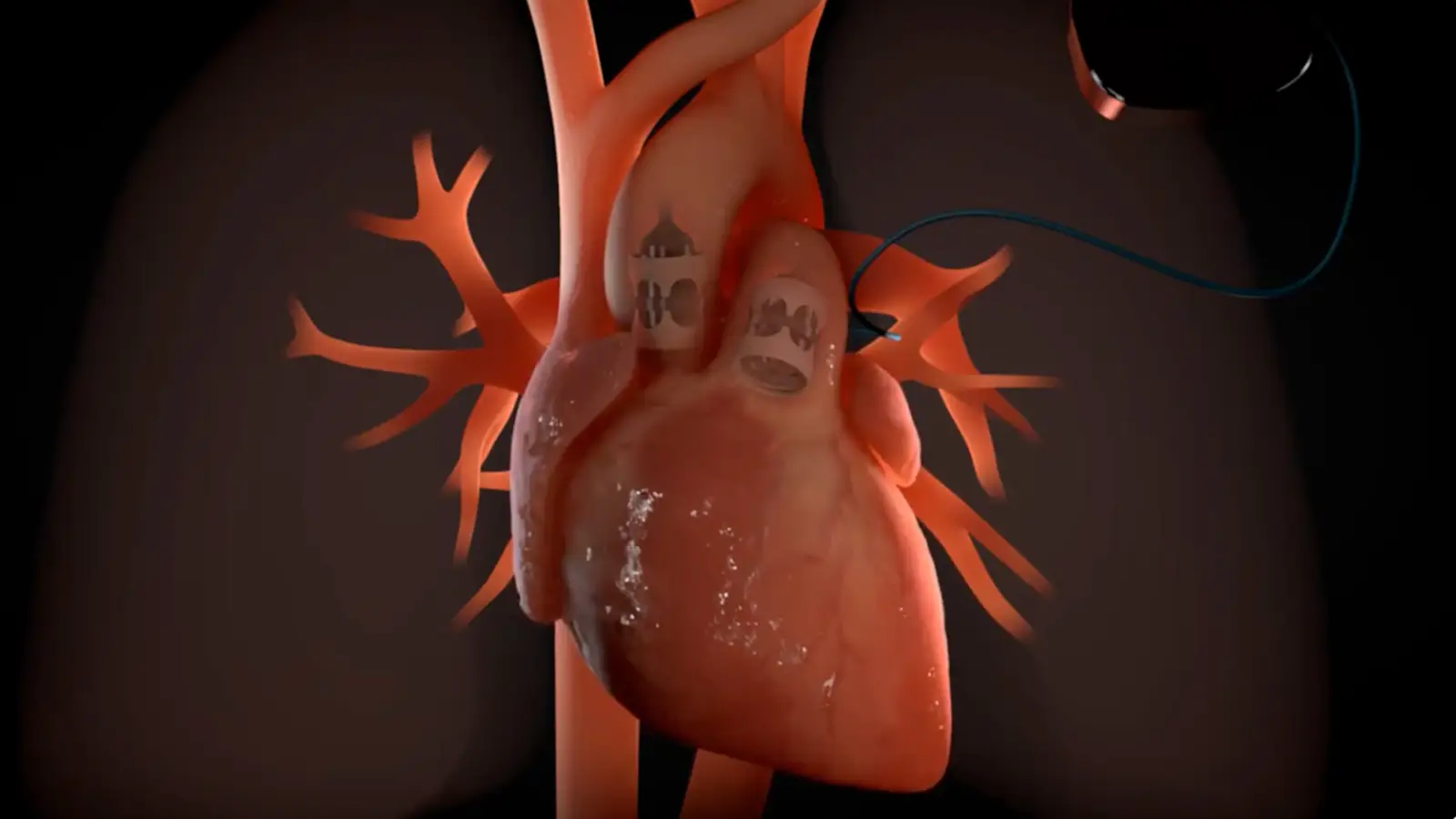
Designed to help patients go anticoagulation-free while supporting both sides of the heart, the reBEAT is a novel, minimally invasive, epicardial, biventricular MCS system with no contact with the patient’s blood, according to Stephen Wildhirt, MD, PhD, co-founder and CEO of AdjuCor.
The reBEAT system comprises a thin sleeve placed around the heart — containing sensors and inflatable cushions — and an external portable controller that synchronizes the device pumping with the patient’s heartbeat.
“Anticipated benefits include a lower risk of bleeding and blood stroke, reduced blood damage, no requirement for blood-thinning medication and improved support of patients with two poorly contracting ventricles,” Wildhirt said.
The MISSION-reBEAT pilot trial showed clinical feasibility in patients with advanced heart failure who’d been selected for durable, long-term LVAD therapy. The study tested the reBEAT as a temporary implant right before conventional LVAD implantation in centers in Denmark, Germany, and the U.K.
CT imaging helped operators select a sleeve fitting the heart for each participant. There were 10 patients (mean age 50 years, 90% men) involved, each of whom got the reBEAT for 3 minutes on average.
There were no device-related serious adverse events, no new ECG anomalies, and no undesired device-tissue interaction, Wildhirt reported.
“The short-term clinical data confirm that soft robotic epicardial MCS is safe and feasible,” he said. “The avoidance of blood contact and providing pulsatile biventricular support will be major drivers for continuation of its clinical evolution.”
He also reported that the plan is to start a feasibility study testing the reBEAT as temporary MCS for bridge to transplantation in the U.S.
Mi-VAD
Further down the pipeline is the Mi-VAD, a minimally invasive, fully implantable, pulsatile pump with biventricular support and no cannula. The concept of the Mi-VAD is a paradigm shift away from apical cannulation toward keeping the natural ventricular architecture, according to Sudhir Kushwaha, MD, of the Mayo Clinic in Rochester, Minnesota.
Mi-VAD is to be inserted through the aorta with no components passing through the aortic valve.
Kushwaha said that the apical coring now standard to LVAD implantation results in permanent myocardial injury. With LVAD insertion, the left ventricular apex becomes a rigid mechanical interface altering ventricular biomechanics, he explained, adding that this results in permanent changes with downstream biologic effects.
Mi-VAD’s pump design would feature a shroud to insulate the rotor from contact with adjacent tissue and a super-elastic nitinol anchor support. Another component of Mi-VAD will be an artificial intelligence-based pump platform that will monitor blood pressure and also allow assessment of ejection fraction, cardiac output, and other metrics.
The device has undergone prototype development and will be undergoing animal studies over the next few years. A second iteration of the Mi-VAD pump is patented and further development and tinkering of the design is expected until 2029. FDA Breakthrough Device Designation will be pursued and preliminary first-in-human studies are expected in 2030, according to Kushwaha.
A Smart Adaptive LVAD?
Then there is the idea of an LVAD with variable speed operation, or a smart adaptive LVAD that matches its speed to the patient’s physiological state based on pressure-sensing inputs that can be implemented in the real world.
Jonathan Grinstein, MD, of PAC Dynamic and the University of Chicago, and colleagues tested the concept using a HeartMate III with fixed speed (5,500 rpm) versus smart speed in two virtual patient models (modeling two stage D heart failure patients under rest/sedentary, sleep, and exercise conditions).
The smart algorithm successfully targeted pulmonary capillary wedge pressure (PCWP) 8-12 mmHg during rest/exercise and PCWP 10-15 mmHg during sleep, and it facilitated intermittent aortic valve opening as well, while staying within standard device speed range, according to Grinstein.
“It showed potential to alleviate cardiac burden by lowering myocardial oxygen consumption, enhanced duration of aortic valve opening, while maximizing recovery potential,” he reported at THT.
Source link : https://www.medpagetoday.com/cardiology/chf/120204
Author :
Publish date : 2026-03-06 19:30:00
Copyright for syndicated content belongs to the linked Source.