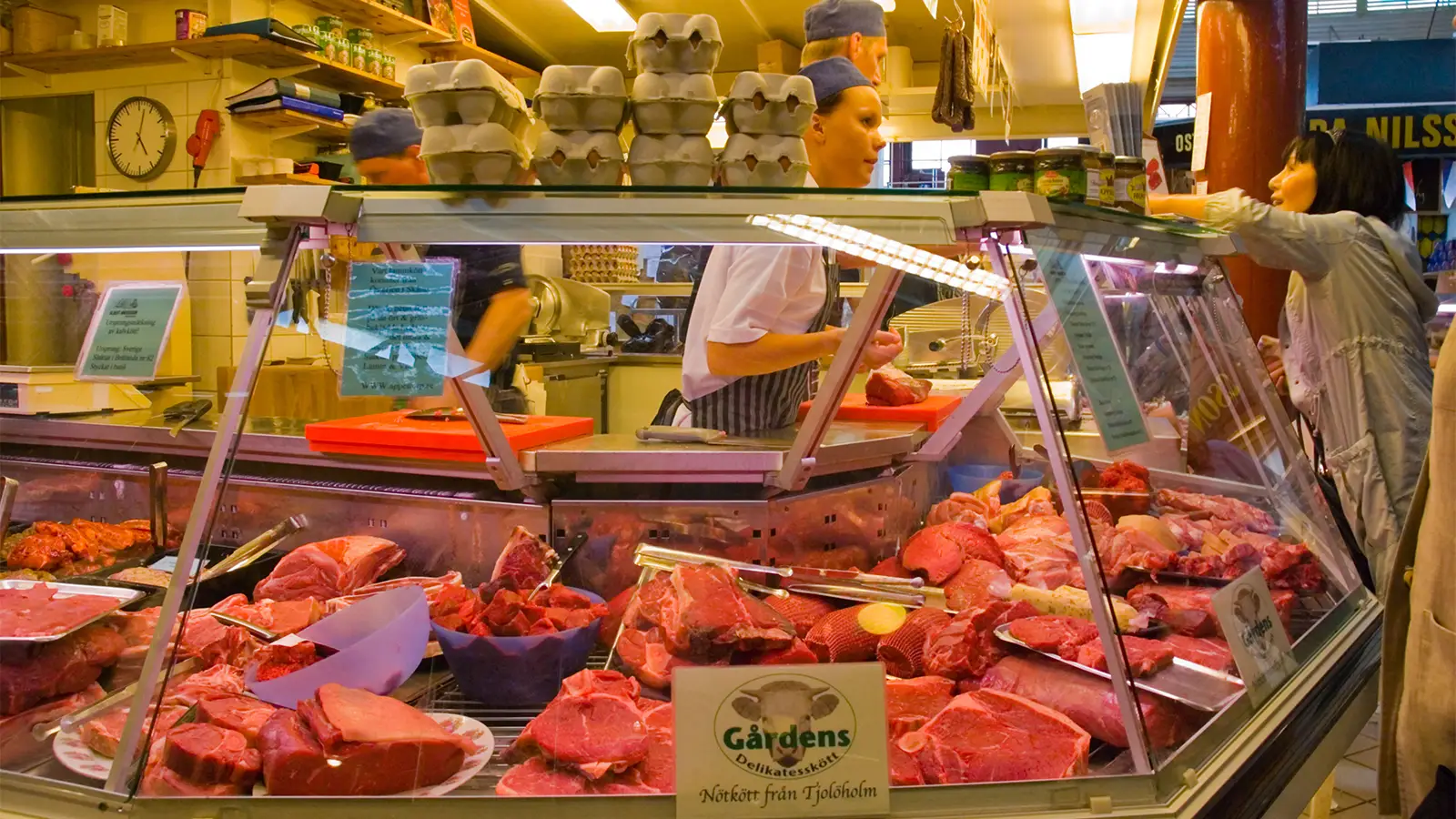
- Higher meat intake was tied to better cognitive outcomes and lower dementia risk in people with certain genetic risk for Alzheimer’s disease in a cohort study.
- This association was seen in people with APOE3/4 and APOE4/4 genotypes, but not in those with lower genetic risk.
- Regardless of genotype, consuming more processed meat was associated with increased dementia risk.
People with a genetic risk for Alzheimer’s disease did not have an expected increase in cognitive decline or dementia if they consumed relatively large amounts of meat, a Swedish cohort study showed.
Higher total meat consumption — comparing the top and bottom quintiles — was tied to better-than-expected cognitive trajectories (β=0.32, P=0.01) and reduced dementia risk (subdistribution HR 0.45, P=0.04) in people who were either APOE4 homozygotes (APOE4/4) or had one APOE3 and one APOE4 allele (APOE3/4), said Jakob Norgren, PhD, of the Karolinska Institute in Huddinge, and colleagues.
This association was not seen in people who had less genetic Alzheimer’s risk, the researchers reported in JAMA Network Open.
“These findings suggest that higher meat consumption than conventionally recommended may be associated with benefits in a genetically defined subgroup comprising approximately one-quarter of the global population,” Norgren and co-authors wrote.
Regardless of APOE genotype, a higher ratio of processed meat to total meat was unfavorably associated with dementia risk (subdistribution HR 1.14, P=0.04). There was no substantial difference between unprocessed red meat and poultry. In post-hoc analyses, all-cause mortality was lower in APOE3/4 and APOE4/4 carriers who ate more unprocessed meat.
When meat consumption was analyzed in relation to other food groups, the favorable associations in people with APOE3/4 or APOE4/4 genotypes were strongest when meat replaced cereals, Norgren told MedPage Today.
“The study shows that different subgroups of the population can respond very differently to the same diet,” he said. “It suggests that the potential for dementia prevention through lifestyle changes may be greater than previously thought — if future research confirms these findings and allows us to develop more individualized recommendations.”
While the outcomes may seem surprising, they align with patterns observed in two large cohort studies, the researchers said.
“Viewed alongside reinterpreted evidence from the Nurses’ Health Study and U.K. Biobank focusing on unprocessed meat, these findings point to a consistent gene-diet interaction, with important implications for public health,” Norgren and co-authors wrote.
In the U.K. Biobank study of 494,000 participants, unprocessed red meat was inversely associated with dementia (P=0.01), which was driven by APOE4 carriers. In the Nurses’ Health Study, supplementary analyses showed an APOE4 interaction (P<0.001) for unprocessed red meat. These patterns were not emphasized in the original publications, Norgren and colleagues noted.
Apolipoprotein E is essential for transporting cholesterol and fats in the brain and blood. The protein is encoded by the APOE gene, which has three main variants: epsilon 2, 3, and 4. All people have two APOE genes, leading to six possible combinations. The APOE3 variant is most common.
People carrying at least one APOE4 allele have a higher risk of Alzheimer’s disease compared with APOE3/3 carriers; people with two APOE4 alleles have the highest risk. The APOE2 allele is associated with lower Alzheimer’s risk.
The oldest variant is APOE4, which may have arisen during a period when evolutionary ancestors ate a more animal-based diet, while APOE3 emerged around the same time as modern humans, Norgren observed.
“Our findings are consistent with the idea that these variants may have evolved under different dietary conditions — but this is still speculative, and we can’t say whether diet drove the genetics or vice versa,” he said.
The researchers studied participants in the Swedish National Study on Aging and Care-Kungsholmen (SNAC-K), an ongoing population-based study of older adults near Stockholm. The mean age of the cohort was 71, and 62% were women. Participants had repeated dietary assessments and cognitive evaluations for up to 15 years.
Among 2,157 participants without dementia, 1,680 had longitudinal cognition data and 569 had APOE3/4 or APOE4/4 genotypes. During follow-up, 296 people developed dementia, and 690 died without dementia.
Median consumption in the highest quintile of meat intake was 869 g/week, standardized for a 2,000 kcal/d diet, while meat consumption in the lowest quintile was 247 g/week.
The study has several limitations including potential survival bias, the researchers acknowledged. Ethnic ancestry was predominantly Northern European, which may limit generalizability. Self-reported dietary data may include errors.
“This is still a relatively new area of research, and the findings should be interpreted with caution,” noted Jacqui Hanley, PhD, of Alzheimer’s Research U.K., who was not involved with the study.
“Studies like this can spot links between eating meat and dementia risk but cannot prove whether it is the cause,” she wrote on the U.K. Science Media Centre website. “More research is needed before suggesting that specific foods can determine whether someone will develop the condition.”
Source link : https://www.medpagetoday.com/neurology/alzheimersdisease/120395
Author :
Publish date : 2026-03-19 21:10:00
Copyright for syndicated content belongs to the linked Source.