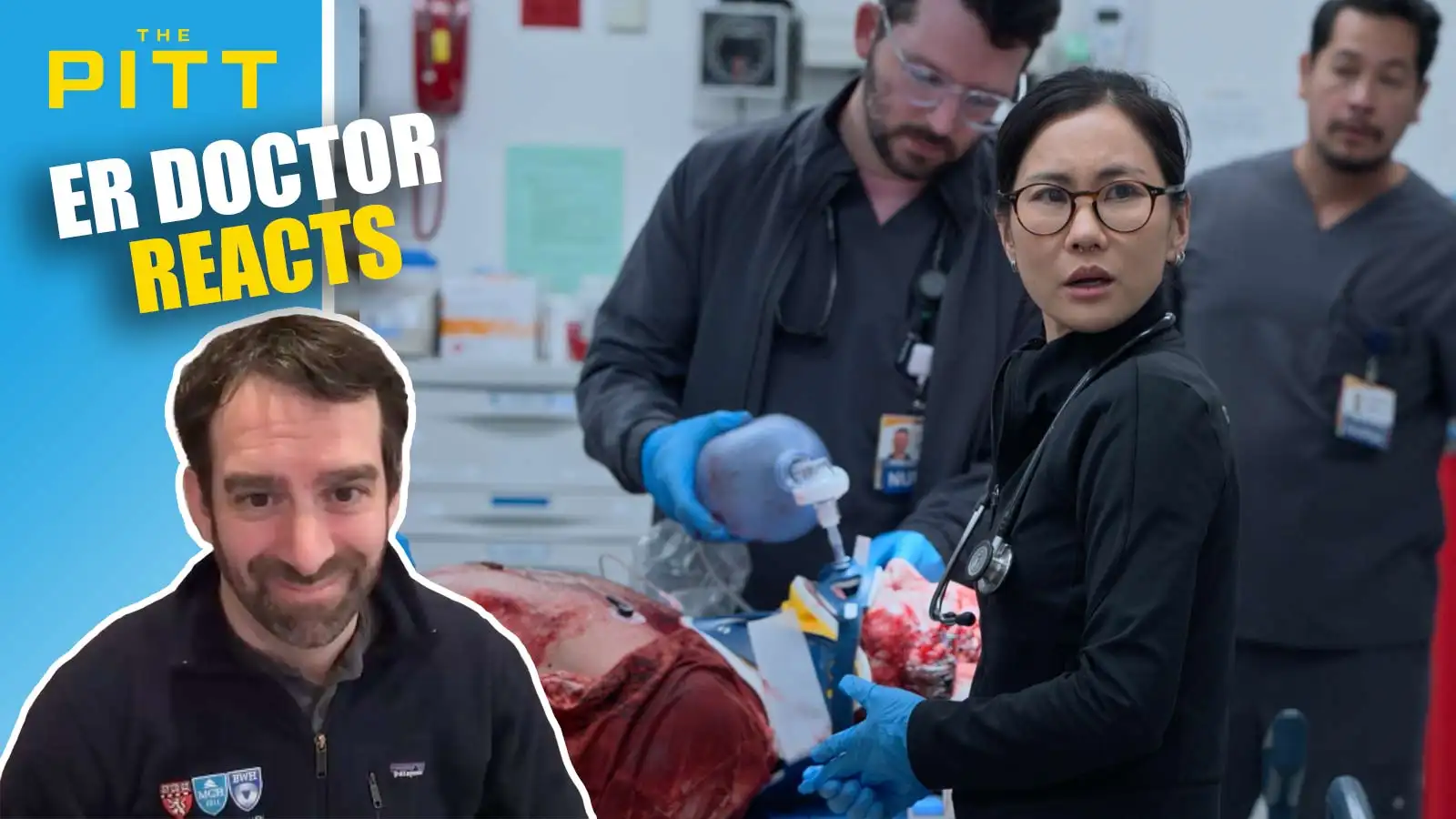
As “The Pitt” continues its second season, MedPage Today is examining the drama through the perspective of an emergency physician.
Practicing emergency room (ER) doctor Jeremy Faust, MD, editor-in-chief of MedPage Today, reacts to Episode 3’s most striking moments. From a headache that turns out to be a brain mass to the long-lasting impacts of trauma after mass violence to a devastating motorcycle death, Faust evaluates what the show captures accurately and where it compresses reality for television.
Click here for more analyses from Season 2 of “The Pitt.”
The following is a transcript of his remarks:
Faust: Hey, it’s Jeremy Faust, editor-in-chief of MedPage Today. We’re back with more analysis of “The Pitt,” Season 2. Let’s get into it. Season 2, Episode 3. So let’s dive right in.
“The Pitt” clip: The Man With Brain Tumor
Faust: So this guy came in with a headache and he was also acting crazy. And I think that’s what’s really interesting is that the altered mental status, the fact that he was so erratic, ends up not being psychiatric, but ends up being a brain tumor. And this is something that we see.
So here it’s really interesting. When we see a mass on imaging, of course everyone’s mind goes to cancer. And a lot of times that’s correct, but there are benign masses, that is a mass that’s not actually cancer, but it’s gotten big enough that it is actually causing symptoms such as loss of balance or changes in mental status. So you can actually have a benign tumor that’s causing symptoms that could cause real problems. I do think there’s a little bit of hemming and hawing here, this idea, oh, it could be an infection. That would not be great news.
So I must say that this is your worst-case scenario for a headache coming into the ER or one of the worst cases that is actually something serious.
There are really two kinds of headaches as far as an ER doc is concerned. Headaches that need to be treated for symptoms but are otherwise benign — that could be a migraine, that could be another kind of headache — or there are headaches that are indicative of a serious process such as a mass, a tumor, but also carbon monoxide poisoning. There are a lot of things that we worry about, and I think that almost every time we have a patient with a new headache, you have to say the word tumor.
So if we do a CAT scan for someone who had this gentleman’s presentation, if that CAT scan was perfectly normal, I always say, “By the way, we checked. We don’t see any tumors.” Because anyone coming into the ER with a new headache that they’ve never experienced, good chance that they’re thinking, “Oh my gosh, I have a brain tumor.” So you have to address that. OK, let’s go to the next one.
“The Pitt” clip: Burn Caused by Post-Traumatic Stress Disorder (PTSD)
Faust: So this patient had a burn dropping a hot tea, I guess, on herself after hearing fireworks. This takes place on the Fourth of July.
So first of all, I just want to say I appreciate this. I think the community appreciates this. The idea that here we are in Pittsburgh and we have a reference to the synagogue shooting from 2018. And I just think that’s a part of the community that should be acknowledged and it’s appreciated.
What I think is interesting medically here is that when we have mass casualty incidents, the shadow of that is not brief. You have the immediate loss, you have the deaths, you have the people who are witnesses, you have the PTSD there. But here we have someone who 7, 8 years later, just burned herself because she heard loud noises on the Fourth of July, firecrackers, fireworks, that essentially, through a post-traumatic stress disorder kind of mechanism, brought her back to that moment where she heard gunfire that was a tragic murder occurring in her presence. And I just think that we as a society need to think about the tremendously long shadow that these events cast and how they lead to problems down the road that we might not always anticipate.
So I thought that this was an important thing to point out. Such an important part of violence prevention is not just the immediate loss of life, but also those surrounding that loss.
“The Pitt” clip: Trauma Death
Faust: So the last clip I want to touch on from this episode is a traumatic death, a death by trauma. And let’s look at it and discuss why it is that they manage it the way that they do.
So one of the most important things to know when you have a patient who is getting CPR or has any traumatic brain injury like that is the pupils. How big are the pupils? And in this case, she’s saying they’re large and they are not reacting to light. That is an extraordinarily bad sign, a very poor prognostic indicator. It basically is highly likely that this person will never have any neurologic recovery. They are probably already brain dead.
So they just showed brain coming out of the skull. This is hopeless.
[Dr. Robby claims he wears his motorcycle helmet]
Well, first of all, I think as fans of the show, we all know that that’s not true. We saw in the first episode, he came into the ER not wearing a helmet on his motorcycle. And I think that that is a great example of how who we are in the ER as doctors may not always be who we are outside. And that’s just life.
So a couple of comments there. The fact that he is not a donor is quite tragic. When you think about who would be a good candidate for organ donation, meaning you could save many, many lives and help many, many people.
Oh, another thing I want to say is that there’s no code here. A lot of traumatic deaths, you do a longer code, you might open the chest as we’ve seen in this show earlier. This one, they call it right away. There’s no real prolonged resuscitative effort in the ED [emergency department]. And the reason for that is simply the fact that you literally saw the brain coming out of the head. There’s no recovering from that kind of injury.
And in fact, this might have been a case where EMS [emergency medical services] could have made what’s known as a field call. And what that means is that someone loses pulses, they’re dead, but for CPR. And of course, they receive CPR by first responders and they get transported to a hospital, to an ER. And in this case though, the EMS teams, the ambulance team, could have said, “Hey, let’s call this on the field. Let’s not transport this.”
And there are various criteria for when a field call is permitted. And in many jurisdictions, exposed brain matter in a head trauma is indicative of a situation in which a field call would be appropriate. It depends on the case. It depends on the jurisdiction. There are different rules, but that is why in this situation, Dr. Robby basically calls it very quickly.
So here we are with this idea that in the past on this show, we’ve seen Dr. Robby lead moments of silence, which I think is so important when someone passes away in the ED, but as is everything in emergency medicine and in the show, nuance matters. They can do that once they have dealt with the other acute emergencies going on. So I thought this was a very appropriate rendering of this kind of situation.
So those are my thoughts from a few scenes in Episode 3 of “The Pitt.” We’ll be back next time with more analysis on this great show.
Source link : https://www.medpagetoday.com/opinion/faustfiles/120457
Author :
Publish date : 2026-03-24 15:46:00
Copyright for syndicated content belongs to the linked Source.