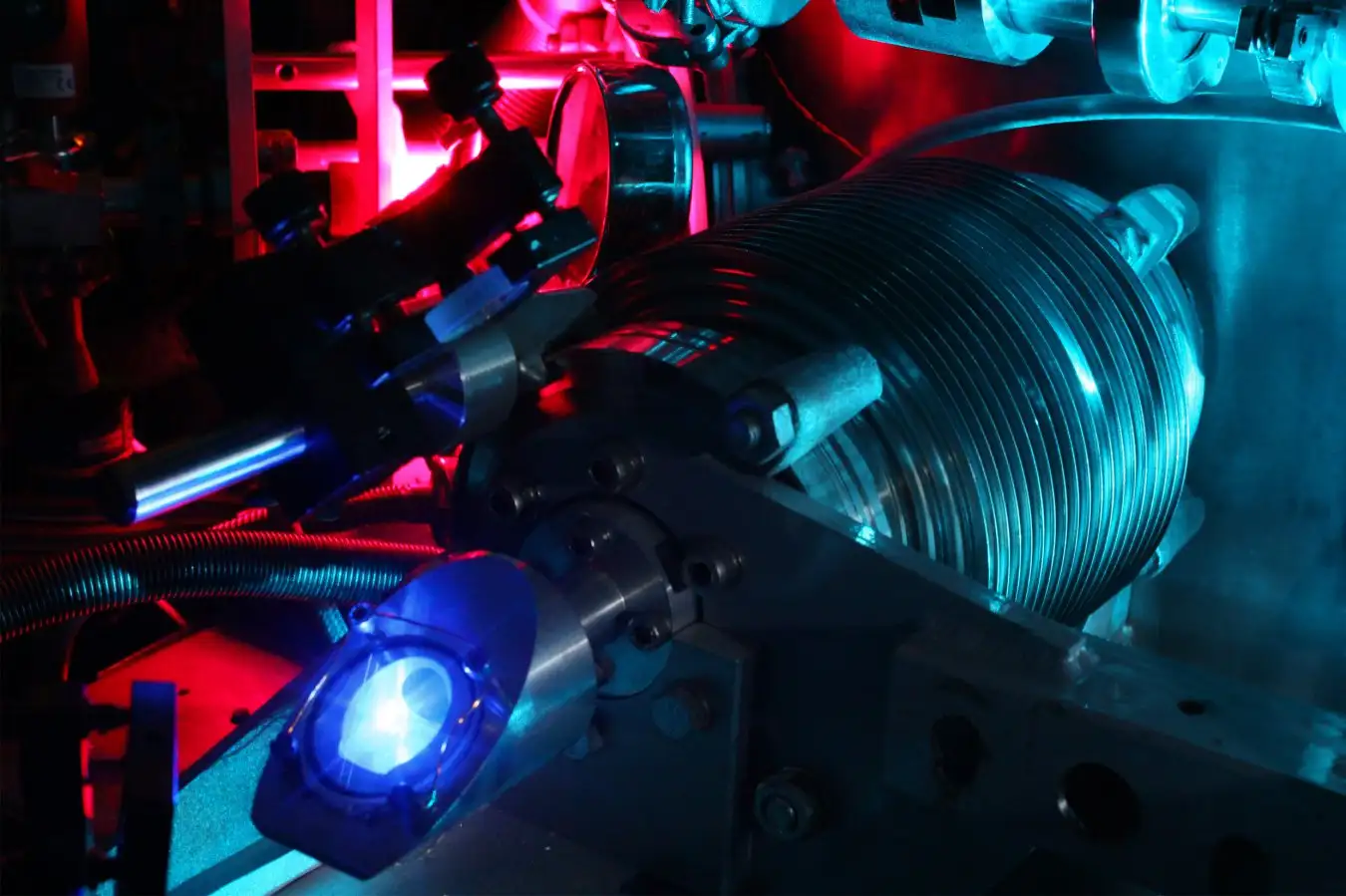
A vacuum chamber used to measure electron transitions in atomic hydrogen, from which the proton’s size was inferred
Axel Beyer/MPQ
At long last, we have pinned down the size of a proton. More than 15 years after an experiment unexpectedly shook the world of particle physics, researchers are regaining their grip on one of this fundamental particle’s most basic properties.
Look around you, and everything you see will be filled with protons. The proton is a fundamental building block of our world – and until 2010, we thought we understood it fairly well. We knew its composition – it is made from three quarks – and we knew its size.
Then, a measurement based on an exotic hydrogen atom showed that the proton may actually be about 4 per cent smaller than expected. Physicists scrambled, exploring sources of experimental error as well as theories about new physics phenomena that could resolve this “proton radius puzzle”. In 2019, another experiment strengthened the evidence that the proton’s size had long been overestimated.
Now, the issue may have finally been settled by a pair of complementary experiments that make the case for the smaller proton more convincing than ever before. They revealed the proton to have a radius of about 0.84 femtometres, or less than 1 million-billionth of a metre.
“When you look at that data, how much money are you willing to bet that the proton radius is what it is? For me personally, right now, with these measurements, the betting odds go significantly up,” says Dylan Yost at Colorado State University, who worked on one of the experiments.
To determine this radius, both experiments focused on hydrogen atoms because each of these has only one proton and one electron. The two particles have opposite electric charges, so they exert electromagnetic forces on each other, and this interaction affects the energies that each particle can have within the atom. But this interaction depends on the size of the proton, which means that one way to find the exact dimensions of a proton is to measure how an electron in the same atom moves from one energy state to another.
The two research teams did just that, using lasers to control the electrons in hydrogen atoms. Between them, they measured three electrons’ transitions between energies that had never been measured before.
From this, they calculated the proton’s radius, and their numbers not only matched each other, but also that momentous 2010 measurement. “It’s 1775836466 very, very unlikely that there is still this proton radius puzzle,” says Lothar Maisenbacher at the University of California, Berkeley, who was part of the second experiment, which was conducted at the Max Planck Institute of Quantum Optics (MPQ) in Germany.
This is no small feat – the sort of experiments that Maisenbacher and his colleagues carried out are notoriously difficult. Hydrogen atoms must be placed in a perfect vacuum; the required lasers are often expensive and must be calibrated extremely carefully. While three or four weeks may be enough to collect data, it can take years to catalogue and understand every possible source of disturbances and errors that could creep into the final measurement. Additionally, these experiments tend to be highly specialised in exactly how they manipulate hydrogen, so that tracking down the precise reason why their findings might diverge is typically very difficult, says Maisenbacher.
But when their findings agree, this diversity of approaches is a strength because an effect that originates with some specific instrumental glitch wouldn’t show up across experiments, says Juan Rojo at Vrije University Amsterdam in the Netherlands. “The proton radius should be a universal property; it should give the same result no matter how you look at it. This is why these two papers are quite nice, because they provide different perspectives to the same number,” he says.
The increased certainty in the proton’s size is especially important for fine-tuning theories about new particles that could be discovered by studying the behaviour of hydrogen’s electron, says Yost. In fact, the MPQ experiment was already precise enough to test the predictions of our best current mathematical model, called quantum electrodynamics, to an accuracy of 0.5 parts per million. The team didn’t find any discrepancies – nothing that would indicate new forces or particles – but Rojo says the two experiments pave the way for similar studies to become an important part of particle physics research.
While giant particle colliders can search for heavy new particles, these tabletop experiments with hydrogen atoms and lasers could look for very light particles that would otherwise remain hidden, says Yost. “Now that we have confidence that we really understand what’s going on, we can say, OK, what sort of limits can we put on new physics?” he says.
Topics:
- particle physics/
- quantum physics
Source link : https://www.newscientist.com/article/2522294-physicists-resolve-a-long-standing-puzzle-over-the-size-of-a-proton/?utm_campaign=RSS%7CNSNS&utm_source=NSNS&utm_medium=RSS&utm_content=home
Author :
Publish date : 2026-04-10 09:00:00
Copyright for syndicated content belongs to the linked Source.