These days, we’re overwhelmed with data.
Every chart on every patient is packed full of data — some of it incredibly useful and important, some of it just a lot of noise, some of it just copy-and-pasted and brought forward from the last note, and the one before that, and the one before that. Figuring out how to tame all this data is going to be critical as we move forward, and certainly smart systems that can see the forest for the trees will prove to be helpful in the not-too-distant future.
Our patients are doing a lot more self-monitoring. They’re showing up for appointments with data from their smart watches, rings, scales, home blood pressure monitors, continuous glucose monitors, and more. They’re going online and asking health-related questions of different AI systems, to find out what may be causing their symptoms, and what evaluations they should undergo.
Now, as you can see from the image below, patients are even able to get lab testing done without a doctor’s prescription, with no one to explain what the results mean to them, or even if these were the right tests to get in the first place.
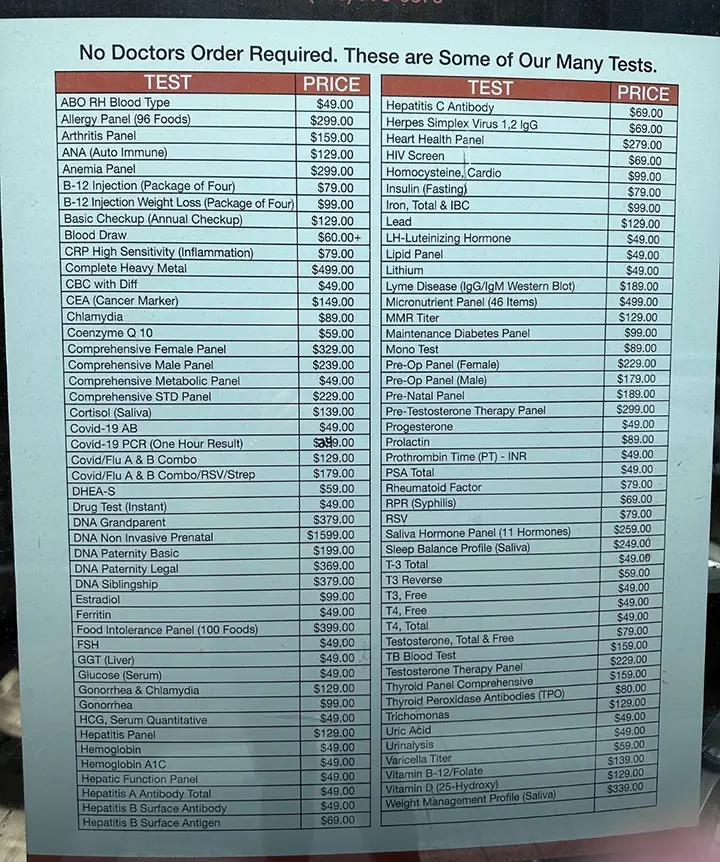
(Note the recent handwritten increase in the cost of a rapid COVID-19 PCR test to $249!)
Our patients are going to urgent care centers and emergency rooms and specialists’ offices, getting reams and reams of testing done. Their insurance companies are sending homecare agencies to visit them to test them, to screen them, to generate more and more data to help inform them about their health (and help the companies maximize their health risk categorization). This often creates more work for us with all this data.
As I wrote recently, when patients arrive in our office, they update their demographic information and are then presented with a series of questionnaires that they’re expected to answer, all of which generates data. And they’ve been interacting with the world out there, leading to claims on their insurance, which leads to still more data.
And then they come to see us for their very brief — all too brief — office visits, where we’re expected to address their acute and chronic medical conditions, the list of symptoms and complaints they been saving up for us, and we’re supposed to hunt down the answers to all of these other things, and hopefully make good use of all this data out there.
It feels like we all need a bigger peripheral brain, a better medical assistant helping us out, someone (something?) to corral all this stuff and put it in the right place, put it in the right order, and help us make sense of it all. Someday soon I hope that we will get to do more listening to our patients, more time for holding their hands, focus more on examining them, more on letting them turn to us for support and more doctoring. And that smarter systems will be in place to help grab all this data, line it up just right, and help us make sense of it all, to make sure nothing bad slips through the cracks.
If the electronic medical record says they’re overdue for a mammogram, but there’s a claim against their insurance for this year’s mammogram that was done at an outside radiology facility, someone, or something, needs to reconcile those two things. If the trend in the data on their home blood pressure monitor or continuous glucose monitor or smart scale or sleep ring is suggestive of a particular medical condition, something should help us sift through all this stuff and bring it directly to everybody’s attention in a timely manner.
And if that huge ream of paper they brought in to their visit, records from their prior physicians or a hospitalization that they had printed out for us, contains a hidden pearl, gem, or nugget, something we need to make sure doesn’t get missed or ignored, that’s when we need systems smart enough to read through all that and separate the useful data from the noise.
Maybe buried deep within those xeroxed pages is a report from the radiologist with a finding that warrants followup — the thing that points us in the right direction. Maybe the combination of one of their answers to one of the questionnaires, coupled with a lab report from the last visit, cross-referenced to something they said during our history of present illness today, will point us to the answer.
We all wish we had all the time in the world to spend on every patient. We’ve all seen the studies that show how many hours we need in a day to take care of all the patients we see already.
In this new world of patient-centered care, with improved remote monitoring, with new sources of data that we’re going to collect on our patients, maybe even in ways we haven’t even dreamed of yet, the amount of stuff we will need to pay attention to is only going to rise exponentially. In some not-too-distant future, perhaps all our patients, maybe even everyone in society for that matter, will be continuously monitored for everything, and there won’t be a single thing that won’t get caught, won’t get found early, won’t get nipped in the bud. But that’s a lot of data, that’s a lot of watching, that’s a lot of synthesizing that even the best of the best doesn’t have the bandwidth for.
For now, it often feels like we’re treading water, trying to keep from sinking, trying to keep ourselves and our patients from being inundated with all the questions we ask and all the answers we get.
It’s likely right there in the data, we just need to get it all in, and then get it all out.
Source link : https://www.medpagetoday.com/opinion/patientcenteredmedicalhome/120906
Author :
Publish date : 2026-04-22 16:47:00
Copyright for syndicated content belongs to the linked Source.