Phoebe Watts for New Scientist; Getty Images
“This is Poppy,” says Howard Greenwood, proudly showing me his prize cow. In truth, though, “cow” is charming nuclear research slang. Poppy is a slim glass column filled with radioactive waste that lives not in a pasture, but in a high-security lab. Greenwood and his team here at the United Kingdom National Nuclear Laboratory (UKNNL) near Preston “milk” her for radioactive lead.
Why engage in this ticklish business? It’s all to do with the rise of a new generation of radioactive drugs that are showing huge promise as cancer treatments. Radioactivity is hardly new in medicine, but these drugs have a rare power and look set to really take off. The only problem is that, if they do, demand for the radioisotopes they include will vastly outstrip current supplies.
Cue a global race to ramp up production. Some, like Greenwood’s team, are digging through stockpiles of nuclear waste and refining it. Others are sifting leftovers from cold war-era atom-bomb projects, or scrounging materials from disused medical devices. It is a high-stakes endeavour, promising not only life-saving treatments but also potentially vast profits. “We’re really seeing big pharma invest billions in it,” says Sven Van den Berghe, CEO of Belgian isotope-maker PanTera.
The ancient alchemists may have been misguided in many ways, but they weren’t wrong that one element can transform into another. It happens naturally, through three main kinds of radioactive decay. An atomic nucleus can emit part of itself in the form of either a bundle of protons and neutrons, an electron, or a blast of radiation. These processes, called alpha, beta and gamma decay, respectively, convert the atom into a different element. Researchers use a unit called half-life to measure how long it takes for 50 per cent of the atoms in a radioactive substance to undergo this transition.
The idea of using radioactivity as a therapy dates back to the early 1900s, shortly after Marie Skłodowska Curie and her husband Pierre discovered the element radium. Doctors found that sealed radium samples, mounted on needles and inserted into patients, could shrink tumours with their fierce blast of alpha particles. This treatment, radium brachytherapy, flourished until the 1950s, when radium was abandoned in favour of safer isotopes.
The more recent buzz around radioactivity in medicine centres on something called radioligand therapy. This addresses the well-known problem with radiotherapy: it can damage healthy cells as well as tumours. The idea is to tether a radioactive atom to a molecule called a ligand that seeks out and binds to cancer cells. In this way, the drugs deliver a precise strike with fewer side effects.
Radioligands really got their boost in 2017, when pharmaceutical giant Novartis launched a drug called Lutathera, which tethers lutetium-177 to a peptide that targets gastrointestinal cancer cells. In 2022, the company brought out another lutetium-177 drug called Pluvicto, which treats prostate cancer. “They demonstrated that targeted radiopharmaceuticals can be developed, approved, manufactured at scale,” says Sophie Letournel at Orano Med, a French radiopharmaceutical developer.

The Sellafield nuclear facility in Cumbria, UK. Some of the nuclear waste stored here is a source of radioisotopes that can power a new generation of anti-cancer drugs
David Levene/Guardian/eyevine
These two drugs racked up $2.8 billion in sales for Novartis in 2025, and now dozens of other pharma companies want a piece of the action. Analysts at Morgan Stanley have predicted this surge in interest will help the global radiopharmaceutical market grow almost sixfold to $39 billion in sales by 2032.
The success of Lutathera and Pluvicto has sparked a rapid build-out of facilities to produce more lutetium-177. But already, researchers are thinking about the next generation of radioligand therapies. Lutetium-177 decays by emitting beta particles, and it can take hundreds of these speeding electrons to kill a cell. On the other hand, isotopes that produce heavier, slower alpha particles can have the same lethal effect with just 10 hits. If betas are like a blast of buckshot, alphas are like a grenade.
Thus, researchers are now developing radioligand drugs with several different alpha-emitting isotopes instead (see “The radioactive armoury”). The trouble is, these alpha emitters are much rarer and more hazardous to produce. So, how are we going to get hold of them?
The world’s most expensive material
The leading option for targeted alpha therapy is actinium-225. Actinium is chemically similar to lutetium, making it easy to hook onto the targeting molecules used in Lutathera and Pluvicto. Clinical trials of these actinium analogues have already progressed to the final phases. Another attraction is that when actinium-225 decays, it produces a cascade of daughters that collectively emit four alpha particles and a couple of betas, potentially boosting its killing power. Such is the demand for actinium-225, says Van den Berghe, that “it is generally said to be the most expensive material in the world”. Global production is less than 0.1 milligrams per year; that needs to increase 1000-fold if the isotope is to treat hundreds of thousands of patients per year, according to calculations by Richard Zimmermann, a radiopharmaceutical analyst at Chrysalium Consulting in Lalaye, France.
There are three major routes to produce it. Some companies start from abandoned radium brachytherapy sources, now so prized that the International Atomic Energy Agency (IAEA) launched a global effort to recover them from waste facilities and hospital basements. Micrograms of radium can be extracted and purified from each source and then blasted with protons from a circular particle accelerator called a cyclotron, triggering a decay sequence that makes actinium-225.
The second approach exploits uranium-233. In 1955, the US detonated a bomb based on uranium-233 in Nevada, but it was judged a flop. Over the following decades, roughly 2 tonnes of uranium-233 were stored at Oak Ridge National Laboratory in Tennessee, where it has gradually decayed into a smorgasbord of other elements, including thorium-229.
Every month, TerraPower Isotopes in Bellevue, Washington, gets a few hundred milligrams of thorium-229, which decays into actinium-225 and other isotopes. The company harvests the actinium-225 each week, and has been shipping it to customers since late 2024. At full scale, the system could supply several hundred thousand patient doses per year, says Scott Claunch, president of TerraPower Isotopes.
Eventually, though, these thorium reserves could run out. That’s why TerraPower is collaborating with PanTera, which has developed a third production route that stems back to the radium hype following the Curies’ discovery.
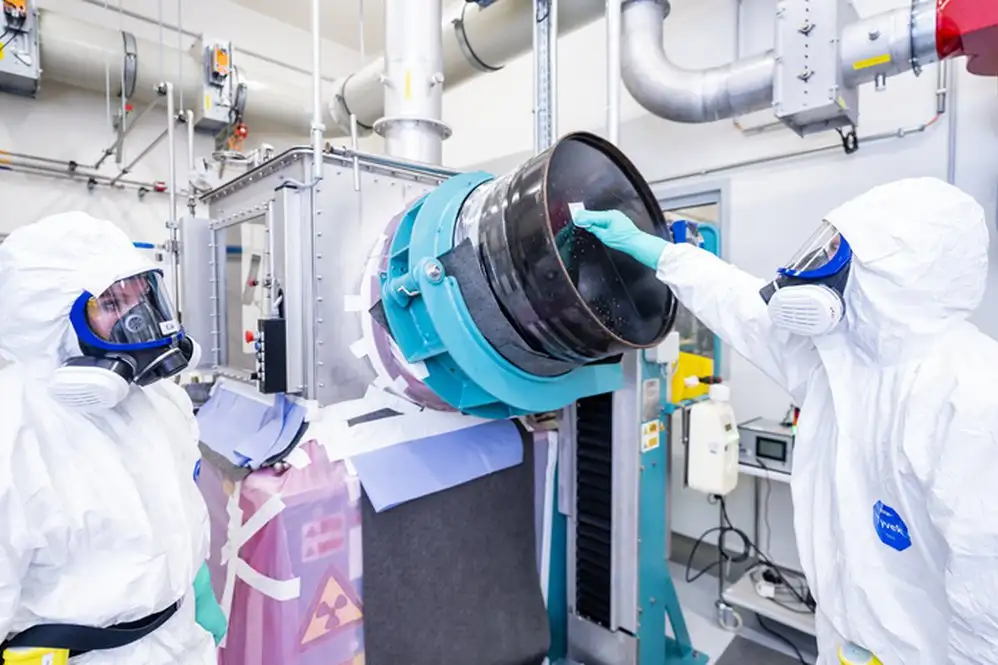
Companies can produce radiotherapies by decaying a plethora of nuclear isotopes
Orano Med
In 1915, Belgian miners discovered uniquely rich deposits of radium and uranium in what is now the Democratic Republic of the Congo, and started digging. The Shinkolobwe mine sent thousands of tonnes of radioactive ore to Belgium and supplied most of the uranium used in the Manhattan Project. Today, the remnants of Shinkolobwe’s bounty are kept at the Belgian Nuclear Research Centre, including about 100 grams of pure radium-226, the world’s largest stockpile of the isotope. “With the recovery capabilities that our technology offers, that’s enough to produce about 450,000 doses a year of actinium-225,” says Van den Berghe.
PanTera’s process starts by firing an intense electron beam into tantalum sheets. The electrons’ sudden deceleration makes them dump their energy as X-rays. “It’s exactly the same thing as a dental X-ray tube, only at much higher energies,” says Van den Berghe. Those X-rays are used to batter a radium-226 target until the atoms release a neutron, forming radium-225 that subsequently decays into actinium-225. PanTera is building a factory in Mol, Belgium, to operate this process at scale, which it expects to be fully operational in 2029.
Milking Poppy
Despite the excitement about actinium-225, it has some drawbacks. For one, the recoil from alpha decay can jolt the atom from its molecular wrapper, allowing it to drift away and potentially cause off-target side effects. “Once the first decay starts, you’ve broken your link with your targeting molecule. So you’re basically free in the body,” says Glenn Rosenthal, co-founder of Nusano, an isotope company near Salt Lake City, Utah. Another issue is actinium-225’s 10-day half-life, which means patients retain the isotope in their bodies long after treatment.
For many researchers, lead-212 looks like a better option. Like actinium-225, its decay chain produces both alpha and beta particles, but its half-life is much shorter, at just 10 hours, meaning that once patients have been treated, their radioactivity would fade quickly.
At least four different isotopes are being explored as ingredients in radioligand therapies, each with their own benefits and downsides
Lutetium-177 | Type of radioactive emission: Beta | Pros and cons: Used in existing cancer drugs Lutathera and Pluvicto. However, beta decay isn’t the most effective way of killing cancer cells, so more of the isotope is needed.
Actinium-225 | Type of radioactive emission: Decay chain includes alpha and beta | Pros and cons: Chemically similar to lutetium, so relatively easy to slot into existing drugs. On the other hand, this may be the world’s most expensive material. It also has a half-life of 10 days, meaning patients are exposed to radiation for a relatively long time.
Lead-212 | Type of radioactive emission: Decay chain includes alpha and beta | Pros and cons: Can be prepared from nuclear waste. Has a half-life of just 10 hours, meaning it doesn’t stay long in patients’ bodies. Many see this as a promising option for future therapies, even if production will take time to ramp up.
Astantine-211 | Type of radioactive emission: Alpha | Pros and cons: Can potentially be used in drugs targeting brain cancers, unlike other isotopes. But its very short half-life means it can’t be stored for long before it is used.
All of which explains why I have found myself at UKNNL’s lab, at a site that handles hundreds of tonnes of uranium per year and rarely welcomes journalists. After clearing a security check, I am treated to a safety briefing on the emergency signals I really don’t want to hear during my visit. “Toxic Release”, a rapidly warbling panic call, means I should head smartly for an exit. Even worse, “Criticality” is a sinusoidal scream of doom that means I simply need to run as fast as I can.
Safety equipment and radiation sensors donned, I finally get to meet Poppy, who sits behind a thick steel safety shield. Her fodder is extracted from nuclear waste (the team prefers to call it “legacy material”) stored at the Sellafield nuclear site in Cumbria, which contains uranium-232. This isotope has spent decades decaying into thorium-228, and that’s what Greenwood’s team is after. When the researchers feed Poppy with a yellow solution of waste, a special resin grabs the thorium atoms, allowing uranium and other elements to pass. Once fully loaded, Poppy contains a few nanograms of thorium-228, which ultimately decays into the coveted lead-212.
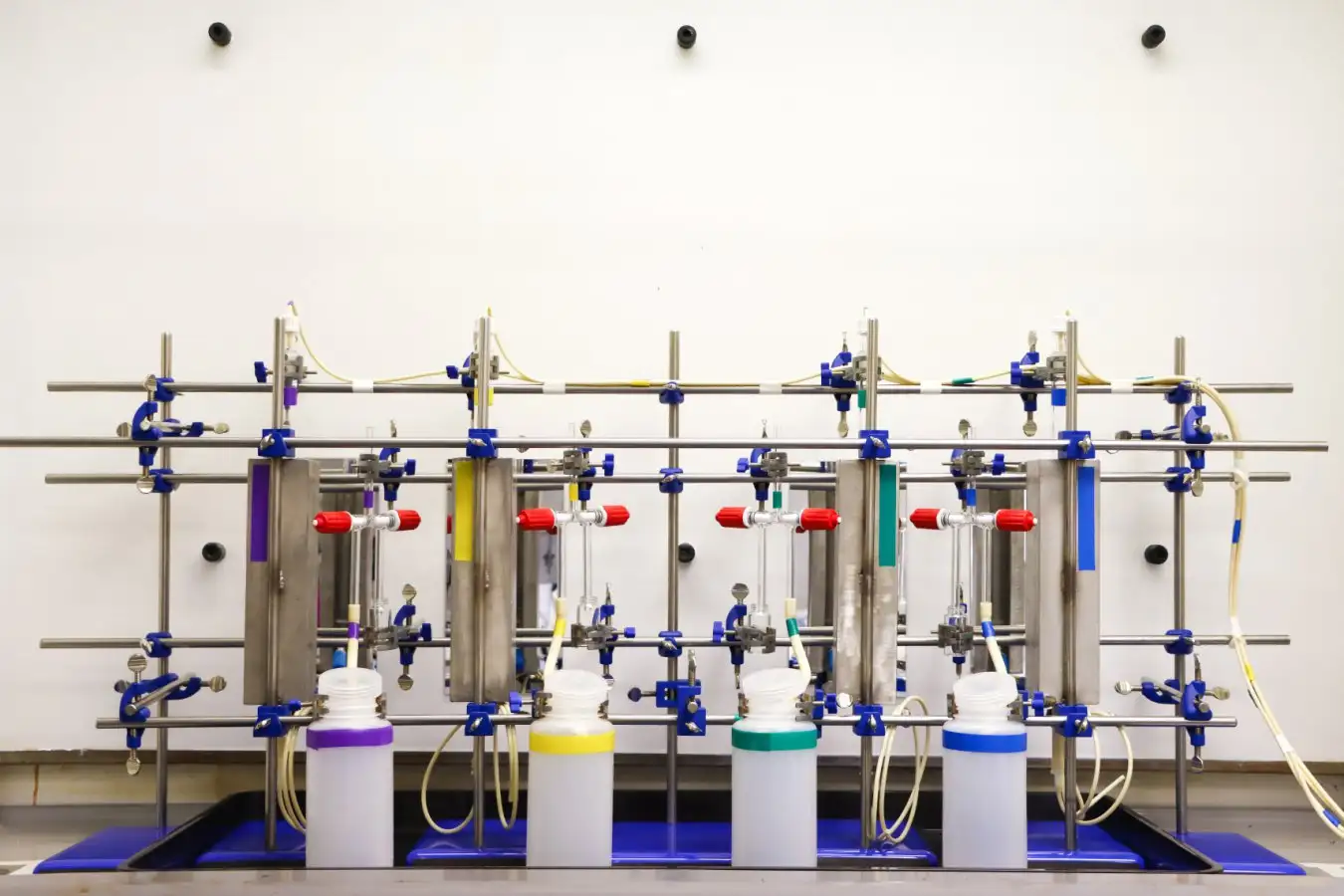
“Poppy” (far left) is one of a set of filtration systems used to collect lead atoms from nuclear waste
UKNNL
Researchers “milk” the accumulated lead-212 every few days by washing Poppy with dilute acid. They expect to send the first batch to drug researchers in May. The researchers will test whether the isotope can be reliably connected to various targeting molecules. “There’s such a buzz about getting this to the stage where it can have a medical benefit,” says Laura Maray, a research technologist on the team. About 10 lead-212-based drugs are in clinical testing, with more on the horizon. Several of these trials depend on lead-212 supplied by Orano Med, which has its own process for harvesting the isotope from a 22,000-drum stockpile of French nuclear waste.
Meanwhile, companies without access to such sizeable reserves hope to make lead-212 and other isotopes using compact fusion systems. Big fusion-power projects, such as ITER in France, aim to generate energy, but in Bristol, UK, Astral Systems is more interested in using the neutrons released by fusion to form useful isotopes. Previous compact fusion devices haven’t produced a high enough concentration of neutrons to enable economical isotope production, but Astral has developed a high-voltage fusor that helps generate a lot more. “It all comes down to the economics of cost per neutron,” says Astral’s Tom Haywood. The company aims to make a range of isotopes, including lead-212, which will depend on radium-226 targets, and expects to have samples ready for customers in the next few years.
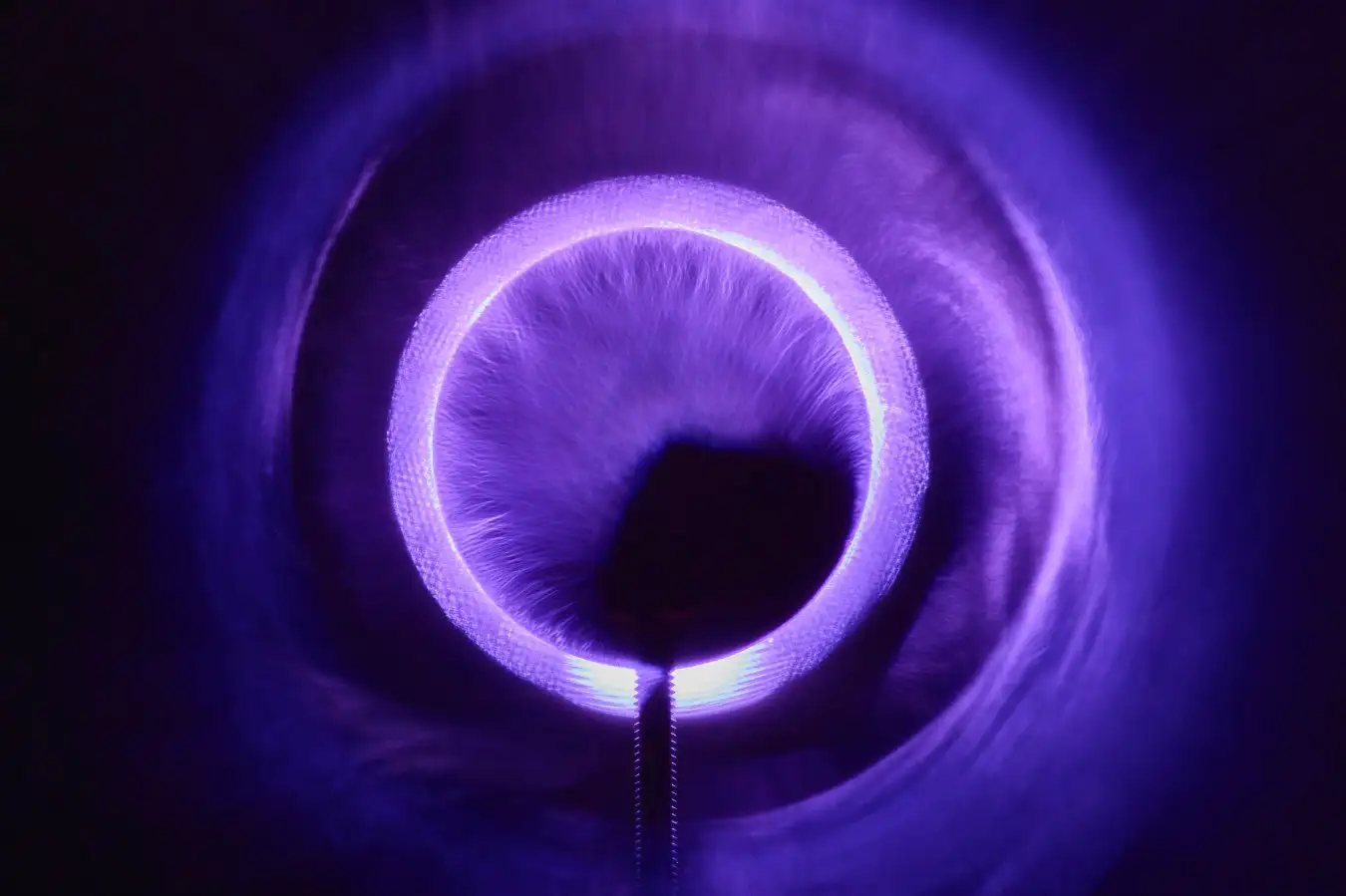
Plasma roils around an electrode in Astral Systems’ fusion reactor. Neutrons produced in the company’s process are being used to produce lead-212
ASTRAL
Other researchers are looking at a curveball option. Astatine is in a group of elements called the halogens, and its chemistry is starkly different from that of lead or actinium, which are both metals. This means that rather than being hugged by a special molecular wrapper, astatine could be directly attached to a drug molecule by a single chemical bond. In principle, some of these astatine-based drugs could be capable of crossing the blood-brain barrier, making them well-suited to treating brain tumours.
Astatine-211 has a half-life of just 7 hours, so it must be produced reasonably close to treatment centres, but that also limits patients’ radiation exposure. Its decay chains involve only one alpha emission, so it might pack less of a punch than actinium 225, but that could also minimise off-target side effects.
The main route to astatine-211 uses a cyclotron to fire alpha particles into atoms of bismuth, but these systems generally produce modest amounts of the isotope. To scale up, Nusano has created a 60-kilovolt ionisation chamber that produces far more high-energy alphas than a conventional cyclotron. These alphas are accelerated, marshalled into pulses and funnelled towards a dozen targets. Nusano’s alpha source is up and running, and its accelerator should come online within the next few months. “We’ll get more astatine than all the other facilities in the world combined,” says Rosenthal.
We will soon know whether the billions invested in all these isotope factories will pay off. “We believe that multiple compounds could potentially be approved by 2030,” says TerraPower’s Claunch. “That year is going to be really important to the industry.” Meanwhile, back at UKNNL, we finish our tour in a cavernous hangar filled with giant mixing vessels and barrels of chemicals, which serves as a pilot plant for processes involving radioactive materials. In principle, this space could produce enough lead-212 to treat thousands of patients per year, and Greenwood is raring to go. “We could start designing a plant tomorrow,” he says.
He concedes it will probably be a few years before lead-212 from cows like Poppy is used in clinical tests. But he is confident that this therapy will become a reality – and he is powerfully motivated to make it work. “Everyone knows someone who has been affected by cancer. A friend of mine died of a kind of cancer that this could have stopped,” he says. “We have the people, the skills and the kit to do this.”
Topics:
- medical drugs /
- atomic physics
Source link : https://www.newscientist.com/article/2521854-we-need-more-radioactive-drugs-can-we-make-them-from-nuclear-waste/?utm_campaign=RSS%7CNSNS&utm_source=NSNS&utm_medium=RSS&utm_content=home
Author :
Publish date : 2026-04-22 16:00:00
Copyright for syndicated content belongs to the linked Source.