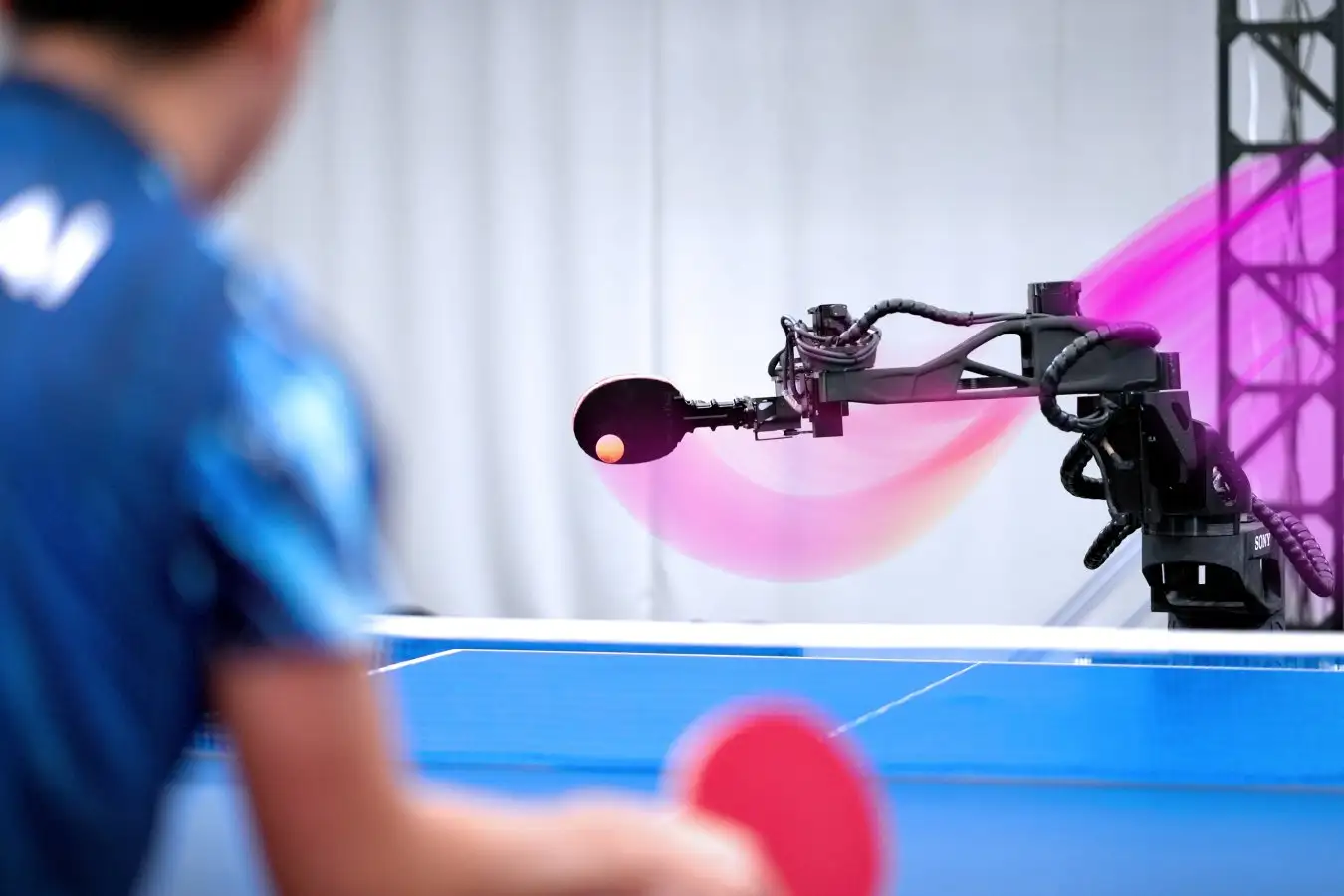
Ace in action during a match in December 2025
Sony AI
Ace, an autonomous robot powered by AI, cutting-edge sensors and an extremely dexterous arm with eight joints, has played competition-rule table tennis and beaten elite human competitors. The robot is the first machine to excel at the sport.
It was the cerebral game of chess that was first disrupted by computers, but Ace’s success suggests physical sports may be about to have their “Deep Blue” moment – the day, in 1997, that a machine of that name beat world chess champion Garry Kasparov.
“Games have long served as benchmarks for AI, including chess for Deep Blue, but also other games in more recent breakthroughs, like [the Go-playing AI] AlphaGo,” says Peter Dürr at Sony AI, Zurich Switzerland, who led the team that built Ace.
But he says those earlier AI milestones were played out online. Ace represents an important advance because it has taken on real-world, professional table tennis champions and held its own.
“Ace offers something that has simply never been captured before: a robot and a human in genuine athletic competition,” says Dürr.
Ace boasts three main advancements in autonomous robotics, he says. Firstly, it uses “event-based sensors”, which means that the robot focuses on certain regions of the images its cameras capture – those indicating changes in motion or brightness, which are critical to tracking the path of the table tennis ball.
Next, the robot’s table tennis skills are built using “model-free reinforcement learning”, which means, says Dürr, the robot “learns through experience in simulation rather than adopting a model of how table tennis should be played”. This process was similar to having the robot play a table tennis computer game, and the robot notched up several thousand hours of training during the process.
And finally, the team has deployed high-speed robot hardware that allows Ace to play with “human-like agility”, says Dürr. In some ways, it is even more agile than a human, because athletes require around 230 milliseconds to react, he says, whereas the total latency of Ace is only around 20 milliseconds.
Currently, the robot looks like a robot from a factory floor, and relies on a network of cameras and sensors surrounding the table tennis arena. But as the technology advances, the researchers expect Ace will eventually be embodied in a humanoid form.
For the matches played as part of a study published today, Japanese professional table tennis league rules applied as Ace competed against five elite but non-professional players, each of whom had competed for at least a decade and trained 20 hours per week. The robot also took on two professionals.
Ace lost only two of its five matches against elite players, but both of its matches against professional players. It did, however, achieve a win in one game within one of the professional matches.
Another advantage that Ace has over humans is that it does not give away any tells of its next move. On the other hand, it lacks the capacity to read any signs of the body language of humans.
“Some of the athletes involved in our experiments commented that they are usually watching their opponent’s face – which Ace does not have,” says Dürr.
Others were surprised by Ace’s ability to read the spin of their serves, despite their attempts to hide it with different motions. The robot also confounded its inventors – especially when it was able to hit balls that bounced off the net, which was not a skill it had trained for. This was a skill that just “emerged”, says Dürr.
Over the past year, since the study was completed, the team has continued to improve Ace’s abilities.
In December 2025, Ace beat a professional player for the first time, and in March 2026, Ace won matches against three more professional players: a female professional, Miyuu Kihara, who is ranked in the top 25 in the World Table Tennis ranking, as well as two male professionals, Tonin Ryuzaki and Fumiya Igarashi.
“With further improvements, it should be possible to outperform even the world champion,” says Dürr.
And improvements go both ways, he says.
“Former Olympian Kinjiro Nakamura noted that before watching Ace, he thought a certain shot was impossible, but having seen it, he believes human athletes could replicate this technique.”
Topics:
Source link : https://www.newscientist.com/article/2523918-table-tennis-playing-robot-on-track-to-becoming-world-champion/?utm_campaign=RSS%7CNSNS&utm_source=NSNS&utm_medium=RSS&utm_content=home
Author :
Publish date : 2026-04-22 16:00:00
Copyright for syndicated content belongs to the linked Source.