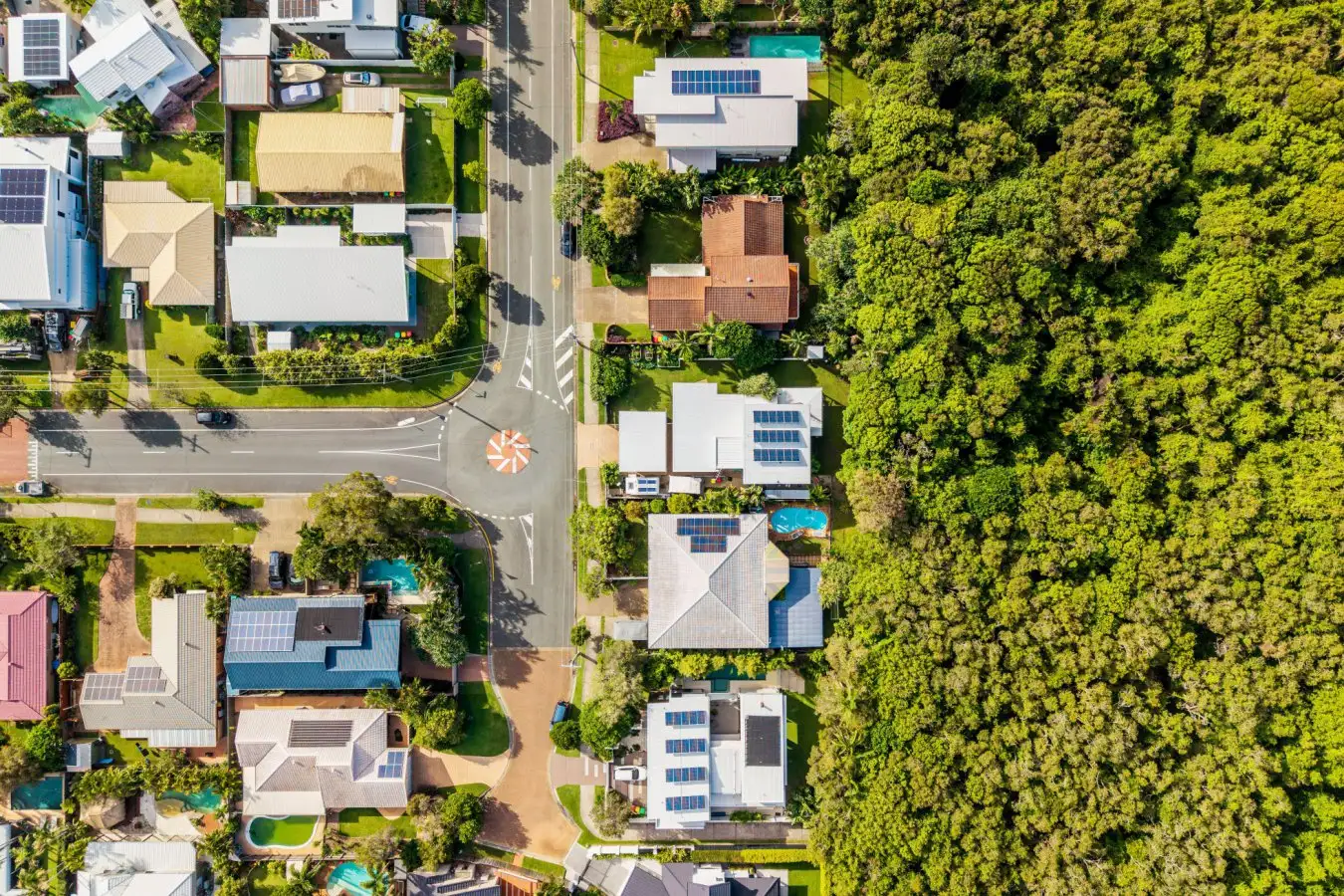
Solar panels offer the possibility of a home with super-low energy bills
Mujie/Alamy
Australia is in the midst of a home battery-installation frenzy, as households scramble to take advantage of a subsidy introduced by the federal government. My household is one of 300,000 that have already installed one of these subsidised batteries, and, much to my delight, I am now running my house and electric vehicle almost for free.
I have been obsessed with home batteries since I first wrote about them for New Scientist in 2018. They store energy captured from solar panels on your roof, so you can use it to power your home and, if you have one, an electric vehicle. By generating and storing all your own energy on your premises, you can reduce your carbon footprint and decouple yourself from price shocks in the external energy market, as we are currently experiencing amid the ongoing tussle over the Strait of Hormuz.
For a long time, the hefty price tags on home batteries made them a pipe dream for myself and most other people. But in recent years, their costs have been falling, even without government subsidies, putting them more in reach.
In my case, I first had to move out of pricey Sydney to meet the initial requirement of owning a home. My husband, children and I moved to a regional town about 400 kilometres north, where we could afford the mortgage on a plain but solid 1970s brick house. We installed 13 solar panels (6.6 kilowatt overall – the most common size in Australia) on our roof to take advantage of the ample sunshine and purchased a relatively cheap Chinese electric car.
The solar panels allowed us to run our dishwasher, washing machine, fridge, electric hot-water system, induction cooktop and other appliances for free on sunny days. But after the sun went down, and on cloudy and rainy days, we had to switch back to using grid electricity. If we charged our car overnight or ran our air conditioning on sweltering summer evenings, we paid for it.
We looked into getting an average-sized 15 kilowatt-hour home battery to store energy from our solar panels for nighttime use, but the cost – A$20,000 (£10,000) – scared us off. When the government introduced its subsidy scheme in July 2025, it brought the price down to A$13,000 (£6,500). We decided this was doable, especially because we could opt to pay it off interest-free over five years.
The battery system we installed contains three lithium iron phosphate (LiFePO₄) battery packs encased in a sleek white box, which is attached to a shaded wall on the outside of our house, to avoid the risk of overheating.
Our bills for electricity usage have since plummeted to around A$25 (£13) per month, despite us cranking our air conditioning overnight. This is a small fraction of the average A$300 (£150) we used to pay before we had solar panels and a battery, although we are also still required to pay a small fixed supply charge to our electricity provider that covers things like meter reading and maintenance of the grid’s poles and wires.
To try to get our costs down further, we have just signed up to a virtual power plant. This connects thousands of households with home batteries so that any surplus energy in individual batteries can be shared. We will be paid up to A$300 (£150) per year for sharing our surplus battery energy, which could cancel out our electricity-usage costs altogether.
Happily, our battery shielded us from the recent spike in fuel prices that occurred after the blockage of the Strait of Hormuz. Petrol prices in Australia went up by 40 per cent and diesel by 70 per cent, but we have continued to run our car for next to nothing. It also kept our lights on during an hour-long blackout on our street one night last week.
Of course, not everyone can afford a home battery, or indeed a home, but there are ways of making this technology more accessible. For example, in the state of South Australia, residents of government-owned social housing can apply to have solar panels and batteries installed on their properties for free to lower their energy bills.
Some people are worried about home batteries catching on fire, but the risk appears to be low. A recent study in Germany found that home battery fires are 50 times less likely than general house fires, four times less likely than electric vehicle battery fires and about on par with tumble dryer fires. Some types of home batteries, including lithium iron phosphate ones, are considered safer than others.
The Australian government’s home-battery scheme has been so wildly popular that it has just had to top it up with another A$5 billion (£2.65 billion), although it will also reduce individual subsidies next month to make the budget stretch to more households. The aim is to have 2 million home batteries installed in Australia by 2030.
Elsewhere, California has also introduced a government subsidy for home batteries and over 200,000 have been installed there to date.
The UK has been slower to adopt the technology, with around 20,000 home batteries currently being installed each year, but the UK government recently announced a plan to introduce a subsidy to encourage greater uptake.
Some of the technologies I’ve written about over the years have admittedly been a bit silly, like robots that give massages or play golf and tiny cars that rats can drive, but home batteries seem like the real deal. It’s satisfying to see them finally taking off and to be able to take advantage of one myself. With all the money we save, maybe we’ll even be able to afford that robot massage therapist.
Topics:
Source link : https://www.newscientist.com/article/2524387-how-i-pay-almost-nothing-to-power-my-house-and-electric-car/?utm_campaign=RSS%7CNSNS&utm_source=NSNS&utm_medium=RSS&utm_content=home
Author :
Publish date : 2026-04-28 10:00:00
Copyright for syndicated content belongs to the linked Source.