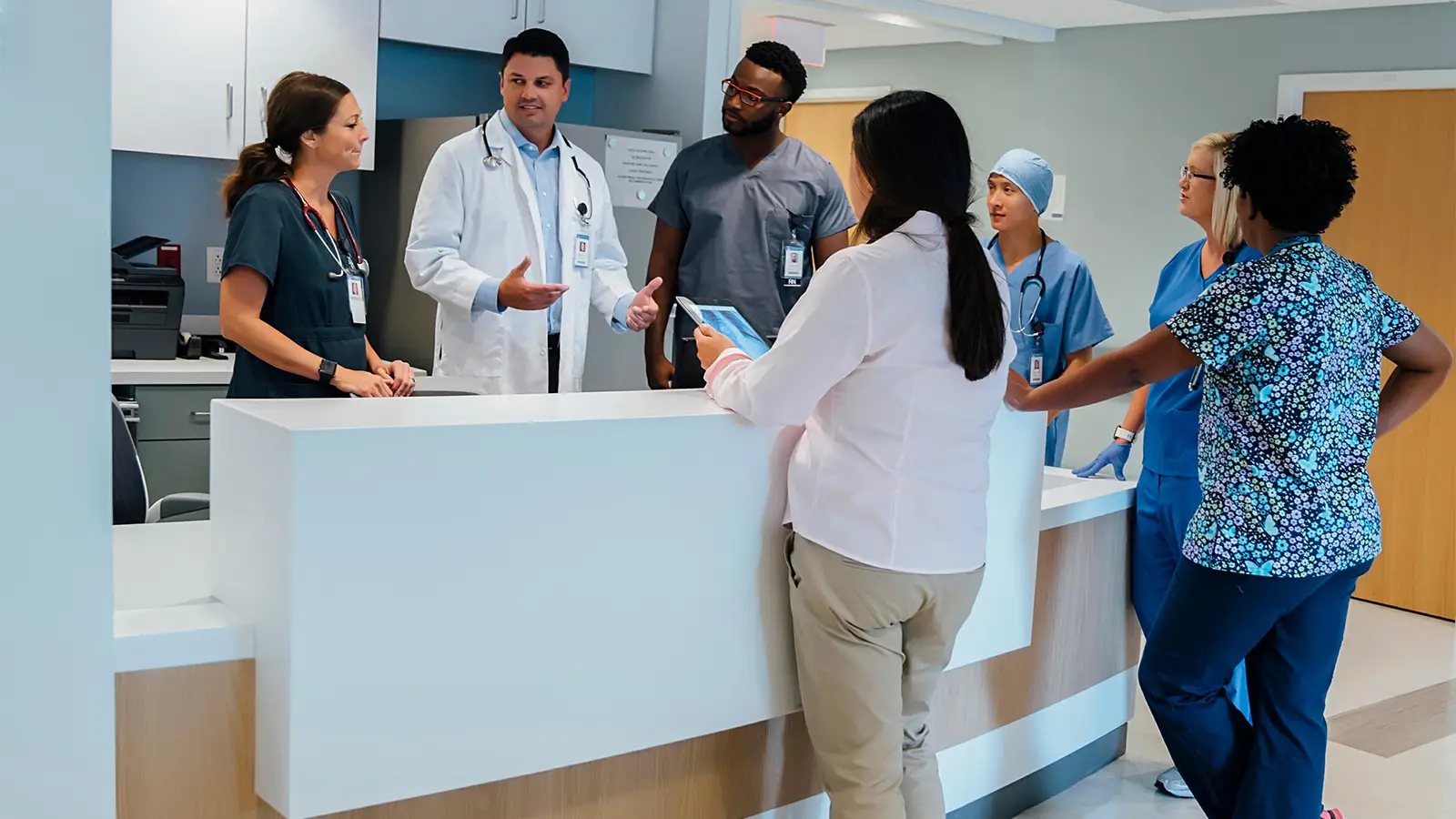
I was sitting in morning rounds with my team when something happened that shocked me. “You’re being racist,” my Black colleague Betty said to me and the other white members of the team.
I came to medicine to do good. I descend from a long line of Jewish physicians whose professional values were to serve whomever they encountered, regardless of skin color or ability to pay. I followed in their footsteps and took my place working in public hospitals, first in Newark, New Jersey and later in Oakland, California. I strived to care for my patients with compassion and integrity. But now I was being told I was failing.
The patient we were discussing was a young African-American man who had been brought in with a gunshot wound. We hadn’t yet met him but were reviewing his case. Someone at the table referred to him as a “gang-banger.” Even though the word hadn’t come out of my mouth, I’d assumed it was true. We all did. Except for Betty.
Betty Clark is a Black octogenarian hospital chaplain on the palliative care service where I work as a doctor. She grew up in Jim Crow Kentucky to a sharecropping family before coming out to California in 1967. Despite the fact that we were colleagues, I hadn’t paid much attention to her contributions to the team. Sure, it was nice to have a chaplain but I didn’t see her as essential to the care of patients. When she called us racist, I grew defensive. My whole identity was being threatened. This hit deep. I stormed out of the room.
Later that afternoon, I arrived at the patient’s room. Picking up the paper chart, I saw Betty’s note. The patient, she wrote, was a postal worker. He’d been shot at random on the highway while driving to work. I realized Betty was right. Our assumptions were wrong. I hadn’t met this man, and I knew nothing about his story.
Implicit bias is something we rarely talk about. Well-meaning physicians and other healthcare practitioners won’t often admit to holding it. It goes completely against the Hippocratic Oath we solemnly pledge on the day we graduate medical school. But bias is one of the earliest human tendencies, originating even prior to language. In early human history, if someone you didn’t know was running towards you, it made sense to assume they were trying to kill you rather than wait and find out.
We’re not living in those days anymore, but old neural pathways die hard. And that holds even for the most compassionate and well-meaning physician. We all know cognitively that we shouldn’t judge a book by its cover — we wouldn’t want to be judged that way ourselves — but bias nonetheless lurks, often unconsciously, in our brains. And it is especially dangerous in environments like the hospital, where the judge is all-powerful and the one being judged is extremely vulnerable. There are hundreds, if not thousands of studies that have shown that bias in healthcare can cause significant harm; it can even be deadly.
That moment was a turning point in my life and career. After seeing her note, I called Betty. She was walking home from work and listened politely as I thanked her for pointing out a blind spot. I asked her out to lunch for the following week, and she accepted. That was the beginning of our 15-year friendship. Betty became my mentor, teaching me to see things I had not seen before, and modeling a more open approach and curious approach. The kind of approach I would wish for myself and my family. No labels, no complacency — only curiosity and compassion.
Our relationship was unusual. Doctors and chaplains don’t usually team up the way we have. My medical expertise combined with her spiritual guidance made for care that proved significantly more than the sum of its parts.
Once you truly see implicit bias, you see it everywhere. And I did see it everywhere. But nothing brought it home more than my relationship with a patient named Edith, whom I met a few years later. Because with Edith it felt personal.
Edith was an 86-year-old Holocaust survivor. No family, and no money to speak of. She had been admitted to our hospital in excruciating pain due to three broken ribs from a fall. She was from the same region in Europe that my family came from. While dozens of my relatives had been killed in a single day by the Einsatzgruppen, Edith’s family had been hidden, and survived. I felt tremendously protective of her, especially given that her last care provider was a Holocaust denier.
We were sitting in rounds discussing her case when one of the social workers, a dear friend and someone I trust very much, said that she “had the feeling that Edith had resources.”
I stared at her in disbelief.
“Edith is on food stamps,” I said. “Is it just because she’s Jewish that you think she has resources?”
The expression on my friend’s face reminded me of how I felt when Betty accused me of being racist. Shame. A burning shame.
It was at this moment that I realized that none of us should be ashamed of our implicit biases. We all have them to some degree, no matter how compassionate or open-minded we are. Whether it’s about race, ethnicity, gender, weight, sexuality, age, tattoos, cigarette smoking, education level — I could go on and on. So it’s actually a very good thing when we become aware of it.
But we can’t stop at that. We must use that awareness to go deeper. Healthcare providers have the great privilege of being in a position to ask questions. We get to be curious about and learn people’s stories. And those stories, I have seen, almost always contain something we can connect with, human to human, rather than label to label. Betty taught me how to question my own biases and grow closer to my patients. For that I will be forever grateful. Now I hope to pay it forward.
Source link : https://www.medpagetoday.com/opinion/second-opinions/120993
Author :
Publish date : 2026-04-28 15:45:00
Copyright for syndicated content belongs to the linked Source.