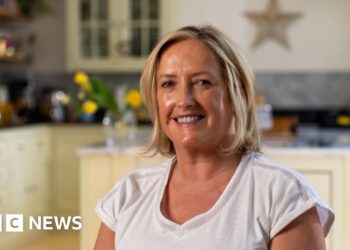
Asal Sayas, a former senior advisor at the White House under President Joe Biden who contributed to the Cancer Moonshot, was just 42 years old when she died after a 6-year battle with young-onset colorectal cancer last week.
While fighting the disease — which has become the top cancer killer of Americans under 50 — Sayas worked tirelessly to push for greater awareness of colorectal cancer, better treatments and support for people living with it, and more funding for critical research in the space, according to those who knew her.
“From a policy and advocacy perspective, what Asal really wanted is more treatments,” Michael Sapienza, CEO of the nonprofit Colorectal Cancer Alliance, told MedPage Today.
Sayas joined the Colorectal Cancer Alliance as a consultant at the beginning of last year, “dedicating the final months of her life to challenging the disease that took it,” the organization said in memoriam. “She spoke about her cancer and demanded progress with unflinching directness, knowing that only the truth, plainly stated, could spark the urgency needed to end this disease.”
Sapienza noted that people under 50 often have delayed diagnosis due to their age. They’re going to the emergency department or another place of care and often being told their pain or other symptoms are something else, he said. By the time they are diagnosed, about 75% have advanced-stage cancer. Sayas had stage IV colorectal cancer at diagnosis.
Prior to joining the Colorectal Cancer Alliance, Sayas served as a senior advisor for infectious disease and cancer at the White House, having already been diagnosed. In this role, she helped to advance the Cancer Moonshot’s goals to reduce cancer mortality and improve patient experience.
“Asal embodied the spirit of the Cancer Moonshot — to move with the urgency of those living with cancer,” former First Lady Jill Biden said in a statement. “Even as she faced her own journey with extraordinary resolve, she never stopped fighting for others, pushing for scientific breakthroughs and a future where fewer families have to endure this kind of loss. Her strength, her voice, and her unwavering belief that we could do better changed lives and moved this work forward in lasting ways.”
Before her work at the White House, Sayas directed government affairs at the nonprofit amfAR, the Foundation for AIDS Research. She also advised Sen. Amy Klobuchar’s (D-Minn.) presidential campaign, years after working for both Klobuchar and Rep. Andre Carson (D-Ind.) on Capitol Hill.
Most recently, Sayas worked with the Colorectal Cancer Alliance’s Project Cure CRC, which funds research on improving colorectal cancer treatments.
Partnerships between patients, advocacy organizations, and pharmaceutical companies have the potential to “play a big part in reducing the cost and timeline in how treatments are created and brought to market,” Sapienza said.
Federal funding is also important, he added, especially when it comes to spurring interest among medical researchers entering the field. Sayas leveraged lobbying efforts as well as relationships on Capitol Hill to push for greater federal funding for colorectal cancer, which hasn’t yet matched that for other high-impact cancers like breast cancer.
Sapienza said there is a need for support services for young-onset colorectal cancer patients, whose financial, relationship, and fertility needs, among others, may be much different than those for older patients.
Greater awareness of colorectal cancer symptoms is key, he noted. While colorectal cancer screening is recommended beginning at age 45 for people at average risk, those with symptoms like blood in their stool, change in bowel habits, cramping, or night sweats before age 45 should get a colonoscopy. “The more we can get this out there, and doctors read this, they may not dismiss it next time,” Sapienza said.
Though there are known risk factors for colorectal cancer, such as obesity, lack of physical activity, a diet high in red or processed meats and low in fruits and vegetables, smoking, heavy alcohol use, inflammatory bowel disease, and a family history of colorectal cancer, exactly what is behind the recent rise in cases in young adults remains unclear.
In the last few weeks, Sapienza said he had been to three funerals for people in their early 40s. “We don’t know why,” he said.
Source link : https://www.medpagetoday.com/special-reports/features/121039
Author :
Publish date : 2026-04-30 15:24:00
Copyright for syndicated content belongs to the linked Source.