[ad_1]
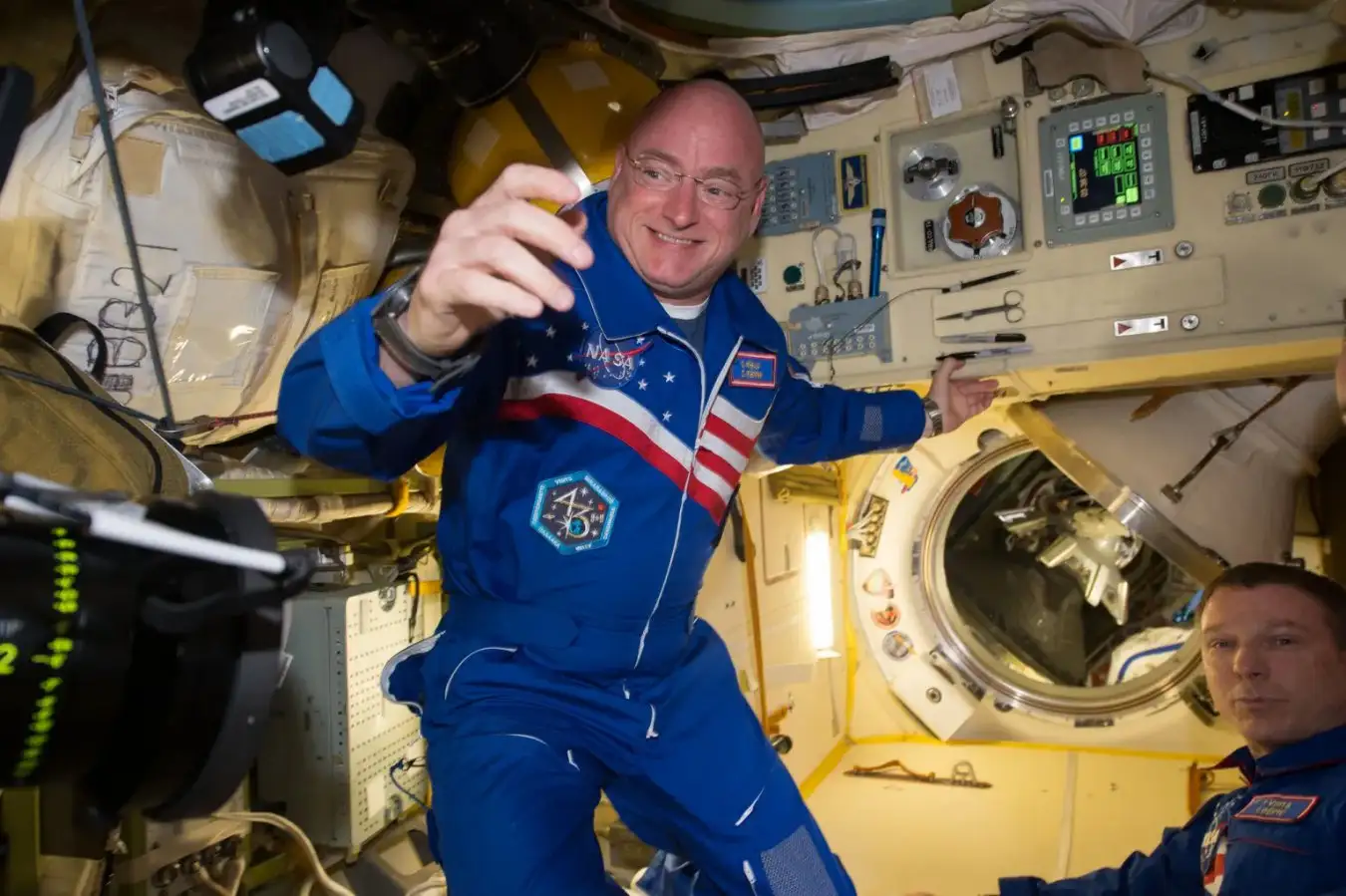
NASA astronaut Scott Kelly spent 340 days in space on one mission
NASA
One of the most famous thought experiments in physics is the twin paradox, first proposed by Albert Einstein in his 1905 paper on special relativity, and later expanded on by physicist Paul Langevin. It goes something like this. An astronaut leaves Earth and spends a few months travelling through space at almost the speed of light. He has a twin brother who stays on Earth. When the astronaut returns, he finds that his brother has aged decades while he is still young. I don’t claim to understand why this would happen, but it has something to do with the relative passage of time experienced by a fast-moving traveller compared with someone on Earth. Or something. It doesn’t really matter: this is a column about ageing.
It is impossible to travel at such speeds, so the twin paradox will remain a thought experiment for the foreseeable future. But something quite similar actually happens in the real world, only in this case, it is the space traveller who ages faster. A twin who goes into space for six months will, by some measures, age 40 times faster than their earthbound sibling.
The vast majority of us will never have to worry about this, but the factors driving accelerated ageing in orbit are increasingly common on terra firma. The good news is that attempts to protect astronauts against these could benefit us all.
As of now, depending on where you draw the boundary, some 781 people have been into space. Some of them spent only hours or days up there, but around half lived on a space station for months. A trip to the International Space Station (ISS) – which has been undertaken by nearly 300 astronauts – usually entails spending six months or more in space.
NASA has long been concerned that extended time in space can harm astronauts’ health and, mindful that lengthy missions to Mars and beyond are on the drawing board, has done extensive research on the impacts and how to mitigate them.
One of the first and most famous was the NASA twin study. In 1996, the agency recruited two identical twin brothers, Scott and Mark Kelly, into the astronaut corps. Both flew on shuttle missions and Scott spent time on the ISS. Mark retired in 2011, but Scott carried on, and when he was selected for a year-long stint on the ISS to take place in 2015, NASA scientists sensed an opportunity. Why not run a twin study, a classic experiment format that uses twins to tease out the relative importance of environmental and genetic influences on health? Ideally, you would want hundreds of pairs of twins, but that was never going to happen in this case, and a sample size of two is more informative than nothing at all. So, the researchers took blood, urine and faeces from both twins before, during and after the flight, and found some clear differences.
One of these was in their markers of inflammation. After a year in space, Scott had elevated levels of several inflammatory molecules and decreased levels of anti-inflammatory ones. He also showed signs of mitochondrial dysfunction.
Both of these are on a list of 12 “hallmarks of ageing”, suggesting that one of the impacts of living in low gravity is accelerated senescence. Subsequent research on other astronauts has shown that extended stays in space trigger at least four more of these hallmarks. Alongside chronic inflammation and mitochondrial dysfunction, astronauts typically also demonstrate genomic instability, a shift towards an unhealthy gut microbiome, disturbances in the endocrine system and blunted sensing of nutrients.
They also show physiological signs of accelerated ageing, sometimes to a shocking degree. These include a steep decline in cardiovascular health, a loss of muscle tissue and bone, cognitive problems and immune dysfunction. The impacts on the cardiovascular system are profound: by one measure of cardiovascular health, the stiffness of the carotid artery, astronauts can age 20 years in six months.
How so? According to Daniel Winer at the Buck Institute for Research on Aging in California, there are four features of living in space that accelerate the ageing process. The first is the lack of gravity, which reduces the load on muscles and bone, causing them to atrophy. The second is a dramatically compressed dark-light cycle: occupants of the ISS experience 16 sunrises and 16 sunsets every 24 hours, throwing a huge space wrench into their circadian rhythms. The third is exposure to high doses of ionising radiation from galactic cosmic rays, equivalent to 480 chest X-rays over six months. The final factor is social isolation. All of these are known to be causal factors in the ageing process.

The detrimental effects of space life are similar to those of stressors on Earth
Curly_photo/Getty Images
“So what?”, you might think. Earthbound mortals are never going to experience these stressors. But actually we do. According to Winer, conditions on Earth do somewhat replicate those of space. We don’t experience microgravity, but sedentary lifestyles have the same effect on muscle and bone. Circadian disruption and social isolation are common, and millions of people are exposed to high levels of ionising radiation from naturally occurring radon gas.
The mechanisms of ageing are still quite opaque, but the good news is that research on long-stay astronauts can help to elucidate them. Astronauts, according to Winer, make an excellent model organism for studying the ageing process. “Spaceflight exposures can be conceptualised as acute, intensified versions of the chronic, lower-grade stressors that drive a substantial portion of age-associated decline in terrestrial populations,” he and his colleagues wrote in a recent review article.
Research on astronauts may even help us to reach that elusive goal of geroscience, anti-ageing interventions. NASA is understandably keen to protect its employees and has collaborated with Winer’s team to find molecules to counteract the pro-ageing effects of space flight. Over the past 70 years, the space programme has delivered multiple medical spin-offs, including cochlear implants and artificial limbs. A fountain of youth would be a most welcome addition to that list. To infinity and beyond!
Topics:
[ad_2]
Source link : https://www.newscientist.com/article/2527465-how-ageing-on-earth-mimics-the-effects-of-space-travel/?utm_campaign=RSS%7CNSNS&utm_source=NSNS&utm_medium=RSS&utm_content=home
Author :
Publish date : 2026-05-22 09:00:00
Copyright for syndicated content belongs to the linked Source.