[ad_1]
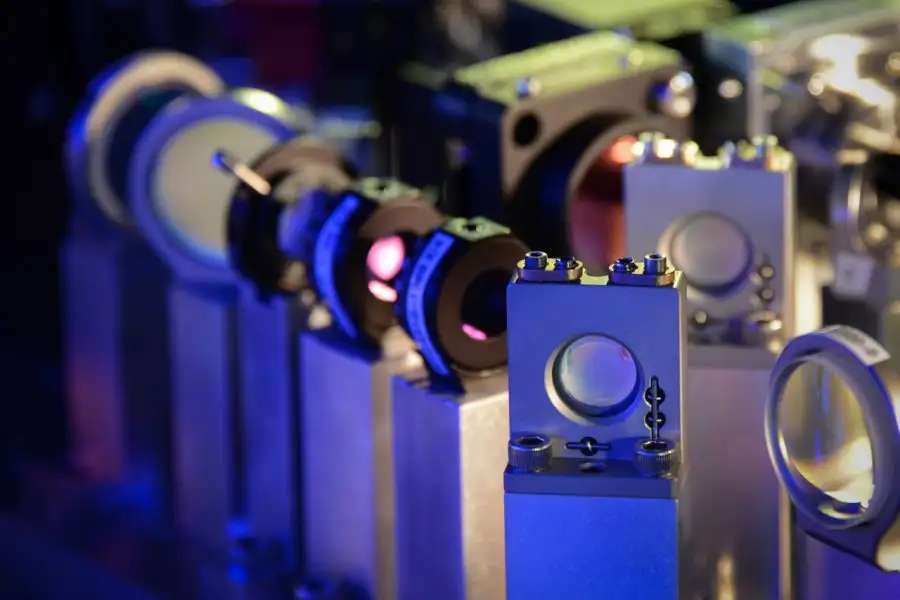
Some of the optical components used in Atom Computing’s quantum computer
Atom Computing
The race to build the first truly useful quantum computer just got more exciting. A quantum computer made from extremely cold atoms has now passed some of the most important milestones towards usefulness, joining a small group of equally able and promising machines.
Though there is wide agreement that sufficiently powerful quantum computers would transform our ability to discover new materials and drugs, and break the encryption that underpins the internet, there are many competing ideas about how best to build them. Industry mainstays such as Google and IBM have spent a decade building quantum computers from tiny superconducting circuits, and this approach is currently the frontrunner.
But an alternate approach that uses electrically neutral ultracold atoms has recently been gaining traction. Ben Bloom at Atom Computing and his colleagues built a so-called neutral-atom quantum computer that can repeatedly catch and correct its own errors, which is a crucial requirement for it to become useful.
“This is a big check mark for what you can do in a neutral-atom system,” he says. “The differences between [experiments] we were doing before were big step changes, but now, it is just about building it better, faster, cheaper.”
The researchers focused on error correction, or the quantum computer’s ability to recognise it made a computational error and discard and restart the calculation. Quantum computers are notoriously error-prone and so fixing them is one of the biggest obstacles towards usefulness.
Error correction involves spreading information across several quantum computing bits, which are called qubits. Some of these qubits are then used as an alert system for when an error has occurred, so that it can be fixed.
The team at Atom Computing showed that they could increase the size of the qubit groups for error correction, from groups of 16 to groups of 32, without introducing any additional errors. In fact, error rates were lower for the larger qubit grouping. This is important because increasing the number of qubits in a quantum computer is ultimately what makes it more powerful.
In 2023, researchers at Google simultaneously increased the qubit number and decreased the error rate in a superconducting quantum computer, as did a team at the University of Science and Technology of China in 2025. Also in 2025, a team of researchers at Harvard University showed the same for another neutral-atom quantum computer. Bloom says that what sets the new experiment apart is that the team could keep the quantum computer running and checking for errors, looking at those alert system qubits, up to 90 times in a row. “The goal was always… to run error correction at infinitum,” he says.
Solving industrially relevant problems will require both lots of qubits and computations that can reliably keep going, and the team at Atom Computing argues that the new work makes a case for being able to do both. “This study is the first to bring together all of the capabilities needed to build a real neutral-atom quantum computer in a single experiment,” says Jeff Thompson at Princeton University. He says that this required an experimental tour de force, but that there is still room for improvement in the overall error rates and speed of computation.
Mark Saffman at the University of Wisconsin-Madison says that this is another step towards building a neutral-atom quantum computer that really could be operated continuously, similar to how conventional computers can just keep working. Yet, Saffman says that as the quantum computer kept working through those 90 rounds of checking for error, some additional errors did accumulate after all, which detracts from its promise of usefulness.
Bloom says that he and his colleagues are already working on addressing some of the errors and he is confident in the team’s ability to continuously improve the quantum computer’s performance. In his view, taken together with the work from other research groups, the new work sets neutral-atom quantum computers as a formidable competitor to other approaches, including superconducting qubits.
“What this work is showcasing is that a lot of the physical mechanisms that stop neutral atoms from being as awesome as superconducting qubits are starting to disappear,” says Bloom. Thompson has a similar view. “I expect rapid progress to follow… across the industry,” he says.
Topics:
[ad_2]
Source link : https://www.newscientist.com/article/2528922-atom-based-quantum-computers-are-catching-up-in-the-race-to-usefulness/?utm_campaign=RSS%7CNSNS&utm_source=NSNS&utm_medium=RSS&utm_content=home
Author :
Publish date : 2026-06-03 15:00:00
Copyright for syndicated content belongs to the linked Source.