[ad_1]
The usual glomerular filtration rate (GFR) threshold could be applied for predicting patient outcomes based on measured (mGFR) values, a retrospective observational cohort study indicated.
Among 6,174 patients, a baseline mGFR of 60 mL/min/1.73 m² was tied to higher rates of all-cause mortality (HR 1.21, 95% CI 1.14-1.28) and kidney failure with replacement therapy (HR 2.85, 95% CI 2.06-3.94) compared with an mGFR of 90 mL/min/1.73 m².
“These findings support the current GFR thresholds by showing that, compared with an mGFR of 90 mL/min/1.73 m2, adverse outcomes were increased at mGFR levels of 60 mL/min/1.73 m2 and rose progressively at lower levels of 45, 30, and 15 mL/min/1.73 m2,” Edouard Fu, PhD, of Leiden University Medical Center in the Netherlands, and colleagues wrote in JAMA. “Adverse outcomes were not consistently increased for mGFR values of 75 mL/min/1.73 m2.”
The findings were simultaneously presented at the European Renal Association (ERA) annual congress in Glasgow.
A GFR threshold of 60 mL/min/1.73 m² or less has been used for years to define chronic kidney disease (CKD) because it represents half of normal kidney function in young adults and is tied to adverse outcomes compared with values of 90 mL/min/1.73 m², Fu’s group noted.
Subsequently, thresholds of 45, 30, and 15 mL/min/1.73 m² are used to stage CKD severity. “These thresholds are used worldwide for diagnosis, evaluation of prognosis, and treatment decisions in people with CKD,” the authors noted.
However, a patient’s GFR assessment ultimately depends on which test is ordered, wrote Peter Reese, MD, PhD, of Vanderbilt University Medical Center in Nashville, and co-authors in an accompanying editorial.
“In routine clinical practice, GFR is estimated rather than measured,” they explained. “Small differences between estimates for GFR that fall close to the thresholds for CKD categorization can reclassify a patient’s disease status, thereby influencing diagnostic testing and treatment decisions.”
While mGFR is the reference standard, it is often not used in clinical practice because it is burdensome, time-consuming, and not widely available. As a result, clinicians rely on estimated GFR (eGFR) to make important decisions, yet these estimates “can be imprecise and misclassify risk in meaningful ways.”
When Fu’s team compared mGFR with eGFR calculated using both creatinine and cystatin C, the risk of all-cause mortality did not differ (ratio of HRs [RHR] at 60 mL/min/1.73 m²: 1.03, 95% CI 0.96-1.10). Conversely, eGFR calculated with creatinine only (eGFRcr) underestimated the mGFR-based association with mortality (RHR 0.87, 95% CI 0.79-0.95) while eGFR calculated with cystatin C only (eGFRcys) overestimated it (RHR 1.17, 95% CI 1.08-1.27).
“Lower serum creatinine level due to reduced muscle mass raises eGFRcr and is associated with poor health status, possibly contributing to the underestimation of mortality risks for eGFRcr thresholds less than 90 mL/min/1.73 m²,” explained Fu and his fellow study authors. “In contrast, inflammation, obesity, smoking, and corticosteroid medications increase serum cystatin C level and lower eGFRcys, which may contribute to the overestimation of risk for GFR thresholds less than 90 mL/min/1.73 m².”
The editorialists said the current findings add to existing evidence that integrating creatinine and cystatin C for eGFR more precisely reflects kidney function than equations that rely on creatinine or cystatin C alone.
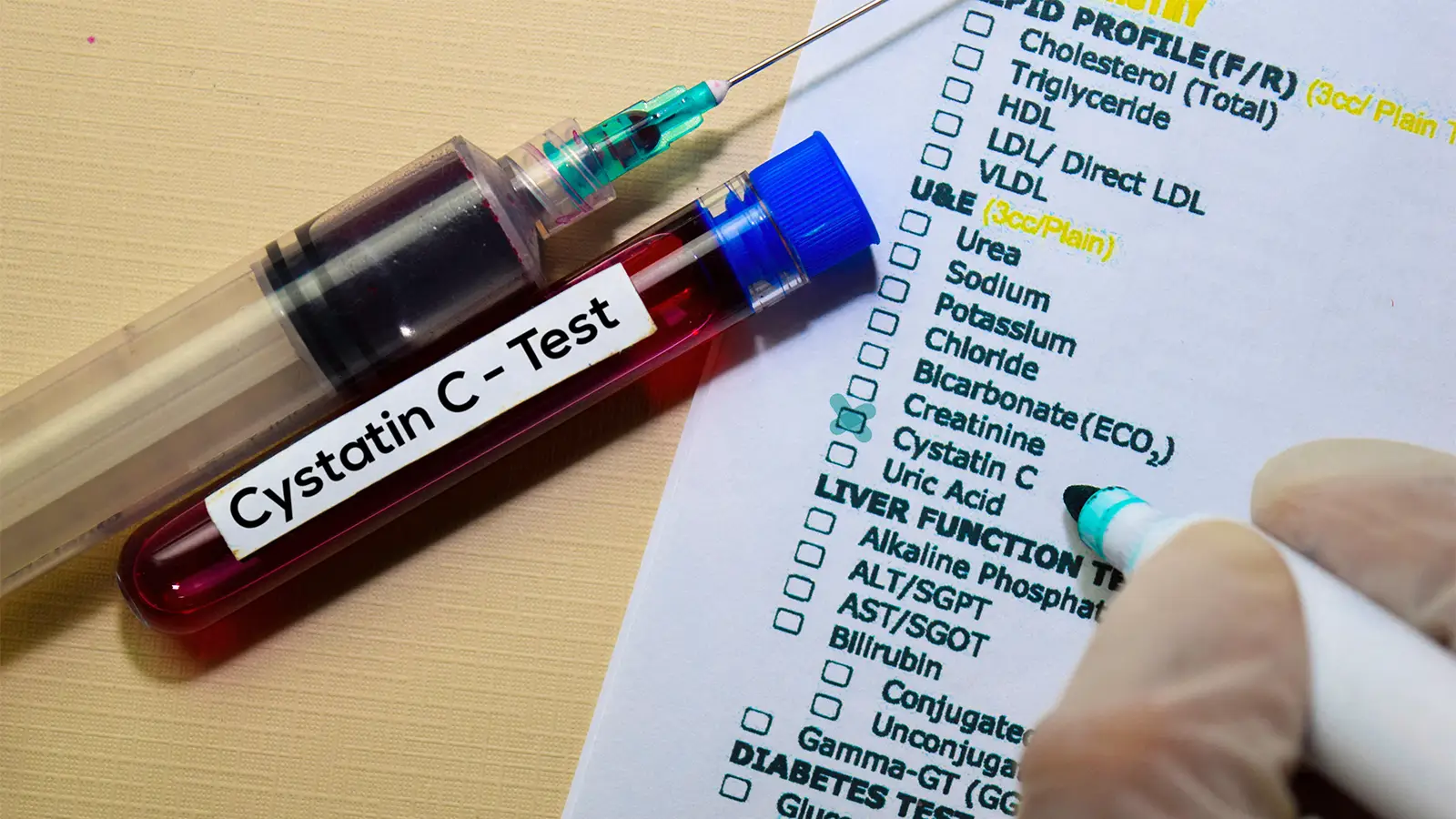
“Ordering a cystatin C test and then evaluating a combined creatinine-cystatin C eGFR could help with clinical decision-making, particularly if there is concern about low muscle mass or if medication dosing depends on accurate GFR assessment,” advised Reese and colleagues.
In current practice, indications for mGFR testing include patients who require a precise GFR for drug dosing, such as in cancer chemotherapy, patients with liver cirrhosis, patients who are kidney transplant recipients or living kidney donors, and patients with discordance between eGFRcr and eGFRcys, the researchers explained.
For this cohort study, Fu and coauthors assessed data on 6,174 Swedish adults from the Stockholm CREAtinine Measurements (SCREAM) project. The median age was 59 years, and 60% of participants were men.
All underwent mGFR testing from January 2011 to December 2021. Estimated GFR was calculated with plasma creatinine, cystatin C, or both using equations from the Chronic Kidney Disease Epidemiology Collaboration.
Hazard ratios for the outcomes of kidney failure with replacement therapy, acute kidney injury, hospitalization for heart failure, and major adverse cardiovascular events were not significantly different between mGFR and any of the eGFR equations.
However, wide confidence intervals for these outcomes suggested limited statistical power, Fu’s team acknowledged, and called for additional studies to evaluate these relationships.
[ad_2]
Source link : https://www.medpagetoday.com/meetingcoverage/era/121602
Author :
Publish date : 2026-06-04 19:21:00
Copyright for syndicated content belongs to the linked Source.