[ad_1]
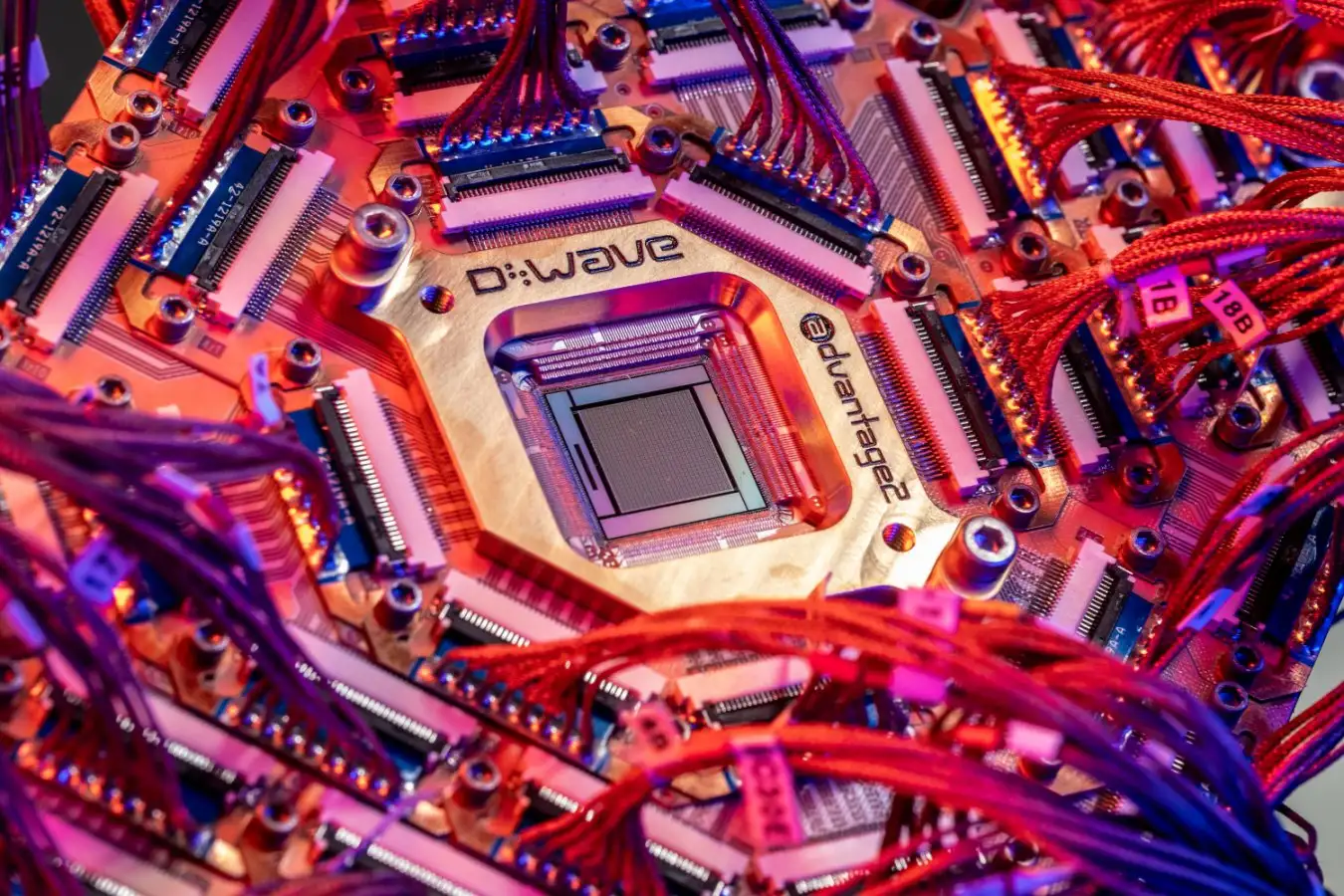
The Advantage2 quantum processing unit
D-Wave
A quantum computer is successfully mining cryptocurrency in the first experiment of its kind, while also using a lot less energy, researchers have claimed.
Cryptocurrencies overlap with quantum computing in two notable ways. The first is that a powerful-enough quantum computer could break the encryption algorithms that currently keep cryptocurrencies secure from hacking. The second is that several studies have shown that using quantum computers could slash cryptocurrencies’ otherwise staggering energy use.
To test this idea practically, Colton Dillion at Postquant Labs and his colleagues have set up an experimental blockchain network called Quip, which has been running since April. The blockchain is the technology behind cryptocurrencies, and is akin to a public ledger or a database in which users add new records by competing to complete a calculation called “proof of work.” For most cryptocurrencies, the winning computer is rewarded with coins, and the block that is added to the ledger makes that transaction permanent.
On Quip, the proof-of-work calculation is a type of optimization problem related to tasks such as finding the best way to schedule deliveries for a food service or assembling the ideal investment portfolio. While most of the computers participating in the Quip blockchain are conventional machines, the network also includes an Advantage2 computer built by D-Wave Quantum – and it seems to be beating the ordinary computers.
“The problem is hard enough to provide a real challenge for classical devices, but not so hard that it goes into the realm of impossibility for both classical and quantum devices. This means that quantum technologies have a real opportunity to have a huge impact,” says Carlos Perez-Delgado at the University of Kent in the UK, who isn’t involved with Quip.
Historically, the computational power and utility of D-Wave quantum computers have generated debate. Notably, in 2024, the firm claimed that one of its quantum computers had solved a problem that would otherwise be impossible for even a conventional supercomputer, but a different team of researchers reported performing a similar computation on a normal laptop just a year later.
Dillion thinks that Quip offers a way to sidestep such disputes because of its decentralized nature. “It’s exactly why it is a blockchain. People who don’t believe our results can join the network and try it for themselves,” he says.
Speaking at an investor presentation on 1 June, D-Wave CEO Alan Baratz said that Advantage2 is only available to Quip for about 5 minutes each day. As a result, says Dillion, it competes on only around a third of the blocks being added to the network, but it wins 92 per cent of those, suggesting that for Quip’s proof-of-work problem, the quantum machine has an advantage over the rest of the network.
What’s more, Baratz said that Advantage2 uses a lot less energy to solve the problem than other computers that compete with it, but the two firms haven’t yet made any detailed benchmarking studies public. “For me, quantum computing is energy-efficient computing for solving hard computational problems,” said Baratz.
Preliminary results from Quip seem to bear this out. Dillion says that, on average, using Advantage2 takes about 100 times less electrical power – 12.5 watts instead of 1334 watts – to win a block. Furthermore, he estimates that a conventional computer that would be able to win the block more often against Advantage2 would need 300 times its power. Additionally, the network was built to be safe against attacks from adversarial quantum computers, which isn’t the case for many existing blockchains that may need to update their software to become quantum-safe.
Does a safer and more sustainable future for the blockchain then lie in networks like Quip? It’s complicated, says Olivier Ezratty at the Quantum Energy Initiative. While using a quantum computer may be less energetically costly on a per computation basis, the costs of building, maintaining and running quantum hardware make it harder to make a purely economic case that the quantum approach can work at scale, he says. “They may reduce the total energy cost, but at the price of a much larger capital expenditure, including the energy cost of manufacturing those D-Wave [quantum computers],” says Ezratty.
Perez-Delagado is more optimistic. “I strongly believe that, given the economic incentives for faster, cleaner, crypto-mining, we will see more of this technology in the future,” he says. In fact, other firms are working on quantum proof-of-work projects as well, such as BTQ Technologies and Quandela, which builds quantum computers that use light, as opposed to Advantage2, which is built from tiny superconducting circuits.
Yet, the team at Quip has a loftier goal in mind. Dillion says that the network could become a worldwide distributed quantum computer, connecting users to many different quantum computers that could then compete to solve different problems, just like Advantage2 competes with conventional computers now. This would democratise access to these currently rare and expensive machines, he says. To get there, the team is working on soon adding another proof-of-work problem and connecting quantum computers made by companies other than D-Wave.
Topics:
[ad_2]
Source link : https://www.newscientist.com/article/2529973-quantum-computer-quickly-mines-cryptocurrency-while-using-less-energy/?utm_campaign=RSS%7CNSNS&utm_source=NSNS&utm_medium=RSS&utm_content=home
Author :
Publish date : 2026-06-12 12:00:00
Copyright for syndicated content belongs to the linked Source.