[ad_1]
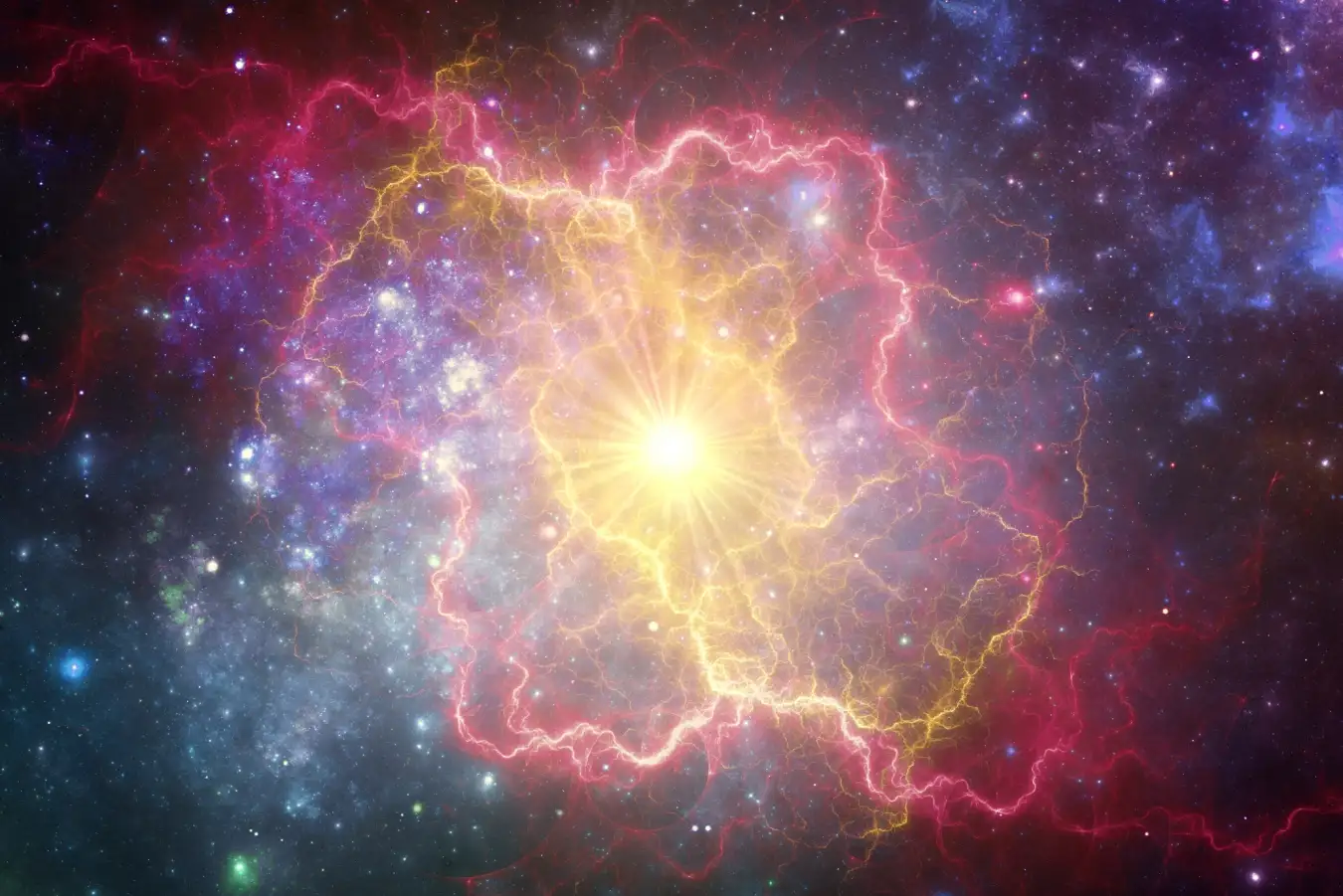
A supernova threatens a civilisation in Claire North’s Slow Gods
Shutterstock/Martin Capek
When I decided to write a space opera, I wanted to start with a supernova. There is no force in the universe like it, either in scale or destructive power – but though it is irrefutably dramatic, it’s also something you can see coming. As a writer, I find this fascinating. What does it mean to look into the heavens and know the exact date when a star will die and with it, your world? What choices do you make, and what price would you pay to save yourself – or your civilisation?
This is the story of Slow Gods.
Let’s imagine for a moment that you are one of these astronomers, watching the stars that will soon destroy your world. For millennia, you’ve known the supernova is coming, and for millennia your people have ignored it. It’s a difficult sell: “Let’s fundamentally transform our entire society to save the lives of billions of people… in about 500 years’ time.” Everyone agrees in a “rhubarb-rhubarb” sort of way that fine, yes, this is a good idea. For someone else. Later.
Well shucks. Suddenly millennia became centuries, became decades. Time is running out. Perhaps you are looking at your newborn grandchild when you realise: you know how, and when, this babe will die. Perhaps they suffocate as the oceans boil, burn alive as the atmosphere ignites or simply die from radiation sickness, skin and organs slowly liquefying. All the incremental changes you made down the years – a distant colony here, a bit of a space elevator there? Not enough. It’s time for your entire civilisation to re-tool around the grim but inescapable premise of saving what you can in the time that remains.
Some hasty maths ensues. You’ve got a century to rescue a population of 5 billion before your planet burns. You build space elevators and vast motherships to carry people across the stars, and at the height of the project can evacuate almost 50 million people a year. (You are going to ignore the perpetual danger of the things lurking in the monstrous dark, infesting the crew with madness, playing tricks with biology or simply gobbling a ship whole. Such creatures defy computation, after all.)
In 100 years you can maybe, in a pinch, get everyone off-planet – but of course it’s never that simple. Children are still being born, the population renewing itself faster than you can evacuate. Perhaps you try to limit population growth? But no – a childless century is as sure a death for your civilisation as fire itself. Life must continue, even if you know that for every child saved, another will die when the planet burns.
Perhaps you are selective about who’s evacuated, and in what order. Do you prioritise the educated, the most fertile, the famous? And by implication, are you going to leave the disabled, the vulnerable, the marginalised behind? This is a genocide by omission, civilisational eugenics – is that who you are?
Fine – a lottery system. At least people can agree it’s fairer, even if no one wants to accept their own powerlessness. You hope and hope that your number will be called, but as the years tick by, that hope begins to slip away. Your people expect you to die quietly, all because of a simple bit of bad luck. Do you?
Even if you escape, where do you go? Some worlds straight up reject your people, leaving millions stranded in the endless dark. Others are more willing to accept you, but only a few hundred thousand at a time, shoved into the most desolate corners of an unwelcoming planet that your biology simply isn’t adapted to. Your people are being scattered into tiny enclaves across the stars, cut off from each other, forgetting their own customs, languages, ideas. You have saved lives, certainly – but you haven’t saved your civilisation. Historians leap into action, bickering over what songs and stories are most quintessentially you. You watch as your society is put into a museum, history sold to the highest bidder, and know that whatever is displayed is only a fraction of who you are.
Or maybe you don’t. This is after all just one story in the galaxy of Slow Gods.
Maybe instead you downplayed the crisis and said “someone else will sort it out”, as if anyone can out-bluff a supernova, and now you’ve got less than a decade before your seas boil, and there are billions of people with nothing to do except die. The richest and most powerful have saved themselves, but they still need income, and for that they need people. Desperate, terrified people who will do anything to survive.
You eye up your gunships. You eye up other worlds – vulnerable worlds, outside the blast radius. And you maybe make a choice to save your own children, even if that means someone else’s child will die, because what parent will do less? Choosing between guaranteed annihilation or violence without end, perhaps you choose a war that will burn the galaxy, having decided that this is no choice at all.
Claire North’s Slow Gods (Orbit) is the July read for the New Scientist Book Club. Sign up here, and come and discuss the book on our Discord channel here.
When you make a purchase via the links on this page, we receive a commission.
Topics:
[ad_2]
Source link : https://www.newscientist.com/article/2531953-why-i-started-my-sci-fi-novel-with-a-world-ending-supernova/?utm_campaign=RSS%7CNSNS&utm_source=NSNS&utm_medium=RSS&utm_content=home
Author :
Publish date : 2026-06-26 09:30:00
Copyright for syndicated content belongs to the linked Source.