[ad_1]
- While other sports like football have received ample attention when it comes to the potential for serious head injuries in young athletes, there are also risks specific to cheerleading’s demands.
- A 2012 rule change banned the “double down” twisting dismount in cheerleading stunts performed in high school and lower-level grades.
- From 2004 to 2012, concussions or closed head injuries per 100,000 cheerleaders trended upward (P=0.0003), with these injuries significantly decreasing in trend after 2012 (P=0.002).
Head injuries among cheerleaders declined after a 2012 rule change that banned the “double down” twisting dismount in stunts performed in high school and lower-level grades, a study showed.
From 2004 to 2012, concussions or closed head injuries per 100,000 cheerleaders trended upward (P=0.0003), with these injuries significantly decreasing in trend after 2012 (P=0.002), reported Audrey Litvak, MD, an orthopedic surgery resident at Washington University in St. Louis, and colleagues in Pediatrics.
Stunting and teammate collision as a mechanism of injury also trended upward prior to 2012 (P=0.0003 and P=0.0005, respectively), then either stabilized (P=0.12) or decreased in trend (P=0.003).
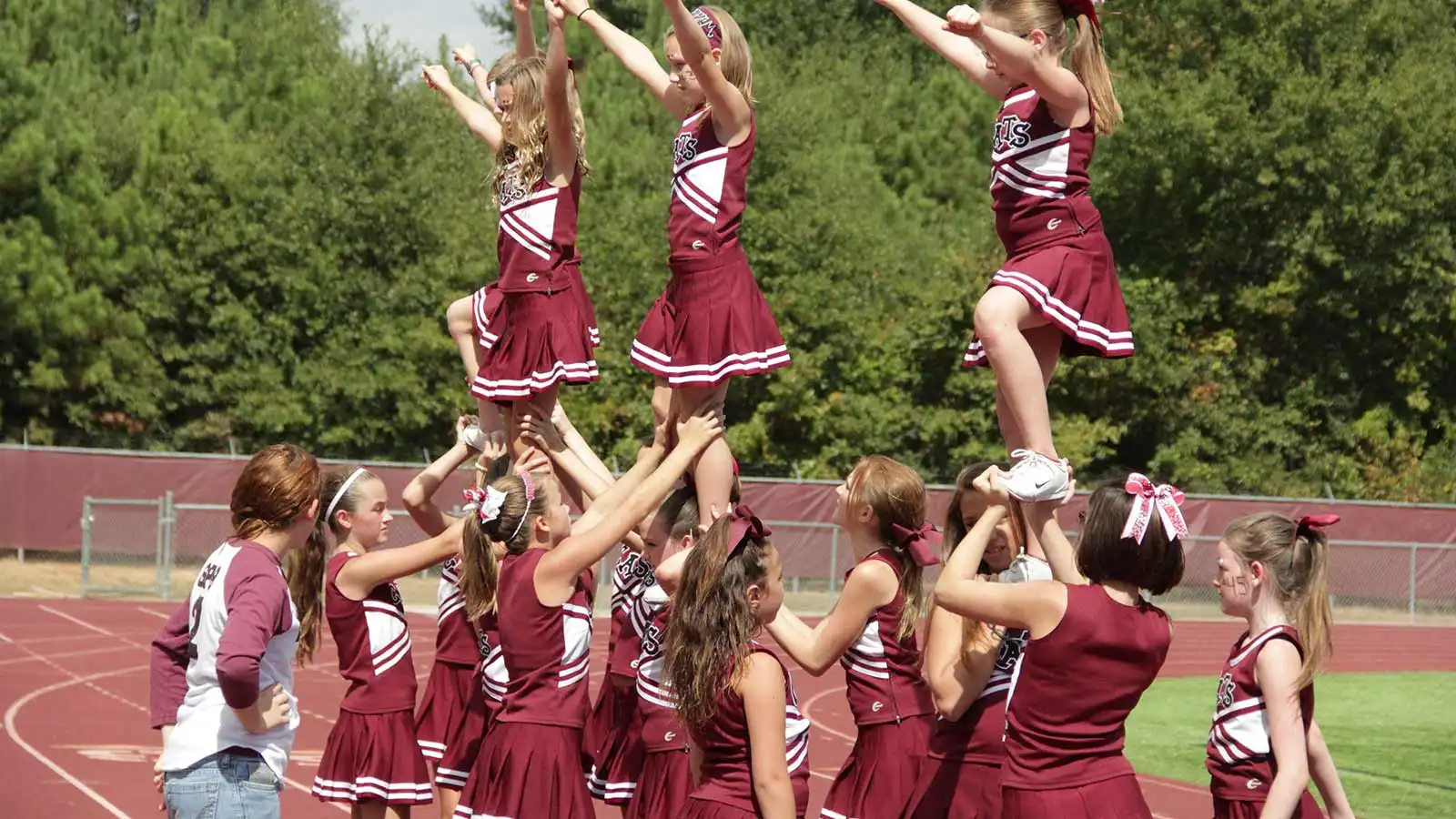
In recent decades, cheerleading has “evolved from a sideline activity to a high-profile contact sport, with its physical demands and head injury rates earning safety risk comparisons to football,” the authors wrote. The competition aspect of the sport includes “high-flying stunts” in which “one athlete (the flyer) is lifted, tossed, or held in the air by teammates (the bases),” they explained. Teams often progress “from simpler lifts to more complex airborne skills as athletes gain experience and can increase skill difficulty.”
While other sports like football have received ample attention when it comes to the potential for serious head injuries in young athletes, there are also risks specific to cheerleading’s demands.
“In a decisive move ahead of the 2012-2013 season, the NFHS [National Federation of State High School Associations] and USA Cheer proactively prohibited the ‘double down’ maneuver — a stunting skill involving a 720-degree twisting dismount performed by a flyer — in high school and lower grade-level cheerleading,” Litvak and colleagues noted. “The ban aimed to explicitly address safety concerns regarding concussion risks linked to teammate collisions during the stunt; yet, despite its critical safety implications, no prior studies have analyzed the effects of the ‘double down’ rule change.”
“Furthermore, despite the popularity of cheerleading, studies analyzing rule changes and long-term injury trends remain limited,” they added. “This is in part due to an absence of a dedicated injury surveillance system, which limits evidence-based safety guidelines and recommendations.”
Litvak told MedPage Today that she and her colleagues “thought there might be some improvement in pediatric head injuries given the head safety concerns that inspired the ‘double down’ rule change, but we really didn’t know what to expect.”
“I think the most surprising and certainly the most encouraging finding was how clear the decreasing trend in both pediatric head injuries and the associated mechanisms of injury were after the rule change,” she said. “While our study can’t establish causation, the findings suggest that thoughtfully designed, evidence-based safety policies can make a meaningful difference.”
“We’ve learned so much about pediatric head injuries through research in football, and I think it’s important to bring that same commitment to other popular youth sports like cheerleading since each sport has its own injury patterns and opportunities for prevention,” Litvak noted.
“Cheerleading involves unique mechanisms for head injury, particularly during stunting, where height, inversion skills, and teammate contact all contribute to concussion risk,” she explained. “Ultimately, our goal is to better understand which measures can reduce concussion risk to keep making the sport safer while balancing this with preserving the unique athleticism, teamwork, and excitement that athletes feel make it so rewarding.”
For clinicians, there is an “opportunity to strengthen injury surveillance by documenting more detailed information about how injuries occur,” she added.
For this study, Litvak and colleagues queried the National Electronic Injury Surveillance System (NEISS) database — a nationally representative probability sample of about 100 U.S. emergency departments — for cheerleading-related injuries from 2004 to 2023.
They identified 16,525 cases of cheerleading-related injuries among kids and teens ages 6 to 18. Ultimately, 15,799 patient records were included in their analysis, corresponding to a national estimate of 551,258 patients. The average age of injured patients was 13.8 years, and 98% were girls.
Fourteen percent of all injuries were concussions or closed head injuries; 39% of head injuries resulted from stunting — as opposed to 5% from tumbling (another component of cheerleading) — and 37% involved teammate collisions.
The pattern of overall cheerleading injuries from 2004 to 2023 was periodic, with annual peaks from September to October and in January (months in which there is return to sports).
Study limitations included the potential for miscoding injuries and limited narrative data on injuries in the NEISS database, Litvak and colleagues noted, as well as inconsistent cheerleading participation data prior to 2014.
[ad_2]
Source link : https://www.medpagetoday.com/pediatrics/generalpediatrics/121995
Author :
Publish date : 2026-07-01 04:01:00
Copyright for syndicated content belongs to the linked Source.