

[ad_1]

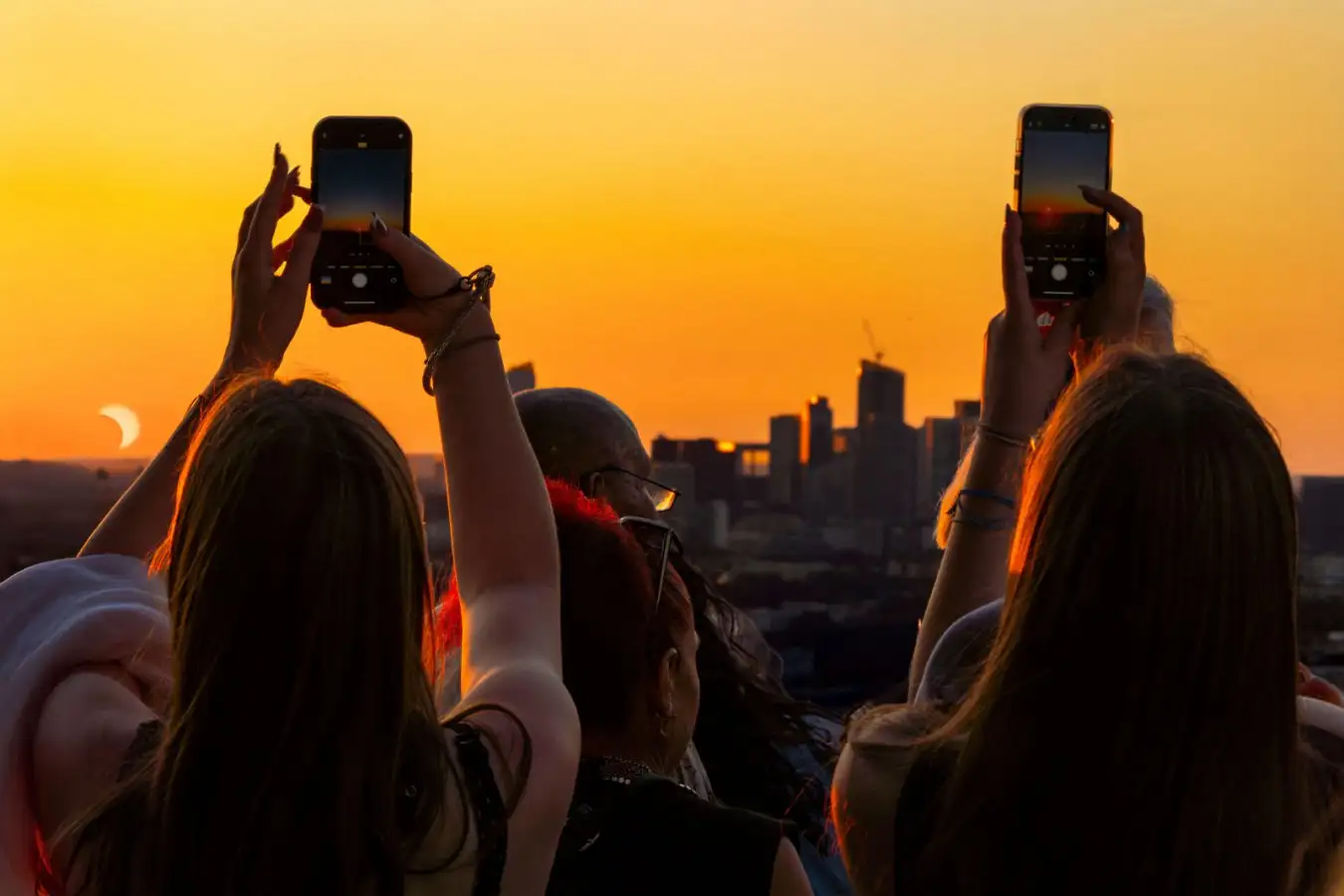
There are several ways you can help scientists study this year’s eclipse
Sirbouman/Alamy
During the total solar eclipse on 12 August, scientists from around the world will have their eyes – and scientific instruments – on the sun. But even if you aren’t a scientist, you can help in their investigations, both during the eclipse and year-round.
A total solar eclipse occurs when the sun and moon line up just right so that the moon blocks out the entire disc of the sun from the perspective of Earth. It is a huge cosmic coincidence that both the sun and the moon happen to be just the right size and at the right distance to give us such a spectacle, and a scientifically useful one at that.
On 12 August, a total eclipse will be visible over parts of Europe and the Arctic and Atlantic oceans, with a partial eclipse covering much of Europe, Canada, north-west Africa and parts of the US. An eclipse like this one is visible from somewhere on Earth just once every 18 months approximately, so during each eclipse, scientists rush out to gather as much data as they can. Here are some ways that you can help out:
1. Record shadow bands from the path of totality: In the moments before and after a total solar eclipse, strange phenomena called shadow bands billow across the ground. These bands are caused by the combination of Earth’s atmosphere and the hidden disc of the sun – it is similar to the effect that causes more distant stars to twinkle. If you are in the path of totality, all you have to do to see them is set out a white sheet or piece of cardboard perpendicular to the direction of the sun. To help out with this citizen science project, which aims to quantify how shadow bands differ based on altitude and distance from the centre of totality, just set up a camera to film the sheet.
2. Photograph the sun with your smartphone: The sun is very nearly spherical, but it isn’t perfect. One of the best ways to measure its shape with precision is to have lots of pictures taken from lots of different locations – that’s what SunSketcher does. It’s a smartphone app that you can set up and leave running as you enjoy watching the eclipse, and it will take carefully timed pictures to capture a phenomenon called Baily’s Beads, or the diamond ring effect. When the very last of the sun is about to be covered by the moon, the lunar landscape lets through tiny points of light, which shine along its edge. The same happens when the other side of the moon is just about to let the sun shine past it again, and these points of light are Baily’s Beads. When lots of photos of the beads, all precisely geolocated, are combined with a map of the lunar topography, that can give us an extraordinarily precise measurement of how far the disc of the sun is from a perfect circle.
3. Measure the darkening of the sky during the eclipse: Even if you are only going to see a partial eclipse, you can still help with scientific research. The Gaia4Sustainability project requires a little bit more equipment and set-up time, but once you have it sorted, you can leave it running all year round and keep collecting useful data. It consists of a small device with a bunch of sensors on it to measure the brightness of the sky and other meteorological factors, and the overarching goal of the programme is to measure light pollution so we can better understand its effects. But during the eclipse, the same sensors can be used to measure atmospheric changes caused by the blocking of sunlight, and the more different spots the team has data from, the more they will be able to learn about atmospheric dynamics during eclipses.
4. Hunt for sun-grazing comets: As is the case for pretty much all astronomical events, a huge portion of the world won’t be able to see August’s total eclipse at all. Not to worry! There are still ways to get involved in solar science. In the Sungrazer project, you can download satellite pictures of the sun and look for moving objects on its outskirts. Some of the objects will be comets skimming past the sun, and once researchers know those comets are there, they can do more detailed research. A huge proportion of the known comets were discovered through Sungrazer. All it takes is a computer, an internet connection and some spare time.
5. Join a DEB observation team for next year: If you want to do something a bit more involved, the Dynamic Eclipse Broadcast (DEB) Initiative might be more up your street. It’s an scheme where teams receive training and some relatively basic equipment to observe eclipses across the path of totality, building up a huge repository of data that can then be used to study the evolution of the corona, the outermost layer of the sun’s atmosphere. Because of the training required, it is too late to join or create a DEB team for this year, but if you are going to be able to spot the 2027 eclipse that will sweep over northern Africa, you can sign up ahead of time.
Even during the eclipse, you shouldn’t look directly at the sun without a solar filter or eclipse glasses to protect your eyes.

Discovery Tours: Eclipses
Explore our tours and cruises designed to help you make the most of experiencing awe-inspiring solar eclipses in handpicked locations around the world.
Topics:
- eclipses/
- solar eclipse 2026
[ad_2]
Source link : https://www.newscientist.com/article/2531817-2026-eclipse-5-citizen-science-projects-you-can-contribute-to/?utm_campaign=RSS%7CNSNS&utm_source=NSNS&utm_medium=RSS&utm_content=home
Author :
Publish date : 2026-07-10 06:00:00
Copyright for syndicated content belongs to the linked Source.