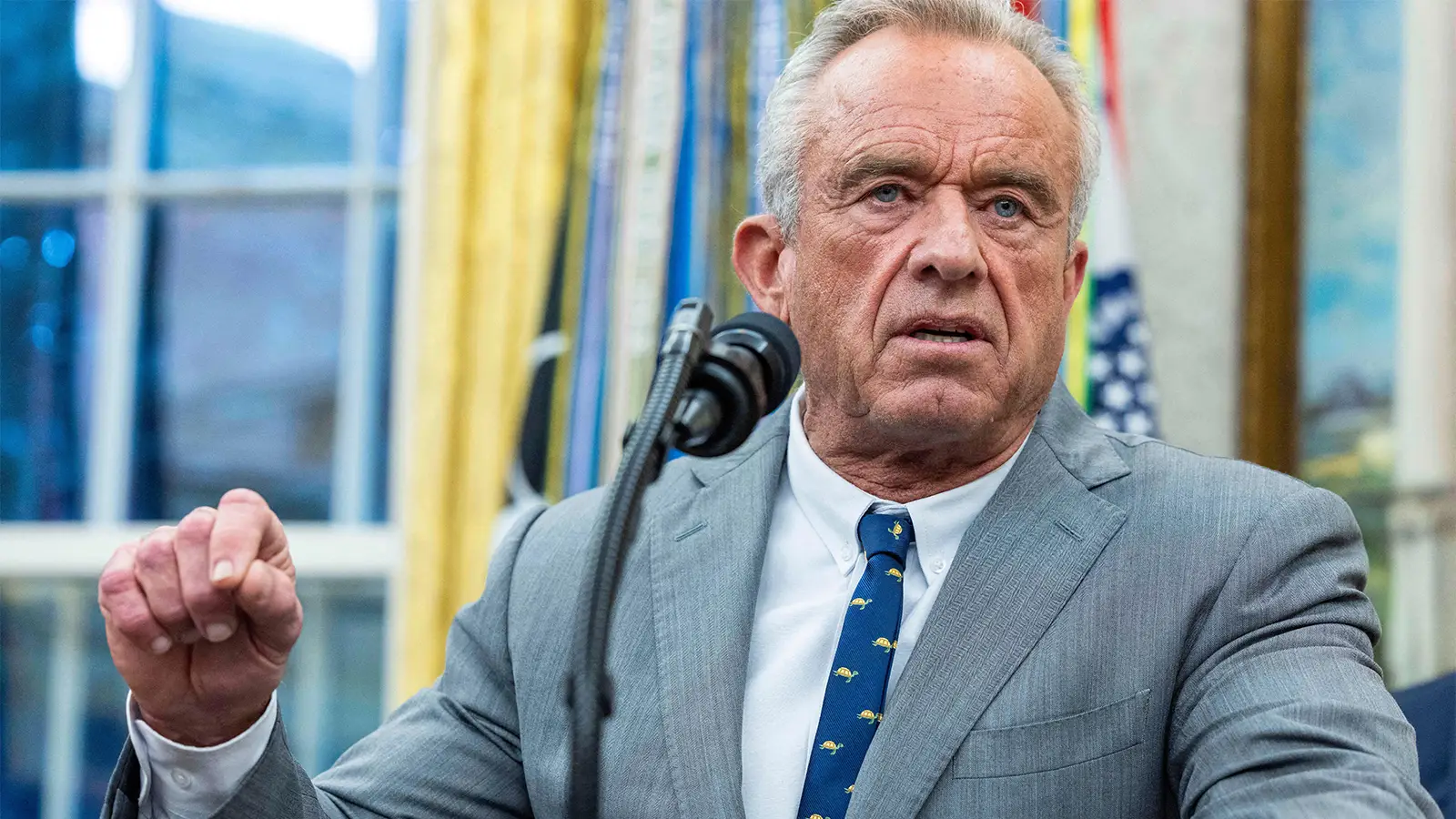
[ad_1] In our civic imagination, a court order is supposed to end the argument. A judge hears both sides, rules, and the government complies. That is the assumption of a constitutional republic. But lately, that assumption has started to wobble. Recent reporting by the New York Times counted 198 lawsuits pertaining to federal funding holds under the current administration. Many plaintiffs have won, yet the administration has often kept pushing -- slow-walking compliance or simply repackaging the same approach under a new label. This creates a cynical paradox: If the executive branch can ignore the law to enact a policy, and then ignore the court to maintain it, is there still a point in going to court? The answer is yes, because the failure to follow process and the refusal to follow court orders are not separate issues -- they are symptoms of the same disease. Where the Law Meets Public Health I've spent my career believing that the law is a shield for the vulnerable, advocating that policy follow science. I went to law school with a specific, perhaps narrow, ambition: to improve access to healthcare and ensure the rules governing our health were built on a foundation of rigorous, transparent evidence. Today, however, I find myself in a role I never sought: a reluctant litigator leading a lawsuit against HHS Secretary Robert F. Kennedy Jr. over his dismantling of the childhood immunization schedule. I did not take this step because I enjoy the adversarial nature of a courtroom. I took it because we are witnessing a collapse of the fundamental agreement that holds our government together: the requirement that power must explain itself. Public health makes the consequences of that collapse impossible to ignore. When rules governing vaccines change without evidence-based processes, the consequences are not abstract. They show up in pediatric clinics, emergency departments, and public health surveillance reports. They show up as preventable infections, outbreaks that ripple through schools and communities, and parents forced to navigate uncertainty about what should be a stable, science-based standard of care. In public health, the rule of law is not merely a procedural safeguard; it is part of the infrastructure that protects life and health. Yet, in our case, the government's lawyers have argued that Secretary Kennedy is not bound by rules. As he works at a frenetic pace to dismantle key elements of vaccine policy, they wave it off as just a difference of opinion about how to promote public health. Public health depends on trust, and trust depends on rules that are predictable and transparent. When vaccine schedules are altered without the evidence-based processes the law requires, it isn't just a "difference of opinion." I argue it is a violation of the Administrative Procedure Act, which exists specifically to prevent high-ranking officials from making life-altering decisions based on whim rather than work. When an official treats evidence like a menu -- selecting what flatters a conclusion and dismissing what complicates it -- they are breaking the law before they even enter a courtroom. If we then allow a subsequent court order to be treated as a "suggestion," we have effectively surrendered the separation of powers. We are left with a one-branch system where the law is whatever the person in charge says it is. Separation of powers is not an abstract civics lesson; it is a guardrail against arbitrary power. Congress writes the laws and controls the purse. The president executes the laws. Courts resolve disputes about what the law permits. When the executive overrides Congress's spending choices by "pausing" appropriated funds, or overrides the courts by ignoring an injunction, they are rewriting the Constitution in real time. Not Accepting a New Normal We have been to this precipice before. In the early 1830s, President Andrew Jackson treated the Supreme Court with indifference, musing about how Chief Justice John Marshall would enforce his decision that Georgia could not impose its laws within Cherokee territory. A century later, southern resistance to Brown v. Board of Education showed that rights are only as real as the willingness of the executive to enforce them. Manufacturing this kind of futility is a governing tactic. If an administration can outlast its critics and ignore the courts long enough, it can convert unlawful actions into a "new normal." By treating court-ordered funding as a negotiable "pause" and the vaccine schedule as a matter of personal preference, the administration is shifting the boundaries of what's possible until the defiance of both judges and scientists becomes an unremarkable feature of governance. Not to litigate is to accept that this "new normal" is valid. Going to court is about insisting on a baseline: the government must follow the law, explain itself on the record, and accept that it cannot simply will outcomes into existence. Law and science both demand reason. Both create a record that can be tested. The shared promise of both is simple: show your work. On Monday, a federal judge granted a stay in our case challenging the dismantling of the childhood immunization schedule. This means the schedule must be restored as our litigation proceeds. Will the ruling actually be followed? That uncertainty tells the broader story of this moment. When compliance with court orders becomes uncertain, the constitutional system is already under strain. If we accept an executive branch that can both disregard the laws of Congress and treat court orders as optional, that imbalance will not stay neatly confined to "politics." It is revealing itself now as providers, states, and families struggle to rely on the federal government as a source of stable, evidence-based standards. Over time it will reveal itself in poorer public health outcomes -- measured not only in statistics but in preventable illness, long-term disability, and lives cut short. There will always be reasons not to sue. Lawsuits can be expensive, slow, and frustrating. Litigation alone will not save the rule of law. It must be paired with congressional oversight and public scrutiny. But abandoning the courts because an administration tries to evade them is like abandoning elections because a candidate lies. The remedy for the abuse of power is not surrender; it is persistence. The alternative is to teach every future president that the law is a suggestion and court orders are merely obstacles to be routed around. In the end, this isn't only about one president, one health secretary, or one vaccine schedule. It's about whether we will remain a country where rights are governed by law -- and where the government must follow the same rules that protect the health and lives of the people it serves. That is a bargain we cannot afford to make. Richard Hughes IV, JD, MPH, is lead counsel for the American Academy of Pediatrics (AAP) in AAP v. Kennedy. He is also an advisor in the biopharma sector, with a particular focus on vaccines. He was vice president of public policy at Moderna during the COVID-19 pandemic and teaches vaccine law at George Washington University in Washington, D.C. Please enable JavaScript to view the comments powered by Disqus. [ad_2] Source link : https://www.medpagetoday.com/opinion/second-opinions/120337 Author : Publish date : 2026-03-17 16:29:00 Copyright for syndicated content belongs to the linked Source.