
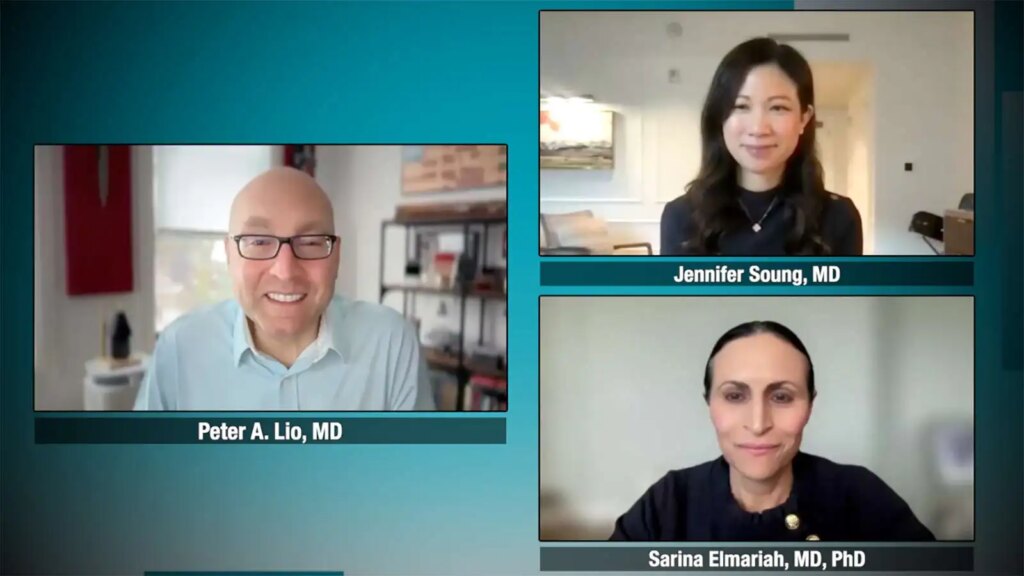
MedPage Today brought together three expert leaders for a virtual roundtable discussion on atopic dermatitis (AD) following the American Academy of Dermatology (AAD) annual meeting: Moderator Peter A. Lio, MD, of Northwestern University Feinberg School of Medicine in Chicago, was joined by Sarina B. Elmariah, MD, PhD, of the UCSF Center for Itch and Neurosensory Disorders in San Francisco, and Jennifer Soung, MD, a dermatologist and director of clinical research at Southern California Dermatology in Orange County.
In this episode, the panel considers safety questions surrounding OX40-targeted therapy in light of the Kaposi sarcoma (KS) cases seen in clinical development, including how such agents may compare with existing options, and if approved, which patients may ultimately be the best fit.
Watch the other episodes here.
Following is a transcript of their remarks:
Lio: Dr. Soung, we know that in thinking about the Kaposi sarcoma, there was another competitor, an OX40 blocker directly that has now sort of dropped — that was rocatinlimab. Any thoughts about how we might view this safety signal when we’re considering some of the options if and when this drug is approved?
Soung: Right. So I’ve been an investigator and had a front row seat in watching my patients improve, and seeing the data here at the late-breaker confirmed what I saw firsthand. One is that the responses had not peaked yet, so it takes some time. And so hoping that the promise of the new or next generation of biologics are going to give us a quicker response and hopefully deeper responses, so higher bars of clearance. So not only skin clearance, but looking for patients to reach zero or minimal itch.
And so it’s exciting to see that the responses have not peaked at that 6 months. However, I’m really cautious about targeting the OX40 class because it’s involved with T cells. And so cautious with the phase II trials as well. In phase II trials, you’re looking at dose-dependent response or figuring out what the optimal dose is. And I do think that in our older patients who perhaps are on higher doses, we may need to be slightly more cautious.
And that’s what we saw with and had no idea that there was or expected that we would be surprised with cases of Kaposi sarcoma. And so I’m cautiously optimistic on targeting T cells just because T cells are involved in so many other parts of the immune system. And it’s going to be a hard bar to beat Dupixent [dupilumab]. The safety is so clean.
So with the two cases of Kaposi’s in both amlitelimab and the [rocatinlimab] program, I think the FDA is going to put some sort of cautionary statement especially and note it on the package insert. And it’s something we may have to mention to patients and kind of hard to explain when you’re compared to [dupilumab/lebrikizumab (Ebglyss)] with the package insert being so clean.
Elmariah: It’s a really interesting point that you bring that up, and it may be that we recognize, I think, the potential benefits, because we all know the heterogeneity of the AD population dictates that we will need different agents for different groups, different ages. Again, these KS cases were patients who had risk factors for KS.
So potentially, as you point out, Jennifer, we may need to be cautious actually in those in whom we may think about a drug like this, but really that idea that you can provide this durable agent or this durable — I hate to call it remission — but really this durable control in patients that will, at this point, we haven’t even really seen what it can do, just allows us to know that we have different agents for our different patients to actually tailor it to a specific indication.
With all of that, there will always be caution with any of these agents, but it may indeed actually have a role. And I think we will definitely see where it goes, but very, very promising in general.
Soung: I think it’s exciting. And this is what I love about clinical trials, is that as we learn how each one of these agents targets one component of the Th2 inflammation, we understand the disease more.
And for example, nemolizumab [Nemluvio] specifically targeting that IL [interleukin]-31 and seeing that there’s a slight disconnect between itch and skin lesions. It’s amazing and powerful at targeting that itch, however, not so good at clearing skin lesions. And I would’ve thought that if we just broke that itch scratch cycle, then perhaps the eczematous lesions would resolve over time.
And so it, I think we’ll continue to learn more even as… you know, just a note in terms of you talk about remission, is that we saw in the lebrikizumab study that after the randomized withdrawal, so patients who reached either a PASI [Psoriasis Area and Severity Index]-75 or an IGA [Investigator Global Assessment] of 0/1 at week 16, some patients were taken off drug. And the patients who were taken off drug almost, gosh, I think it was almost like 40% to half of patients maintained a response for a period of time.
So again, kind of referencing that longer, whether it’s remission, potential disease modification, and that’s why we see in a recent study last fall that you could potentially dose every 8 weeks. So I think we’ll continue to learn more about how targeting certain cytokines might be more high yield, if that’s the best way to put it.
Please enable JavaScript to view the comments powered by Disqus.
Source link : https://www.medpagetoday.com/meetingcoverage/aad-expert-video-roundtable/121122
Author :
Publish date : 2026-05-05 18:05:00
Copyright for syndicated content belongs to the linked Source.