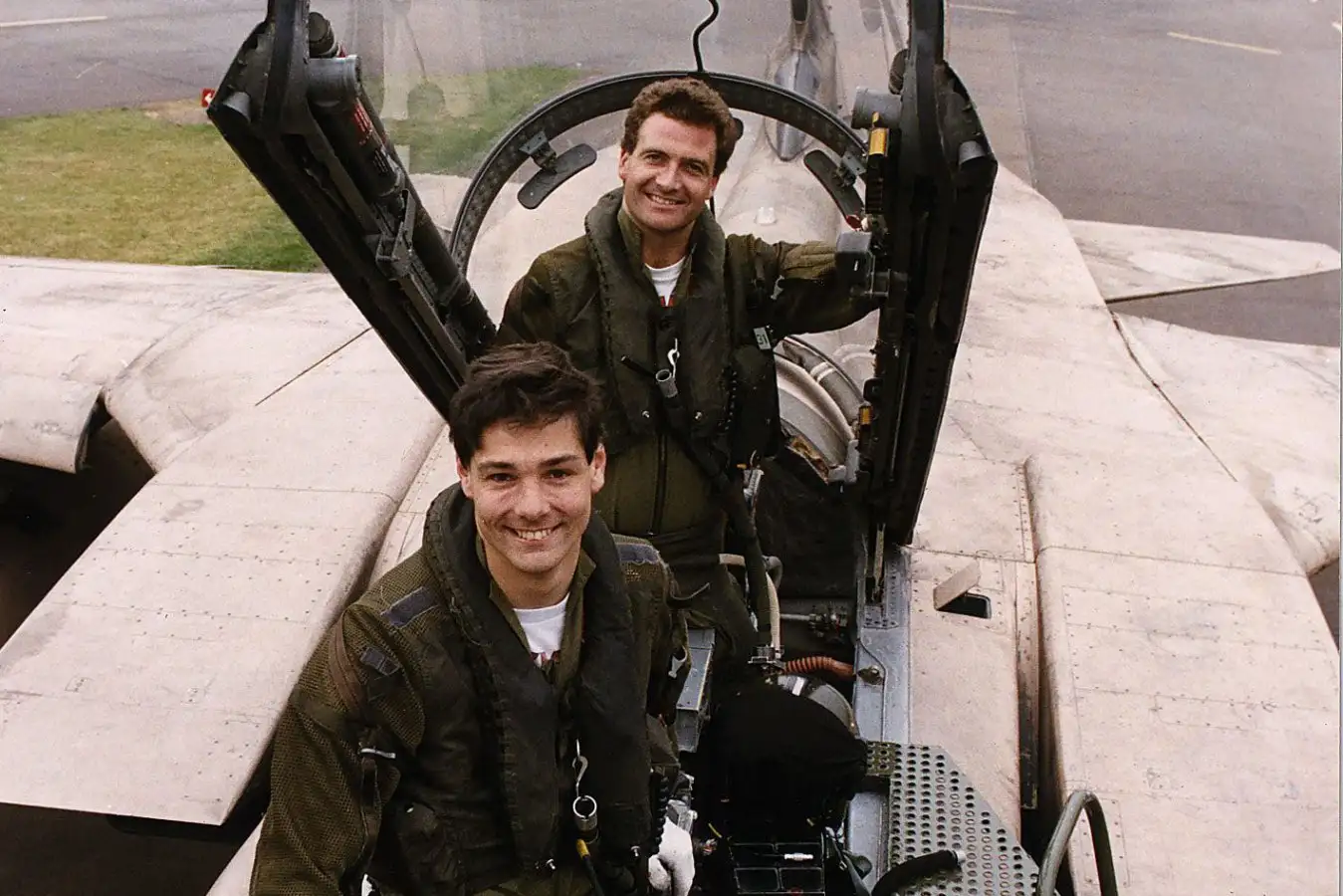
Pilot John Peters (front) and navigator John Nichol became prisoners of war
Trinity Mirror / Mirrorpix / Alamy
The Uncertainty Toolkit
Sam Conniff and Katherine Templar-Lewis, Bluebird (UK, now; US, April)
Few people have withstood the stress that fighter pilot John Peters faced during the Gulf War. After completing a mission in January 1991, his plane was struck by a missile in the desert near Basra in southern Iraq. Peters and his navigator John Nichol ejected and ran for 2 to 3 hours before Iraqi soldiers caught them.
As a prisoner of war, Peters was subjected to brutal interrogations. The prospect of dying alone was never far from his mind. Yet, somehow, he made it through. After leaving the air force, he studied business management and now works as a motivational speaker.
Could we learn something from his resilience to help with our own stress? That’s the premise of The Uncertainty Toolkit by social entrepreneur Sam Conniff and cognitive scientist Katherine Templar-Lewis. Peters joins a group of so-called Uncertainty Experts – former gangland bosses, refugees and people who have struggled with addiction, whose expertise (combined with hard science) has fuelled a new approach to tackling the anxiety that comes with our ever-changing circumstances.
Conniff and Templar-Lewis’s programme revolves around the amusing acronym FFS, which describes the three main effects of uncertainty: fear, fog and stasis. Put simply, you feel scared of what will happen, confused by the unpredictability of the situation and immobilised by the prospect of action. Through progressive exercises, the toolkit is designed to help us overcome each obstacle.
It is an enticing prospect that should have wide appeal, and the authors have previously worked with scientists at University College London to test it out on more than 20,000 participants through an interactive online documentary. The details of the study’s methods and results are sparse, but it appears to have flipped the participants’ views of uncertainty from largely negative to largely positive – no mean feat.
Despite this promise, the book can be frustrating to read. There is a lot of repetition, with the same concepts redefined multiple times in near-identical wording – sometimes on the same page. The stories of the Uncertainty Experts often feel underpowered and fail to deliver strong insights. For instance, we are told that Peters shows the importance of building strong personal narratives to improve our decision-making and power us to act. But his example drowns in bathos, as we learn that, when threatened with execution, Peters decided that he wanted to be remembered as a “nice” person.
“
We should check for feelings that sway judgement: hunger, anger, anxiety, loneliness, tiredness
“
Notwithstanding all this, the book is packed with useful strategies for better emotional regulation. Alongside the usual suspects (mindfulness and yogic breathing), we are taught reflective exercises to identify avoidant behaviours, balance fears of failure with the prospect of regret, and reframe anxiety as excitement. We are encouraged to cultivate gratitude, identify our values and reconnect with our community – all of which should help us escape the FFS state that characterises our typical response to uncertainty.
Perhaps the book’s most useful insight concerns intuition. Our emotional instincts can offer a useful compass for decision-making, particularly when there is simply too much information to process. Unfortunately, gut feelings can often be overwhelmed by our mental and physiological state. For this reason, the authors say we should check ourselves for the most common feelings known to sway our judgement: hunger, anger, anxiety, loneliness and tiredness, best remembered via another handy acronym, HALT.
Elsewhere, Conniff and Templar-Lewis persuade us to challenge stereotypes and widen our perspective by engaging with the people we oppose. That’s sound psychological advice for anyone who wants a clearer vision of the world around them.
By the end, I was convinced by the authors’ approach – until they somewhat undermine their scientific credibility by citing the predictions of the “Balkan Nostradamus” mystic, Baba Vanga. “She said that 2030 (ish) will be defined by climate catastrophe and all-out international war,” we are told breathlessly, as evidence of the chaos facing the world. FFS indeed. But if you can overlook these lapses in judgement, this is an empowering read.
David Robson is a writer. His latest book is The Laws of Connection
Topics:
Source link : https://www.newscientist.com/article/mg26935780-600-a-new-book-provides-a-toolkit-to-tackle-anxiety-can-it-really-help/?utm_campaign=RSS%7CNSNS&utm_source=NSNS&utm_medium=RSS&utm_content=home
Author :
Publish date : 2026-01-14 18:00:00
Copyright for syndicated content belongs to the linked Source.