
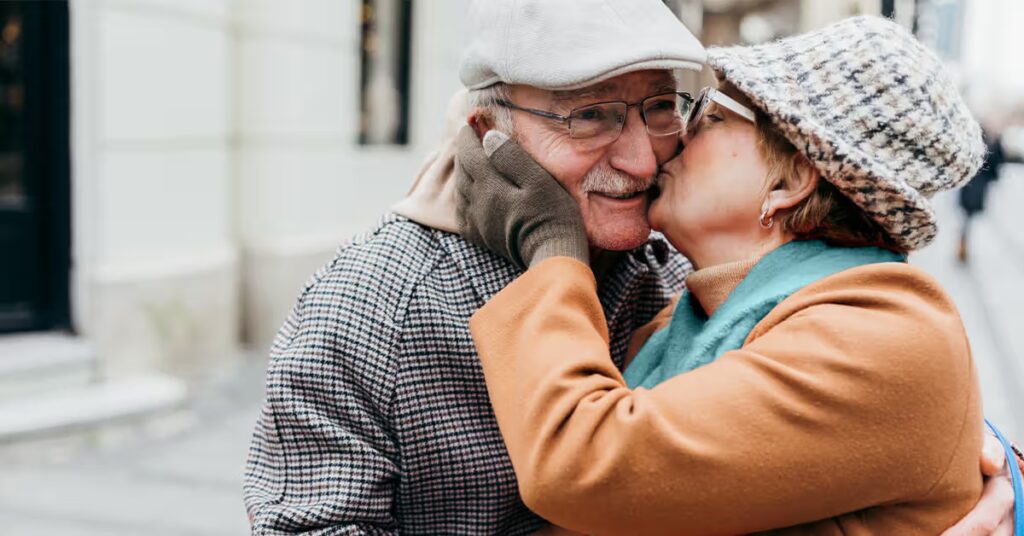

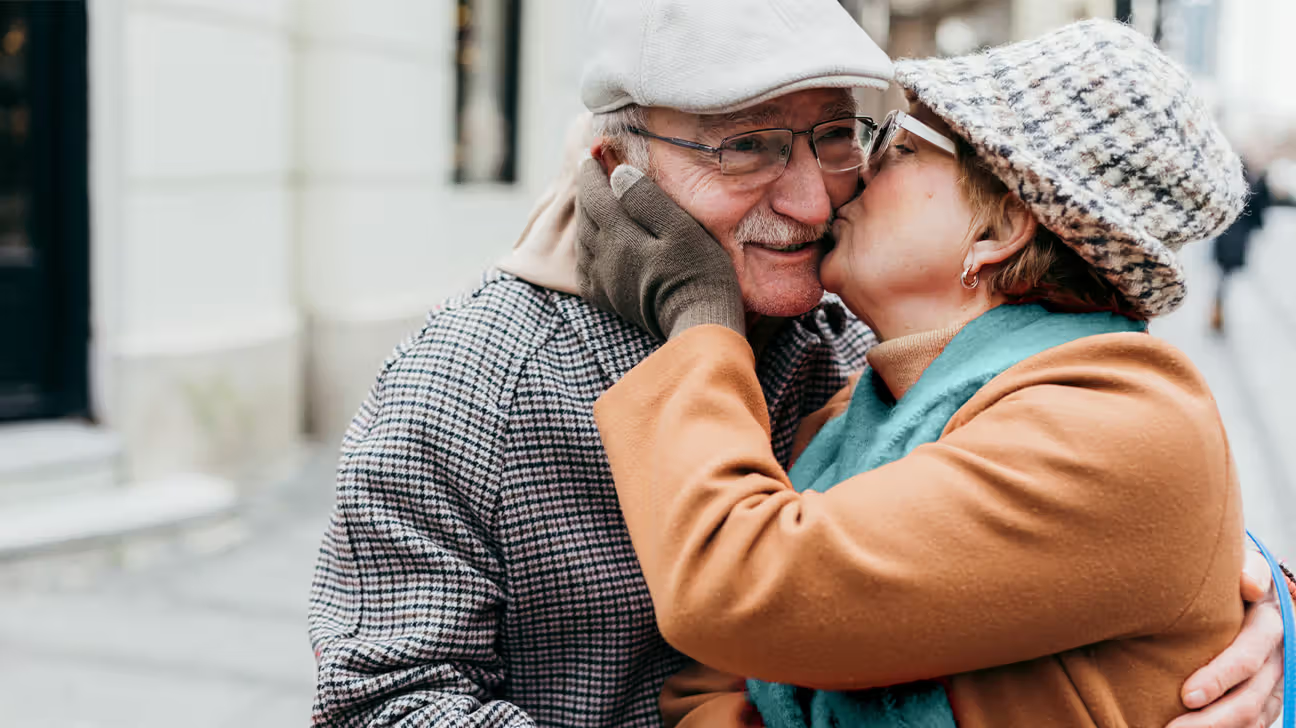
- A recent study has shown that adults remain interested in sexual activity and intimacy in relationships into their 80s.
- The study participants emphasized that physical connections are among the most important aspects of a relationship, with some even saying that a lack of intimacy would be a “deal breaker.”
- The findings could help dispel stereotypes and misconceptions about sex and aging, as well as encourage an open discussion about sexual health with older adults.
It’s a common misperception that the desire for sex and romantic relationships wanes as people age.
However, a recent study published in the Journal of Sex Research found that adults ages 60 to 80 expressed not only a desire, but a need for sexual intimacy in a relationship.
In fact, many view a relationship that lacks sexual intimacy as less than a complete relationship, with some even seeing it as falling short of their definition of romance.
“Older adults who report sexual activity report greater overall well-being and life satisfaction, Arien Muzacz, PhD, clinical associate professor of counseling at The College of Education, Oregon State University, told Healthline. Muzacz was not involved in the study.
While older adults may have the same desire for sexual intimacy, they may experience certain challenges.
“Adults don’t become more asexual as they age; however, they may become less sexual, even though the desire for intimacy remains strong,” said Karyne Wilner, PsyD, licensed psychologist and author of “Releasing Toxic Anger for Women,” who wasn’t involved in the study.
“Many in their 70s, 80s, 90s, and beyond feel desire and romance, but at the same time, they have more difficulties with sex,” she told Healthline.
The researchers interviewed 100 individuals. The participants were split evenly, with 50 single males and 50 single females, ages 60 to 83, with average ages of 65.6 for males and 66.8 for females.
The study focused on how single older adults framed their desire for new sexual and romantic relationships.
Almost three-quarters of the participants openly stated that they didn’t want to be in a relationship if it didn’t involve sexual activity.
Many participants stated that not having sex was a “deal breaker” in a relationship.
One participant, Dean, 68, said, “That would be a deal breaker. I’m still able to be intimate. So that would be a deal breaker. I mean, it might end up as a friendship instead of a relationship. Period.”
Evelyn, 65, agreed. “No, sex has to be part of your relationship. So, if you don’t want to have sex, then what’s the use of having a relationship? . . . You can be friends without having sex. If you just want to be friends, that’s fine. But if you try to do a relationship, then sex has to be a part of it.”
Around 30 of the participants stated they may be somewhat open to a romantic relationship that didn’t involve sexual activity. However, these statements were generally either contradictory or came with caveats.
“Older adults [may] need to look at sexuality in a new way,” said Wilner.
“It can be the touch of a hand on the small of [the] back, sitting or lying close together, a tender massage, or rubbing against each other. It may not end in the strong orgasm or release of yesteryear, but there may be moments of great intimacy with loving bodies intertwined,” she said.
Those who did entertain the idea of a relationship without sexual intercourse typically included stipulations, such as:
- having non-penetrative forms of sexual contact
- changing their partner’s mind
- already loving someone when the sex stopped later in the relationship
“I think sexuality needs to be encouraged among older adults, married and partnered, as well as single,” said Wilner.
“I hope that this study and others like it will encourage people to follow their desires and be realistic about their needs, but also to be flexible in how they define sexuality. If it’s pleasurable, it’s sexual, even when it doesn’t look like the sex you used to have.”
When people talk about sexuality in older adults, they often focus on ability, finding that older adults may have less or no sex, or that the quality of sex is lower, due to bodily changes that come with age.
“Your body may change as you age due to physiological processes such as menopause, the type of exercise you get, or the medicines you take. However, sexuality is still important; it is part of the joie de vivre, it empowers your life force and energizes you,” said Wilner.
The participants in this study also mentioned that biological issues, such as difficulty with erections and lubrication, were among their concerns about having sex at an older age. However, they viewed these as inevitabilities to overcome, not enough to prevent their pursuit of sex.
“Open yourself to a new form of intimacy based on sensual touch or scents,” suggested Wilner.
While the study participants were clear that sex is an important part of romantic relationships, they also showed flexibility in the details of sex. They were aware that the type of sexual experiences one can have may change with age.
Both males and females noted that, as long as the relationship included sex, the frequency of sex was less important.
One of the participants, Howard, 62, said that it was the physical connection, not the frequency, that was essential to the health of the relationship.
“I would think you have to have some kind of intimacy, sexual relations somewhere. It might not be a once a month or twice a month, but [it is necessary] to keep the flow in the relationship going,” he said.
Some of the participants also alluded to the way sex as an older adult may not have the same vigor and pleasure of sex as a younger adult. However, this did not negate the value or importance of sex in a relationship.
Wilner said the study is important because it’s “more in touch with reality than the myth that when people reach a certain age, they lose interest in sex.”
She noted that the results may be reassuring to those who desire sexual connections but feel it may not be appropriate behavior at their age.
The study may not only help dispel the myth and stereotype that older adults lose interest in sex, but it may also help open the conversation about sexual health with these individuals.
“STI prevention is essential for any older adults due to increased risks like thinning of the vaginal walls and reduced lubrication in the vaginal canal (the latter can be addressed by using water-based lubes that do not erode latex prophylactics),” said Muzacz.
“There is also a reality that older adults in communal settings like retirement communities may have multiple partners, so STI prevention and testing are recommended for any older adults engaging in partnered sexual activity,” she added.
The recent study researchers suggested that older adults and their healthcare professionals may often avoid the topic of sexual health. However, the study shows that sexual activity remains a vital piece of relationships to many older adults.
This makes it even more important to incorporate sexual wellness into routine healthcare for older adults.
“People — no matter what their age — need to have a sense of the person they are being intimate with and some knowledge of that person’s dating or marital history. I also think that conversations with physicians, gynecologists, or urologists about safe sex would be helpful in learning how best to protect yourself,” said Wilner.
Source link : https://www.healthline.com/health-news/older-adults-desire-sexual-intimacy
Author :
Publish date : 2026-03-15 08:33:11
Copyright for syndicated content belongs to the linked Source.