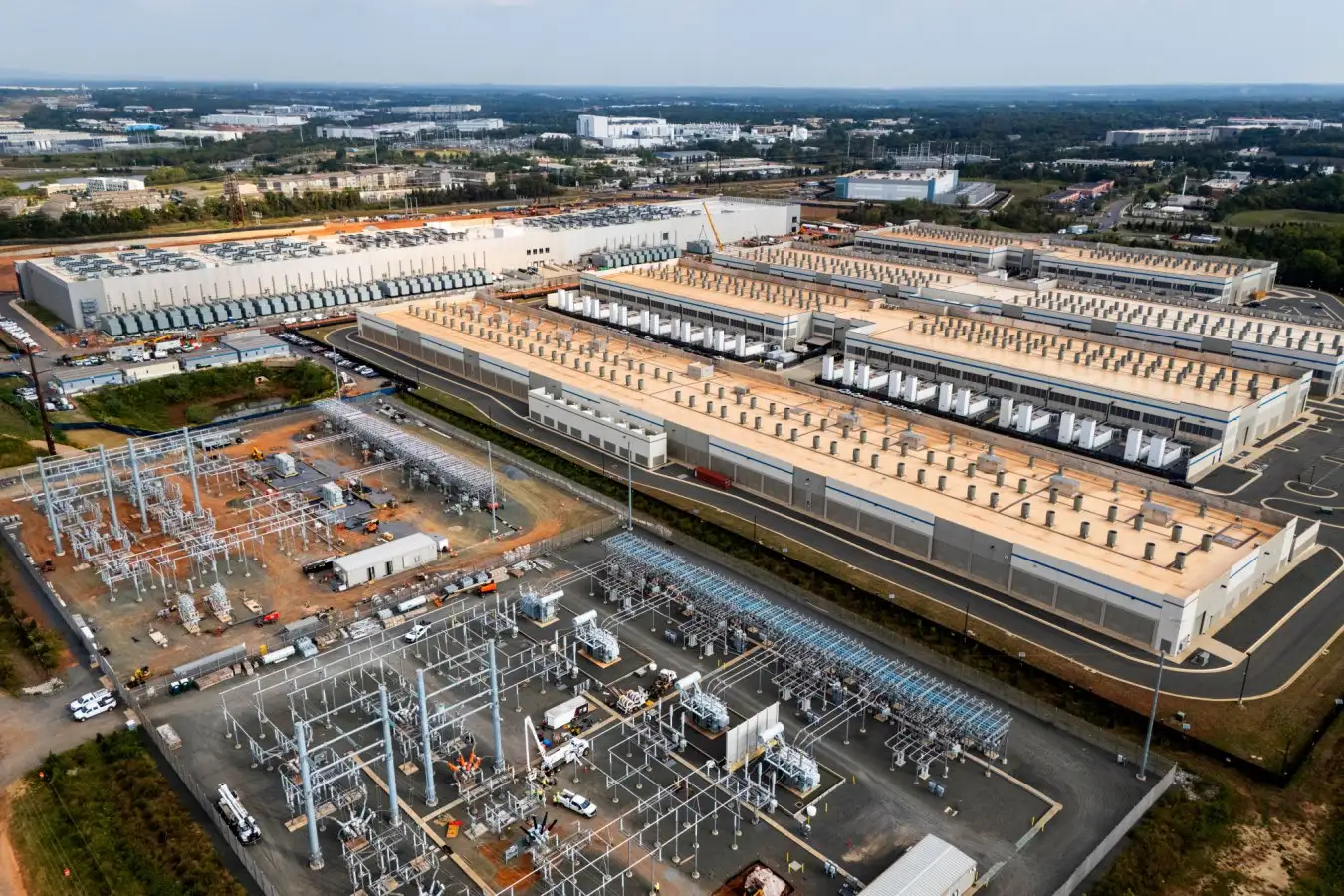
A data centre in Ashburn, Virginia
JIM LO SCALZO/EPA/Shutterstock
As the AI industry rapidly expands, questions about the environmental impact of data centres are coming to the forefront – and a new forecast warns the industry is unlikely to meet net zero targets by 2030.
Fengqi You at Cornell University in New York and his colleagues modelled how much energy, water and carbon today’s leading AI servers could use by 2030, taking into account different growth scenarios and possible data centre locations within the United States. They combined projected chip supply, server power usage and cooling efficiency with state-by-state electrical grid data to conduct their analysis. While not every AI company has set a net zero target, some larger tech firms that are active in AI, such as Google, Microsoft and Meta have set goals with a deadline of 2030.
“The rapid growth of AI computing is basically reshaping everything,” says You. “We’re trying to understand how, as a sector grows, what’s going to be the impact?”
Their estimates suggest US AI server buildout will require between 731 million and 1.125 billion additional cubic metres of water by 2030, while emitting the equivalent of between 24 and 44 million tonnes of carbon dioxide a year. The forecast depends on how fast AI demand grows, how many high-end servers can actually be built and where new US data centres are located.
The researchers modelled five scenarios based on the speed of growth, and identified various ways to reduce the impact. “Number one is location, location, location,” says You. Placing data centres in Midwestern states, where water is more available and the energy grid is powered by a higher proportion of renewables, can reduce the impact. The team also pinpoints decarbonising energy supplies and improving the efficiency of data centre computing and cooling processes as major ways to limit the impact. Collectively, those three approaches could cut the industry’s emissions by 73 per cent and its water footprint by 86 per cent.
But the group’s projections could also be scuppered by public opposition to data centre installations because of their potentially extractive impact on the environment. In Virginia, which hosts about one-eighth of global data centre capacity, residents have begun lodging opposition to further planned construction, citing the impact on their water reserves and the wider environment. Similar petitions against data centres have been lodged in Pennsylvania, Texas, Arizona, California and Oregon. Figures from Data Center Watch, a research firm tracking data centre development, suggests local opposition has stymied $64 billion worth of projects. However, it is unclear, even in places that have successfully rejected data centres, just how much power and water they may use.
That is why the new findings have been welcomed – albeit cautiously – by those who have attempted to study and quantify AI’s environmental impact. “AI is such a fast-moving field that it’s really hard to make any kind of meaningful future projections,” says Sasha Luccioni at AI company Hugging Face. “As the authors themselves say, the breakthroughs in the industry could fundamentally alter computing and energy requirements, like what we’ve seen with DeepSeek”, which used different techniques to reduce brute-force computation.
Chris Preist at the University of Bristol in the UK says, “the authors are right to point out the need to invest in additional renewable energy capacity”, and adds data centre location matters. “I think their assumptions regarding water use to directly cool AI data centres are pretty pessimistic,” he says, suggesting the model’s “best case” scenario is more like “business as usual” for data centres these days.
Luccioni believes the paper highlights what is missing in the AI world: “more transparency”. She explains that could be fixed by “requiring model developers to track and report their compute and energy use, and to provide this information to users and policymakers and to make firm commitments to reduce their overall environmental impacts, including emissions”.
Topics:
Source link : https://www.newscientist.com/article/2503556-ai-power-use-forecast-finds-the-industry-far-off-track-to-net-zero/?utm_campaign=RSS%7CNSNS&utm_source=NSNS&utm_medium=RSS&utm_content=home
Author :
Publish date : 2025-11-10 10:00:00
Copyright for syndicated content belongs to the linked Source.