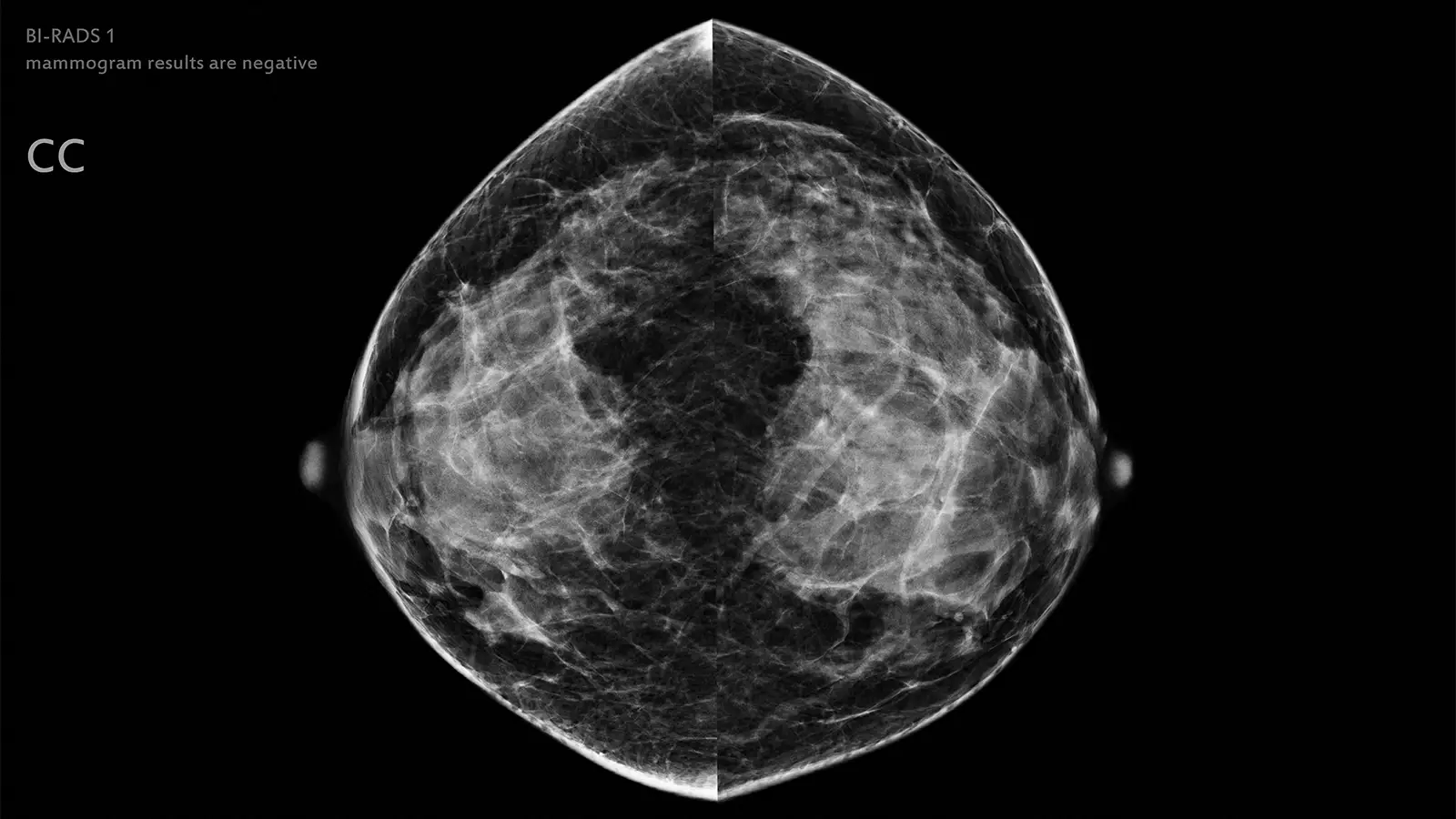
- A partially autonomous AI approach to breast cancer screening could safely eliminate the need for radiologist review of low-risk mammograms, a study suggested.
- The AI strategy reduced radiologist workload by 63.6% and increased the cancer detection rate by 15.2% compared with standard double-blind reading.
- One of the barriers to adopting an AI strategy are the ethical challenges of having most mammograms read only by AI and automatically assessed as normal without radiologists’ review, the researchers said.
Artificial intelligence (AI) could potentially be used to safely exclude low-risk mammograms from radiologist review, according to results from a prospective noninferiority trial.
When comparing standard double-blind reading versus partially autonomous AI-supported screening in which cases classified by AI as low risk were assessed as normal and the remainder were double read with AI support, the AI strategy reduced radiologist workload by 63.6%, reported Esperanza Elías-Cabot, MD, of the Reina Sofía University Hospital and the University of Córdoba in Spain, and colleagues.
The AI strategy also increased the cancer detection rate by 15.2%, with an absolute difference of 1.0 per 1,000 exams (7.3 vs 6.3, P<0.001), thus meeting the study's requirement for noninferiority, they noted in Nature Medicine.
However, the recall rate was 14.8% higher with the AI strategy, with an absolute difference of 0.7% (increasing from 4.8% to 5.5%), which was not noninferior to the standard strategy.
“These results confirm that the high AI accuracy in identifying screening exams that are very likely normal together with a high cancer detection accuracy that provides effective concurrent decision support could be used to safely implement a partially autonomous AI screening workflow,” Elías-Cabot and team wrote.
They pointed to previous retrospective and prospective studies that have shown that AI has been highly accurate in identifying low-risk breast screening exams with a very high negative predictive value.
“As a consequence, the radiologist’s reading could be completely avoided for such low-AI-risk exams, thus effectively introducing autonomous AI reading and partially automated screening,” they noted.
“One of the major barriers for clinical adoption of our proposed strategy is certainly the ethical challenges arising from having most screening mammograms read only by AI and automatically assessed as normal without radiologists’ involvement,” the authors acknowledged.
They noted that this could lead to cancers being missed (11 with the AI strategy in this study). But, they also pointed out that more cancers (54) were missed by radiologists when not using AI for decision support in screening.
Nevertheless, the ethical implications of the AI approach “must be carefully considered,” they wrote. “If there is no radiologist review of a significant proportion of exams, additional screening quality assurance processes such as automated mammography image quality control and continuous postmarket surveillance of AI performance are necessary steps before implementing such an autonomous AI screening workflow for the very likely normal screening exams.”
The objective of this study was to prospectively confirm that an AI system can be used to completely omit human reading in a large proportion of screening exams classified as low risk for cancer. The study was conducted at a single site in Spain and included 31,301 women (median age 59), 55% of whom underwent digital mammography, and 45% who underwent digital breast tomosynthesis (DBT).
The positive predictive value was similar with both strategies — 13.19% with the standard strategy and 13.23% with the AI strategy, while the false-positive rate was slightly higher with the AI strategy (4.8%) versus the standard strategy (4.2%).
Subanalyses by modality showed that the workload reductions with digital mammography and DBT were fairly similar (62.1% and 65.5%, respectively), but the cancer detection rate with digital mammography was 37% higher with the AI strategy versus the standard strategy (absolute difference of 1.6 of 1,000), as was the recall rate (28.2% higher, with an absolute difference of 1.3%).
On the other hand, the cancer detection and recall rates remained stable with DBT. Still, Elías-Cabot and colleagues suggested that the significant workload reduction achieved “is the most important aspect in favor of incorporating AI in screening programs using DBT.”
In the study, there were 252 screen-detected cancers across both strategies (189 invasive and 63 carcinomas in situ). The AI strategy detected 10.1% more invasive carcinomas, 35% more carcinomas in situ, and more grade I invasive carcinomas (30.2%), and T1 (13.5%) and N0 invasive carcinomas (15.6%), compared with the standard strategy.
Source link : https://www.medpagetoday.com/hematologyoncology/breastcancer/120393
Author :
Publish date : 2026-03-19 20:31:00
Copyright for syndicated content belongs to the linked Source.