
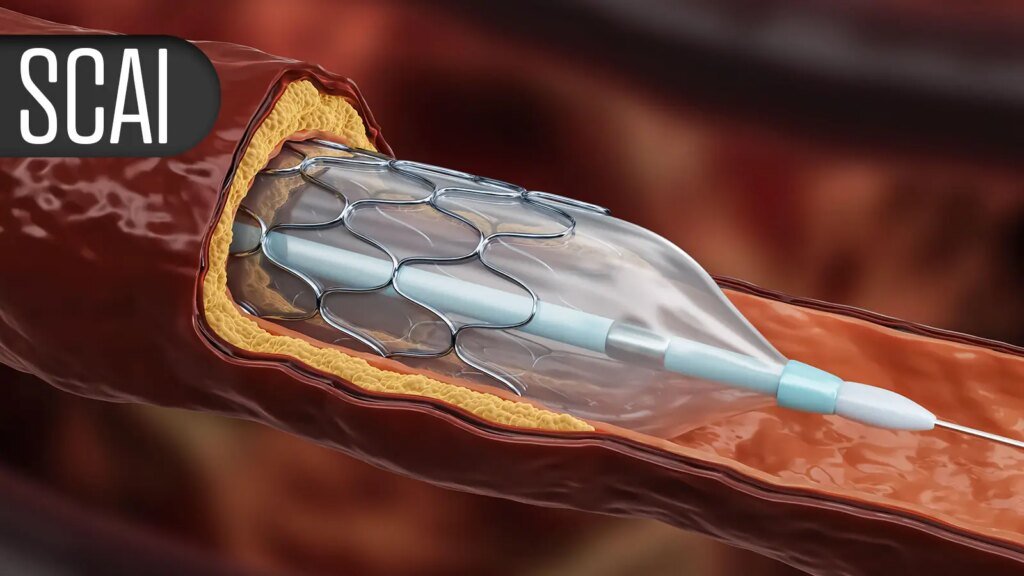
The AltaValve transcatheter mitral valve replacement (TMVR) system had sustained effects among patients with severe mitral regurgitation out to 1 year, according to an early feasibility study (EFS).
Among 30 participants with severe mitral regurgitation at baseline, 29 had no or trace mitral regurgitation after receipt of the AltaValve, with one patient converted to surgery, reported Konstantinos Voudris, MD, PhD, of the Minneapolis Heart Institute, at the Society for Cardiovascular Angiography & Interventions (SCAI) annual meeting held in Montreal.
Overall, 26 and 22 patients had no or trace mitral regurgitation at 30 days and 1 year, respectively. Meanwhile, mitral valve gradients increased from 2.5 mm Hg at baseline to 4.1 mm Hg at 30 days and 4.0 mm Hg at 1 year.
Additionally, left ventricular dynamics improved at 1 year, with left ventricular outflow tract (LVOT) diameter and gradient unchanged.
Voudris called the results “definitely promising” during a press conference and pointed to AltaValve’s pivotal single-arm ATLAS trial, which is in active enrollment in the U.S., Europe, and Canada. The EFS cohort will be followed annually up to 5 years, he noted.
“Our findings suggest excellent valve performance, sustained positive outcomes, and a low rate of complications, as health benefits did not taper off at 1 year post-TMVR,” Voudris said. “We hope this can become a durable, efficient, and therapeutic option for a broad patient population with limited treatment options.”
Of note, 54% of the EFS cohort had a narrow LVOT at baseline.
The AltaValve was designed to minimize LVOT obstruction and work around the anatomical limitations of current TMVR technology, namely the transapical Tendyne and transseptal Sapien M3 systems currently on the market.
Voudris noted that many TMVR systems rely on subvalvular fixation with rigid anchoring mechanisms. These increase the risk of LVOT obstruction and present anatomical limitations in people with complex mitral valve anatomy, large annuli, and mitral annular calcification (MAC), leading to infamously high screen failure rates associated with this technology.
The AltaValve instead relies on atrial fixation. It features a bovine pericardium valve within a stent frame, topped with a stent cap that is attached to the delivery system. An annular ring is designed for no active attachment to native mitral valve or left ventricular structures, and the ring comes in three sizes.
“The AltaValve is an exciting and novel transseptal prosthesis that should help address the vexing problem of anatomical suitability of TMVR devices,” commented James McCabe, MD, of Beth Israel Deaconess Medical Center and Harvard Medical School in Boston, in an editorial that accompanied the AltaValve EFS 6-month report from November.
“[T]he frame of the prosthesis importantly sits across the true mitral annulus as a counterpoint to the cage’s atrial contact,” McCabe wrote. “This is meaningful because it allows this prosthesis to address patients with MAC. Even within the context of this EFS, 7% of treated patients had ‘complex’ MAC, and the ongoing AltaValve pivotal trial also allows MAC, as long as [mitral regurgitation] is the predominant valve pathology.”
However, the pivotal 450-patient ATLAS trial is not expected to be completed for at least another few years.
In the meantime, McCabe pointed to concerns that still need to be addressed regarding the AltaValve: issues with atrial hypercontractility when it comes to the cage’s atrial contact, for example, and the iatrogenic atrial septal defect after TMVR that, if left open, may lead to volume load on the right ventricle.
Conducted in Europe, the U.S., and Japan, the AltaValve EFS enrolled 30 patients with symptomatic severe mitral regurgitation who were at high surgical risk and ill-suited for transcatheter edge-to-edge repair.
Mean age was 77 years, and 63% were women. Eighty percent of participants had New York Heart Association (NYHA) class III/IV symptoms. The average Society of Thoracic Surgeons Predicted Risk of Mortality (STS-PROM) score was 5.3%, and left ventricular ejection fraction was 53.8%. The etiology of mitral regurgitation was split between functional mitral regurgitation and degenerative mitral regurgitation/mixed cases, and MAC was moderate/severe in 23%. Three in four participants had a history of chronic or paroxysmal atrial fibrillation.
The most commonly used valve size was 46 mm (50%), followed by 54 mm (27%) and 40 mm (23%). AltaValve was delivered via transseptal access in 57% of patients, and the remaining 43% had transapical access.
TMVR with transseptal access was linked to an all-cause mortality rate of 12% at 1 year, with no cardiac mortality, while transapical access was tied to an all-cause mortality rate of 38% at 1 year, with 31% having cardiac mortality.
New pacemakers were required for 3% of patients at 1 year. Meanwhile, there were no mitral valve reinterventions, new-onset atrial fibrillation, or stroke events logged at that time.
Following TMVR with AltaValve, NYHA symptom classification improved to I/II in 96% of patients at 30 days and 1 year. Six-minute walk test results went from 238 m at baseline to 282 m at 1 year — in the transseptal cohort, the improvement was particularly notable (from 227 m to 292 m).
Please enable JavaScript to view the comments powered by Disqus.
Source link : https://www.medpagetoday.com/meetingcoverage/scai/120971
Author :
Publish date : 2026-04-27 16:09:00
Copyright for syndicated content belongs to the linked Source.