


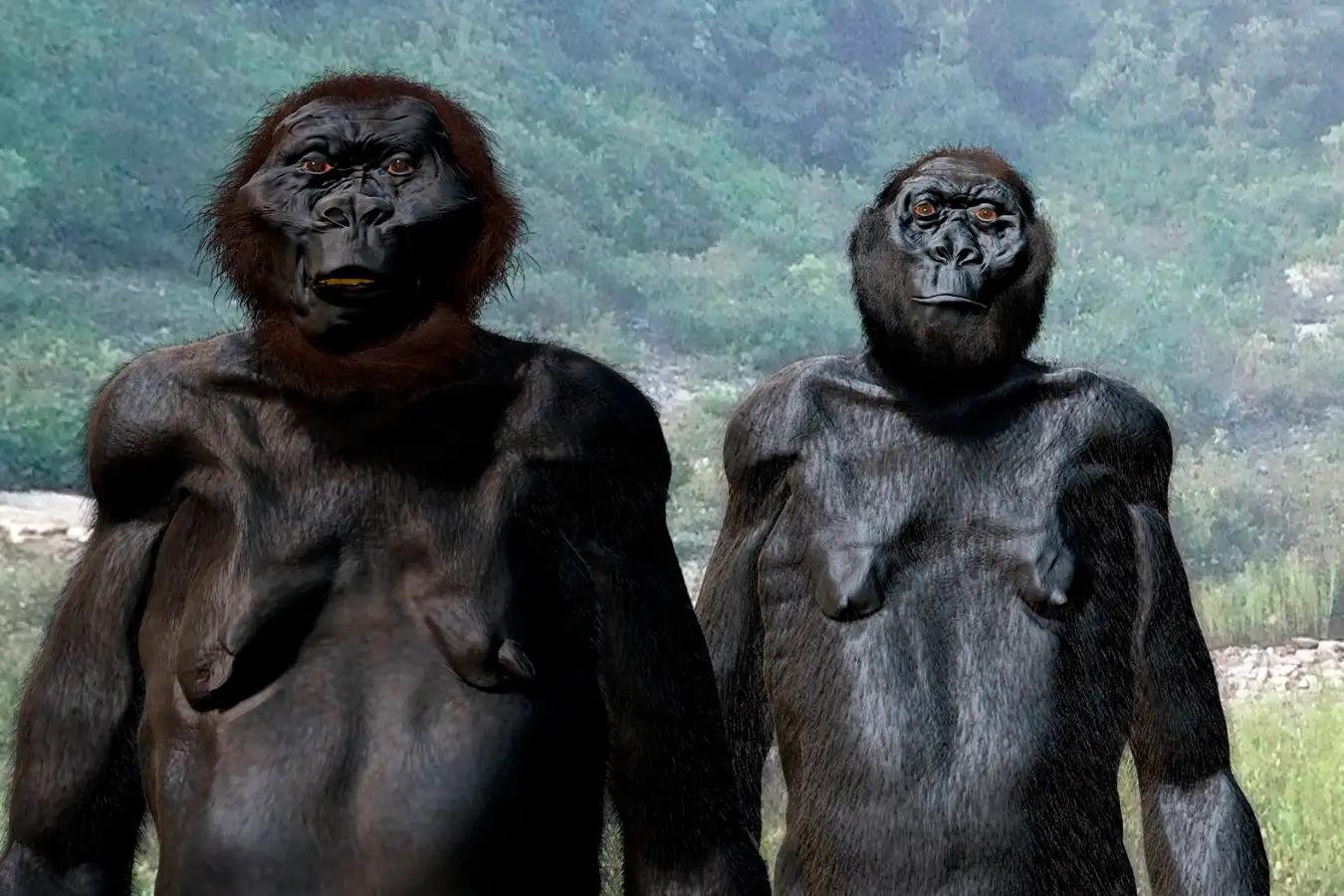
Illustration of Paranthropus hominins, which lived between 2.7 and 1.4 million years ago
JOHN BAVARO FINE ART/SCIENCE PHOTO LIBRARY
For the first time, the remains of ancient humans called Paranthropus have been found in the remote Afar region of Ethiopia. The discovery dramatically expands the area over which Paranthropus roamed, and suggests they lived in a wide range of ecosystems.
Paranthropus remains are known from eastern and southern Africa, between 2.7 and 1.4 million years ago. They are thought to be closely related to Homo, the group that includes modern humans and Neanderthals. They may have evolved from earlier hominins called Australopithecus.
Zeresenay Alemseged at the University of Chicago in Illinois and his colleagues have been excavating a site called Mille-Logya, in the Afar depression in north-east Ethiopia, since 2012. The Afar is a treasure trove of hominin remains, including many Homo and Australopithecus remains. “Paranthropus had been eluding us,” he says. “We had pretty much concluded that it had never made it that far north.”
On 19 January 2019, Alemseged’s local assistant brought him a part of a lower jawbone, with no teeth. “The first thing that struck me was its size,” says Alemseged. That same day, the team also found the crown of a left lower molar tooth.
A CT scan confirmed telltale Paranthropus traits: not just the size of the jawbone but the proportion of width to height, and the complexity of the tooth roots hidden inside the jaw. The team couldn’t tell which of the three recognised species of Paranthropus the bones belong to, but based on the location it is likely to be Paranthropus aethiopicus or Paranthropus boisei.
The jawbone is about 2.6 million years old, the team says, based on multiple dating methods. That makes it one of the oldest Paranthropus known.
“There’s no question that it’s Paranthropus,” says Carrie Mongle at Stony Brook University, New York, who wasn’t involved in the research. “I don’t think there’s any question about the date.”

The fragments of the Paranthropus mandible after being assembled in the field
Alemseged Research Group/University of Chicago
Previously, the northernmost Paranthropus specimen was a skull from Konso in southern Ethiopia. The new specimen is over 1000 kilometres further north.
“The main point is that it expands the geographic range of Paranthropus,” says Mongle.
For Alemseged, the new specimen is also evidence of greater versatility. Paranthropus’s large jaws and teeth have long been interpreted as evidence of a tough, chewy diet. While we don’t yet know what the Mille-Logya Paranthropus ate, the area seems to have been relatively open, whereas other early specimens of Paranthropus were found in wooded areas.
“Yes, they were specialised,” says Alemseged, “[but] I think we might have inflated our understanding of that specialisation.” Their specialised bodies don’t seem to have stopped them living in both wooded and grassy areas. “Different Paranthropus populations were able to exploit different habitats based on where they lived, like Homo did, like Australopithecus did.”
Mongle says there was already evidence of Paranthropus succeeding in new environments, because they adapted to the expansion of grasslands across east Africa, opting to eat more grasses. The new Mille-Logya specimen adds to the evidence of their versatility.
In recent years, evidence has emerged that Paranthropus could use, and perhaps also make, simple stone tools. For instance, stone tools described in 2023 from Kenya were found associated with Paranthropus teeth and no other hominin remains. In 2025, Mongle helped describe the first Paranthropus hand, which proved to be highly dextrous.
That makes sense, says Alemseged, because there is growing evidence that Australopithecus could make and use tools, and they existed before Paranthropus. Tool use may well go back to the ancestor we share with chimpanzees, he says.

Discovery Tours: Archaeology and palaeontology
New Scientist regularly reports on the many amazing sites worldwide, that have changed the way we think about the dawn of species and civilisations. Why not visit them yourself?
Topics:
- human evolution/
- ancient humans
Source link : https://www.newscientist.com/article/2512373-ape-like-hominin-paranthropus-was-more-adaptable-than-we-thought/?utm_campaign=RSS%7CNSNS&utm_source=NSNS&utm_medium=RSS&utm_content=home
Author :
Publish date : 2026-01-21 16:00:00
Copyright for syndicated content belongs to the linked Source.