
[ad_1]
- At 10 years, TAVR with the second-generation balloon-expandable Sapien XT was associated with higher mortality and aortic valve reintervention than surgery in the intermediate-risk PARTNER 2A trial.
- In a separate observational analysis, the third-generation Sapien 3 did not show these associations.
- Both studies were limited by initial plans to follow patients for 5 years, resulting in the need for patient re-consent and a vital status sweep.
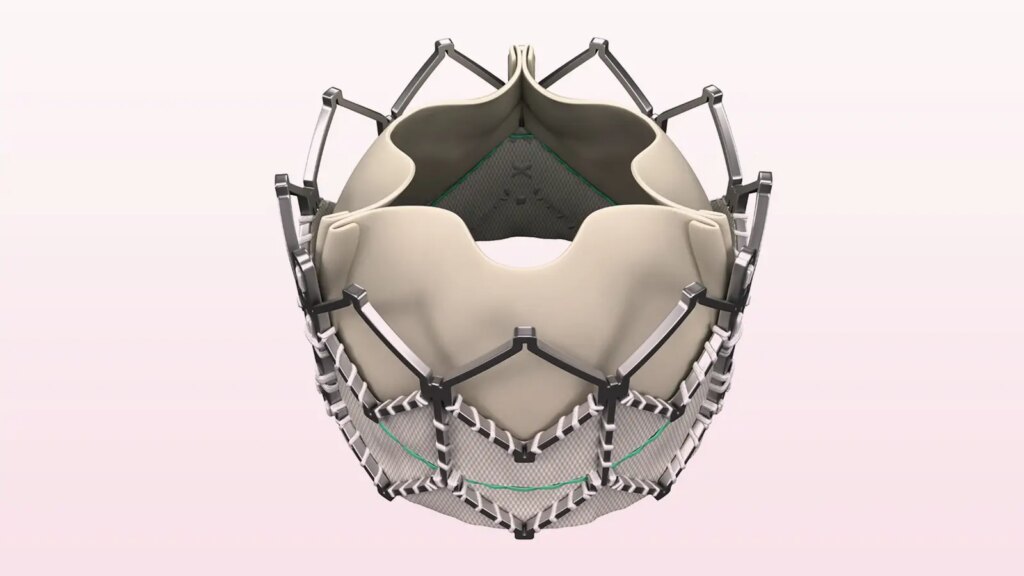
Ten-year results were disappointing for older-generation Sapien transcatheter aortic valve replacement (TAVR), with a newer iteration providing some reassurance on deaths and aortic valve reinterventions.
In the PARTNER 2A randomized trial, second-generation Sapien XT TAVR was compared against surgical aortic valve replacement (SAVR) among patients with severe, symptomatic aortic stenosis at intermediate surgical risk. By 10 years, all-cause mortality reached 86.1% with TAVR, significantly higher than the 82.8% with surgery (HR 1.13, 95% CI 1.02-1.25).
What’s more, the incidence of aortic valve reinterventions, accounting for the competing risk of death, reached 6.3% and 1.6% of TAVR and SAVR groups, respectively (P<0.001). Moderate or greater paravalvular regurgitation rates were 10.5% versus 0%, a numerical excess for the TAVR group, according to researchers led by Vinod Thourani, MD, of Piedmont Heart Institute in Atlanta.
“It is important to contextualize these 10-year findings. The elevated paravalvular regurgitation and reintervention rates likely reflect, at least in part, limitations of the Sapien XT device and the absence of routine CT-based sizing at the time of the study. Both aspects have evolved substantially in contemporary practice with current-generation THV [transcatheter heart valve] platforms and the adoption of systematic CT-based procedural planning. Likewise, transthoracic access routes used in this trial have been largely supplanted, and associated outcomes should be interpreted as reflecting an earlier era of TAVR practice,” study authors argued.
Meanwhile, results were more reassuring for the third-generation Sapien. An observational analysis of Sapien 3 TAVR versus SAVR, based on comparisons of PARTNER 2 registry participants and matched controls from PARTNER 2A, yielded no differences in survival and aortic valve reinterventions at 10 years for people at intermediate surgical risk.
The two reports were published together in the Journal of the American College of Cardiology.
The Evolution of TAVR
“Read together, these reports show that there is no single ’10-year TAVR result.’ Long-term outcomes are shaped by the index procedure: valve generation, access strategy, preprocedural CT planning, implantation technique, and the amount of residual valve dysfunction carried forward from the index procedure,” according to an editor’s note by Aakriti Gupta, MD, MSc, of Cedars-Sinai Medical Center in Los Angeles.
Indeed, there was a major gap in technology between the two studies. The PARTNER 2A trial had started enrolling in 2011, and the PARTNER 2 registry in 2014. To go from the Sapien XT to the Sapien 3, the balloon-expandable device had undergone design improvements, and operators learned to be more fastidious regarding patient screening and valve sizing, among other changes.
The payoffs were evident in the observational PARTNER 2 results.
Ten-year all-cause mortality rates were a comparable 83.4% for TAVR and 82.3% for surgery (HR 1.01, 95% CI 0.91-1.13), and aortic valve reintervention reached 2.0% versus 1.9%, respectively, upon adjustment for competing mortality (P=0.47), according to Tamim Nazif, MD, of Columbia University Irving Medical Center in New York City, and co-authors.
Better long-term results can also be expected given that the growing TAVR field has already progressed to yet-newer devices (e.g., Sapien 3 Ultra and Ultra Resilia).
“The anticipated 10-year results of the PARTNER 3 trial will ultimately demonstrate whether the observed improvements in clinical outcomes with [Sapien 3] are maintained in a younger, lower-risk patient population and reflect improved valve durability,” Nazif and colleagues wrote.
In the end, however, there is an inherent limit to how much further TAVR can be taken, cautioned Michael Borger, MD, PhD, of Leipzig Heart Center in Germany, who explained that TAVR techniques retaining the calcified native aortic valve cusps and more extensively manipulating the prosthetic valve leaflets do not bode well for long-term valvular performance.
“Have we therefore reached the inherent limits of transcatheter management of [aortic stenosis] in lower-risk patients? Or will technologic advances continue to push TAVR into the ever-shrinking SAVR patient population? Only time will tell,” Borger concluded in an editorial.
PARTNER 2A and 2 Study Details
PARTNER 2A was a randomized trial that enrolled patients at 57 centers to TAVR or SAVR. There were 1,910 people randomized (mean age 81.6 years, 45.4% women, mean Society of Thoracic Surgeons [STS] score 5.8%).
In this trial, the difference in deaths hinged by access route, with transfemoral (TF)-access TAVR associated with similar mortality as SAVR (83.9% vs 82.1%, P=0.27) and transapical/transaortic (TA/TAo) TAVR showing a significant mortality disadvantage (93.2% vs 85.1%, P<0.01; P=0.03 for interaction).
“The higher mortality observed with TA/TAo TAVR likely reflects both patient selection and procedural factors. Patients requiring TA/TAo access represent a distinct clinical phenotype, as these patients are typically selected because of unfavorable iliofemoral anatomy or advanced peripheral vascular disease, which is associated with a greater burden of systemic atherosclerotic disease and cardiovascular comorbidity. In addition, TAVR via TA or TAo requires more invasive approaches, thereby potentially attenuating some of the minimally invasive advantages of TF TAVR relative to surgery,” wrote Thourani’s team.
“Currently, about 95% of TAVR procedures in the United States are performed via TF access, and alternative access approaches, including transcaval, transaxillary, and transcarotid, have largely supplanted TA/TAo TAVR,” the PARTNER 2A investigators continued.
Of the 24 TAVR and 35 SAVR patients with available echocardiographic data at 10 years, mean gradients were 12.6 mm Hg and 12.7 mm Hg, respectively, at 10 years.
Thourani’s team emphasized that the PARTNER 2A program had been designed for 5-year follow-up, and there were challenges trying to get the 10-year data. Patient re-consent was required beyond 5 years, hence 61.9% of TAVR patients and 54.1% of SAVR patients had data available for the all-cause mortality analysis.
Only after a vital status sweep did the investigators gather mortality data for about 90% of the PARTNER 2A cohort. Even so, this approach left the door open for possible bias for the 10-year report, study authors acknowledged.
Separately, the PARTNER 2 single-arm registry included 1,069 TAVR recipients via TF or TA/TAo access. This group was compared with 936 people of the surgical arm of the PARTNER 2A trial; propensity score matching created well-matched groups of 783 individuals each at baseline (mean age 82 years, 43% women, mean STS score 5.5%).
Among 32 TAVR and 30 SAVR patients with available echocardiographic data at 10 years, mean gradients were 11.0 mm Hg and 12.6 mm Hg, respectively, in this study.
At 10-year follow-up here, there were 59.8% of TAVR and 53.6% of surgical patients with a known vital status for all-cause mortality analysis. A vital status sweep improved the completeness of mortality data to 88.5% and 89.8%, respectively, again with limitations.
“The 10-year PARTNER 2A results and the accompanying observational analysis, despite the challenges of long-term follow-up, represent an important contribution to the evidence informing the lifetime management of aortic stenosis and, at the same time, make the forthcoming longer-term outcomes of PARTNER 3 and Evolut Low Risk even more awaited,” wrote Davide Capodanno, MD, PhD, and Kamil Bujak, MD, PhD, both of Azienda Ospedaliero-Universitaria Policlinico “G. Rodolico-San Marco,” University of Catania in Italy, in their own editorial.
“They do not diminish the transformative impact of TAVR but serve as a timely reminder that durability remains a central consideration as the field enters its second decade,” Capodanno and Bujak continued.
Please enable JavaScript to view the comments powered by Disqus.
[ad_2]
Source link : https://www.medpagetoday.com/cardiology/interventionalcardiology/121783
Author :
Publish date : 2026-06-16 17:59:00
Copyright for syndicated content belongs to the linked Source.