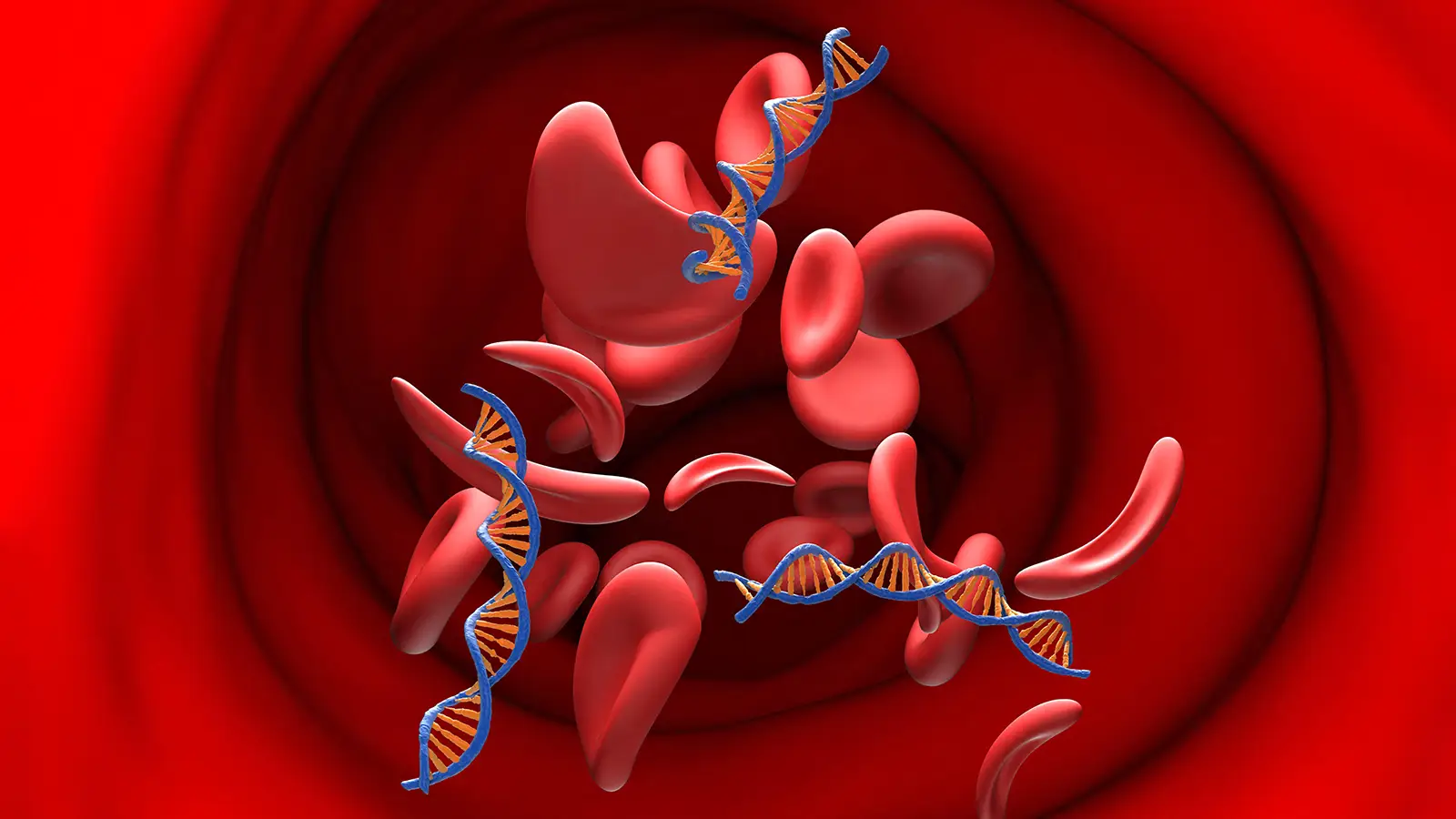
- In patients with sickle cell disease treated with ristoglogene autogetemcel, mean anti-sickling fetal hemoglobin levels were above 60% with a mean durable reduction in corresponding sickle hemoglobin below 40%.
- The median time to neutrophil and platelet engraftment was relatively short — 17.5 days and 19 days, respectively.
- No patients had an investigator-reported severe vaso-occlusive crisis after engraftment.
Treatment with the investigational base-editing gene therapy ristoglogene autogetemcel (risto-cel) showed promise in patients with sickle cell disease, according to an interim analysis of the phase I/II BEACON study.
Neutrophil and platelet engraftment occurred at a median of 17.5 and 19 days, respectively, and all 31 patients had at least one adverse event, with 27 experiencing an adverse event of grade 3 or higher and 12 having a serious adverse event (none considered related to risto-cel), reported Matthew M. Heeney, MD, of the Boston Children’s Cancer and Blood Disorders Center, and colleagues.
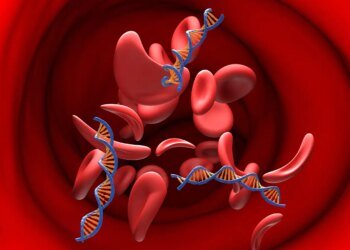
The mean fraction of on-target edited alleles in peripheral blood was 67.4%, the mean anti-sickling fetal hemoglobin (HbF) as a fraction of total hemoglobin was more than 60%, and the sickle hemoglobin (HbS) as a fraction of total hemoglobin was less than 40% at 6 months, and these levels were maintained throughout follow-up, they wrote in the New England Journal of Medicine.
The study’s ultimate primary efficacy endpoint is freedom from severe vaso-occlusive crises for at least 12 consecutive months, starting later than 60 days after the last red-cell transfusion, as adjudicated by the endpoint adjudication committee. In this interim analysis, none of the patients had an investigator-reported severe vaso-occlusive crisis after engraftment.
“To some extent, more non-sickling Hb is better, or really the converse, less sickling Hb is better,” Heeney told MedPage Today.
“Sickle trait — which is generally asymptomatic under normal physiological conditions — has about 55-60% HbA [hemoglobin A, the primary type of adult hemoglobin] and 40-45% HbS,” he explained. “We hope about 60% HbF and 40% HbS will be similar. Some may have concerns about too much HbF, but naturally occurring HPFH [hereditary persistence of fetal hemoglobin] with very high HbF levels does not appear to be deleterious.”
Regarding the rapid engraftment reported in the study, the researchers noted that this “has the potential to reduce the duration of hospitalization, limit transfusions, and hasten recovery from conditioning-related complications such as infection or mucositis, thereby enhancing safety and reducing the treatment burden on patients, families, and healthcare facilities.”
As described by Heeney and colleagues, unlike other gene therapy strategies, risto-cel introduces precise edits at the HBG1 and HBG2 promoter regions to inhibit BCL11A binding and promote the expression of anti-sickling fetal hemoglobin.
“This targeted approach preserves overall BCL11A expression, avoiding disruption of its broader biologic functions,” they pointed out.
Gene-editing strategies are designed to directly address the underlying genetic mutation responsible for the disease or induce the production of fetal hemoglobin.
This approach was endorsed by the FDA with the approval of exagamglogene autotemcel (exa-cel; Casgevy) — a CRISPR/Cas9 gene-edited therapy — for use in patients ages 12 and older with sickle cell disease and transfusion-dependent beta thalassemia.
Overall, results from BEACON and studies evaluating renizgamglogene autogedtemcel (reni-cel) affirmed the role of gene editing “as a potentially curative treatment for hemoglobinopathies,” wrote Franco Locatelli, MD, PhD, of IRCCS Bambino Gesù Children’s Hospital in Rome, in an accompanying editorial.
In the study evaluating reni-cel in sickle cell disease, the treatment led to normalization of the total hemoglobin level and an increase in the percentage of fetal hemoglobin, with no vaso-occlusive events occurring in 27 of 28 patients after infusion.
Results from BEACON — while preliminary — “may point to a therapeutic option for patients in the future,” Locatelli noted. However, in the case of reni-cel, its sponsor has reassessed the company’s clinical development priorities and has decided to discontinue the gene therapy.
“Thus, although the data reported [in the reni-cel studies] are notable with respect to safety and efficacy, the decision to terminate research on reni-cel eliminates one potential option for patients: these two studies therefore represent a kind of Pyrrhic victory,” he added.
Locatelli pointed out that ex vivo gene therapy is resource-intensive and ill-suited to treat large numbers of patients in countries with limited resources, where most patients with sickle cell disease and transfusion-dependent beta thalassemia live.
“Scientists and clinicians working in the field of hemoglobinopathies have a moral duty to invest energies to identify or validate strategies capable of offering curative gene-therapy options in a wider perspective,” he wrote. “Although in vivo gene-editing approaches are currently far from the patient bedside, their systemic delivery may one day be positioned to tackle this need.”
The phase I/II BEACON study enrolled patients ages 12 to 35 with sickle cell disease who had had at least four severe vaso-occlusive crises in the 2 years before enrollment. Mean age was 22.8, 52% were male, and 81% were Black.
After myeloablative conditioning with the administration of busulfan, patients received a single infusion of risto-cel. Patients were followed for a mean of 6.6 months.
One patient died from idiopathic pneumonia syndrome — “a known noninfectious inflammatory lung injury that can occur after [hematopoietic stem and progenitor cell] transplantation in the context of high-dose conditioning regimens, such as busulfan,” Heeney and colleagues noted. No patients had engraftment failure or cancer.
They acknowledged that the current analysis was limited by the short duration of follow-up.
Source link : https://www.medpagetoday.com/hematologyoncology/hematology/120603
Author :
Publish date : 2026-04-01 21:00:00
Copyright for syndicated content belongs to the linked Source.