
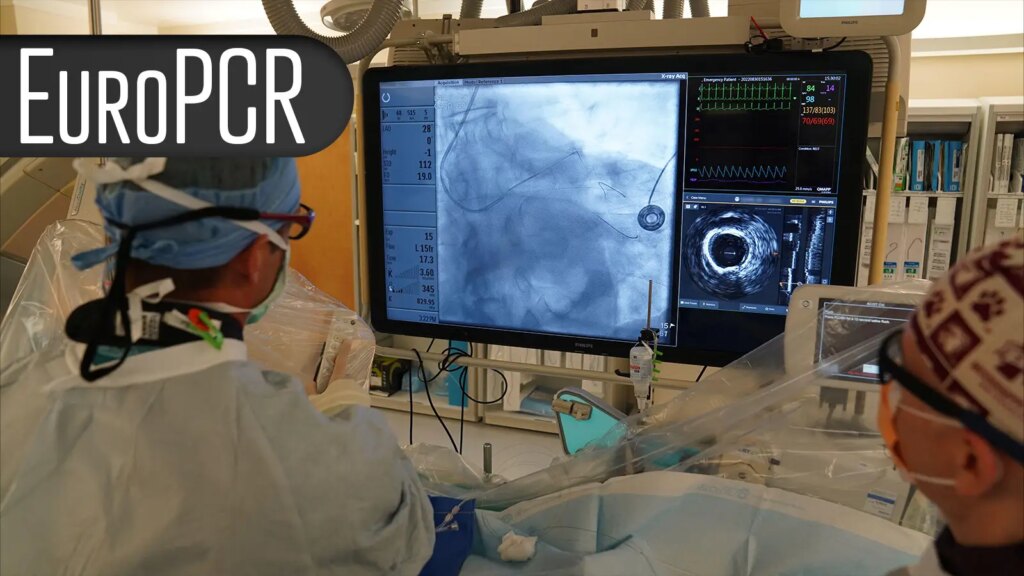
A major complication of transcatheter mitral valve replacement (TMVR) could be prevented using a newer percutaneous leaflet modification technique, according to registry data.
Early adopters of the so-called “BATMAN” (balloon-assisted translocation of the mitral anterior leaflet to prevent outflow tract obstruction) technique achieved successful TMVR without left ventricular outflow tract (LVOT) obstruction and procedural death in 95.1% of cases, reported Gennaro Giustino, MD, of Gagnon Cardiovascular Institute in Morristown, New Jersey.
The primary safety endpoint — an in-hospital composite of death, stroke, or major cardiac structural complications — occurred in 7.3% of patients, he noted at the EuroPCR meeting held annually in Paris.
“BATMAN was associated with high technical success, effectiveness in preventing LVOT obstruction, and appeared to be safe in ViR [valve-in-ring] and ViV [valve-in-valve] procedures,” Giustino and co-authors wrote in JACC: Cardiovascular Interventions, where the study was published.
LVOT obstruction has long posed a major hurdle for the field of TMVR, a less invasive operation for patients with failed surgical valves, rings, or severe mitral annular calcification (MAC) not suitable for mitral valve surgery. Risk of LVOT obstruction is one reason for the notoriously high screen failure rates for TMVR candidates, hence the great interest in a dedicated device for leaflet laceration and valve technology that would allow broader anatomical suitability for patients.
Meanwhile, several percutaneous techniques have been developed to prevent LVOT obstruction with the current technology, albeit with high procedural complexity, long procedural times, and inconsistent effectiveness, the researchers noted.
BATMAN is one emerging technique to modify the anterior mitral leaflet (AML) to prevent LVOT obstruction. The transseptal BATMAN technique can be done via antegrade and retrograde approaches. In both cases, the AML is traversed using a radiofrequency or electrified wire, then serial balloon inflation is performed to accomplish complete laceration or allow heart valve implantation.
Speed is one of the attractions of this technique; indeed, the same wire used for AML modification is also used for transcatheter heart valve implantation, minimizing the number of catheter and wire exchanges. In this study, BATMAN-TMVR was associated with short procedure times, with a median time from initial leaflet traversal to first valve implantation of 26 minutes and a total fluoroscopic time of 42 minutes.
Of note, Giustino reported that even with BATMAN, valve-in-MAC (ViMAC) TMVR was associated with lower success rates (85% vs 100% for ViR and 96% for ViV, P=0.04) and a higher safety composite endpoint rate (21% vs 0% and 8%, respectively, P=0.02). There was one major cardiac structural complication directly attributed to BATMAN in a ViMAC patient.
The four patients in which the primary efficacy endpoint was not met due to complications of TMVR were in the ViV (one left atrial laceration during delivery of the valve) and ViMAC groups (one apical left ventricular wire-induced perforation, one valve embolization, and a laceration of the aorto-mitral curtain directly attributed to BATMAN).
Ultimately, BATMAN can be considered a complementary technique alongside the more established LAMPOON for leaflet modification during TMVR, Giustino said. In some situations, one would be safer, and in others, the two could be used interchangeably, he explained.
“An advantage of LAMPOON over BATMAN is that in its simplified version of tip-to-base LAMPOON the leaflet modification is accomplished … without the need of traversing the base. Drawbacks of this technique is that it may result in damage of the aorto-mitral curtain and the aortic valve and therefore it should not be used in patients without a protected mitral annulus,” the researchers wrote.
Meanwhile, “it would be advisable to reserve [BATMAN] only in presence of a protected mitral annulus (e.g., ViV, ViR cases with complete annuloplasty rings, or ViMAC with significant anterior annular calcification),” they added.
In any case, it remains difficult to predict how a given valve is going to sit in the mitral position. “We need to get better at predicting LVOT geometry after TMVR,” Giustino noted.
This cohort study included 83 consecutive patients from 2023 to 2026 who were undergoing transseptal BATMAN-TMVR and were at high risk of LVOT obstruction based on a predicted neo-LVOT area of <200 mm2 on preoperative cardiac CT or the presence of a long AML (≥25 mm).
Median age was 77 years, and 66.3% were women. The median Society of Thoracic Surgeons (STS) score was 8.8% for mortality; 88% were in New York Heart Association class III or IV. The cohort represented a mix of moderate-to-severe or severe mitral regurgitation (54.8%) and severe mitral stenosis (48.2%).
TMVR involved the balloon-expandable Sapien 3 or MyVal devices. The decision to perform AML modification was left to the TMVR operator’s discretion, as were decisions regarding the use of cerebral embolic protection (56.6%) and preemptive mechanical cardiocirculatory support (28.9%), as well as preemptive alcohol septal ablation (18.1%).
Successful AML traversal and intra-leaflet balloon-assisted laceration was achieved in all but one case (98.8%). The one exception was a ViV BATMAN-TMVR that converted to tip-to-base LAMPOON, which in turn resulted in aortic valve leaflet damage and severe aortic regurgitation requiring transcatheter aortic valve replacement.
Please enable JavaScript to view the comments powered by Disqus.
Source link : https://www.medpagetoday.com/meetingcoverage/europcr/121370
Author :
Publish date : 2026-05-20 16:44:00
Copyright for syndicated content belongs to the linked Source.