
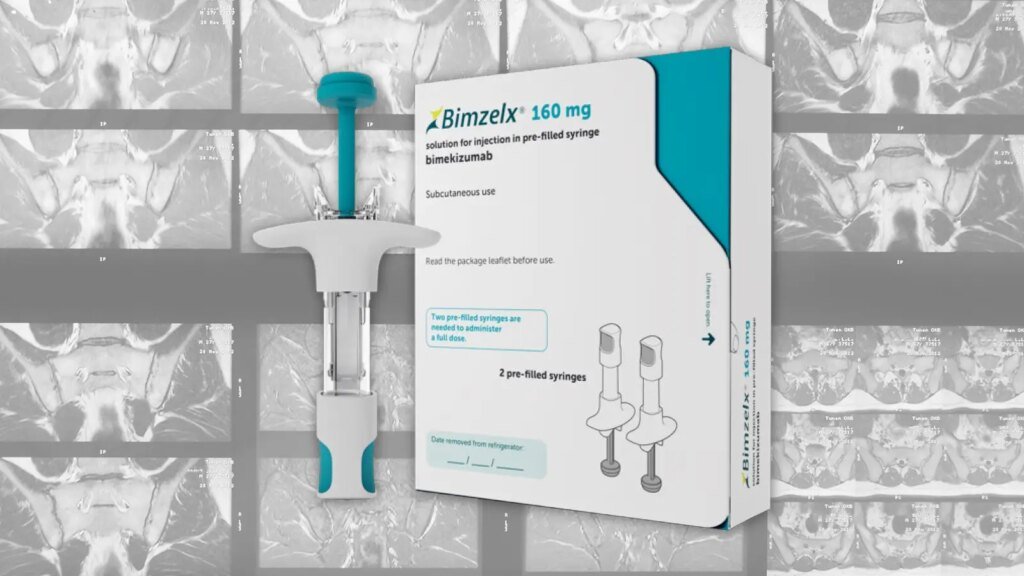
- Bimekizumab (Bimzelx) is approved for psoriasis, spondyloarthritis (SpA), psoriatic arthritis (PsA), and hidradenitis suppurativa, but has not been on the U.S. market very long.
- Safety data for conditions other than plaque psoriasis thus far have come from 1-year follow-up in the drug’s clinical studies; this study pooled longer-term data from open-label extensions in SpA and PsA.
- Treatment-emergent adverse event rates were consistent with shorter-term data and no new concerns were seen.
Adverse effects from bimekizumab (Bimzelx) through 2 years or more of treatment for psoriatic arthritis (PsA) and axial spondyloarthritis (axSpA) were about as expected from shorter-term data, results from long-term extension studies indicated.
Rates of all treatment-emergent adverse events (TEAEs) were 126.9 per 100 patient-years of treatment among the 1,409 participants with PsA and 129.6 per 100 patient-years for the 848 axSpA patients, according to Philip Mease, MD, of the University of Washington in Seattle, and colleagues.
But events of significant concern were much less common, the group reported in RMD Open. For example, oral candidiasis occurred at rates of 3.8 and 3.5 per 100 patient-years in the PsA and axSpA groups, respectively. Only a few of these were severe and discontinuations on account of them were uncommon (0.3 and 0.2 per 100 patient-years), Mease and colleagues noted.
Serious opportunistic infections were even rarer. There were none in the axSpA participants and just two among those with PsA. And no cases of active tuberculosis developed in either group.
As well, rates of new-onset cancers and major cardiovascular events were less than 1 per 100 patient-years and unremarkable for patients with rheumatologic diseases.
“The overall safety profile of bimekizumab was consistent with previously reported data in axSpA, PsA, psoriasis, and hidradenitis suppurativa,” the investigators wrote. “In combination with previously reported efficacy data, these results support a positive benefit-risk profile of bimekizumab for the treatment of axSpA and PsA.”
In the U.S., bimekizumab, an inhibitor of interleukin (IL)-17A/F, hasn’t been on the market very long — its first approval, for plaque psoriasis, came in late 2023 (although it won European authorization in 2021). Subsequent approvals for PsA and axSpA came about a year later. Thus, postmarketing data remain scant at this point, meaning that long-term safety data must come from follow-up of the drug’s clinical trial participants.
The more than 2,200 patients included in the new analysis were treated in two phase IIb studies and six phase III trials; four of these involved long-term, open-label extensions with up to 4 years of follow-up, and at least 2 years as of the study’s July 2025 cutoff.
Mease and colleagues were especially keen to examine incidence of fungal infections, as IL-17 is key to resisting them and thus could be a significant problem for patients receiving IL-17 inhibitors. They found overall rates of 8.4 per 100 patient-years in the axSpA group and 7.9 per 100 patient-years in PsA. Candida infections accounted for about half of these events, most occurring in the oral cavity. Infections with Tinea species were much less common (0.6-0.8 per 100 patient-years). Other unspecified fungal species were responsible for the remaining infections. Most fungal infections were mild to moderate, the researchers said.
Other events of interest included liver abnormalities, suicidal ideation and behavior, and new-onset inflammatory bowel disease (IBD). These came up earlier in the trials, resulting in warnings on bimekizumab’s label.
The new analysis won’t eliminate these concerns but they did appear to be infrequent at most. Elevations in alanine or aspartate aminotransferases above three times the upper limit of normal occurred at rates of 1.9-2.0 per 100 patient-years; for elevations above five times the upper limit of normal, rates were about two-thirds lower.
New IBD diagnoses (probable or definite) were seen in 0.7 per 100-patient-years in the axSpA group, and 0.2 per 100 patient-years in those with PsA.
There were no completed suicides in either group, and rates of suicidal ideation or attempts were almost vanishingly small: 0.12 per 100 patient-years in axSpA and 0.05 per 100 patient-years in PsA. “All individuals who experienced an adjudicated [event of this type] had a history of psychiatric disorders, ongoing traumatic and stressful circumstances, or other additional confounding factors,” the investigators wrote.
Across all TEAEs, the most common were COVID-19 infections, upper respiratory infections, and nasopharyngitis. Together these events occurred at rates of roughly 22-25 per 100 patient-years.
Going forward, Mease and colleagues indicated, “[i]t will be important to assess the safety profile across a more representative population of patients. Additionally, future research should consider the safety profile in subgroups of patients that may have higher risk of [adverse events],” such as those also receiving methotrexate, who may face increased risk of liver damage.
Please enable JavaScript to view the comments powered by Disqus.
Source link : https://www.medpagetoday.com/rheumatology/arthritis/120278
Author :
Publish date : 2026-03-12 18:33:00
Copyright for syndicated content belongs to the linked Source.