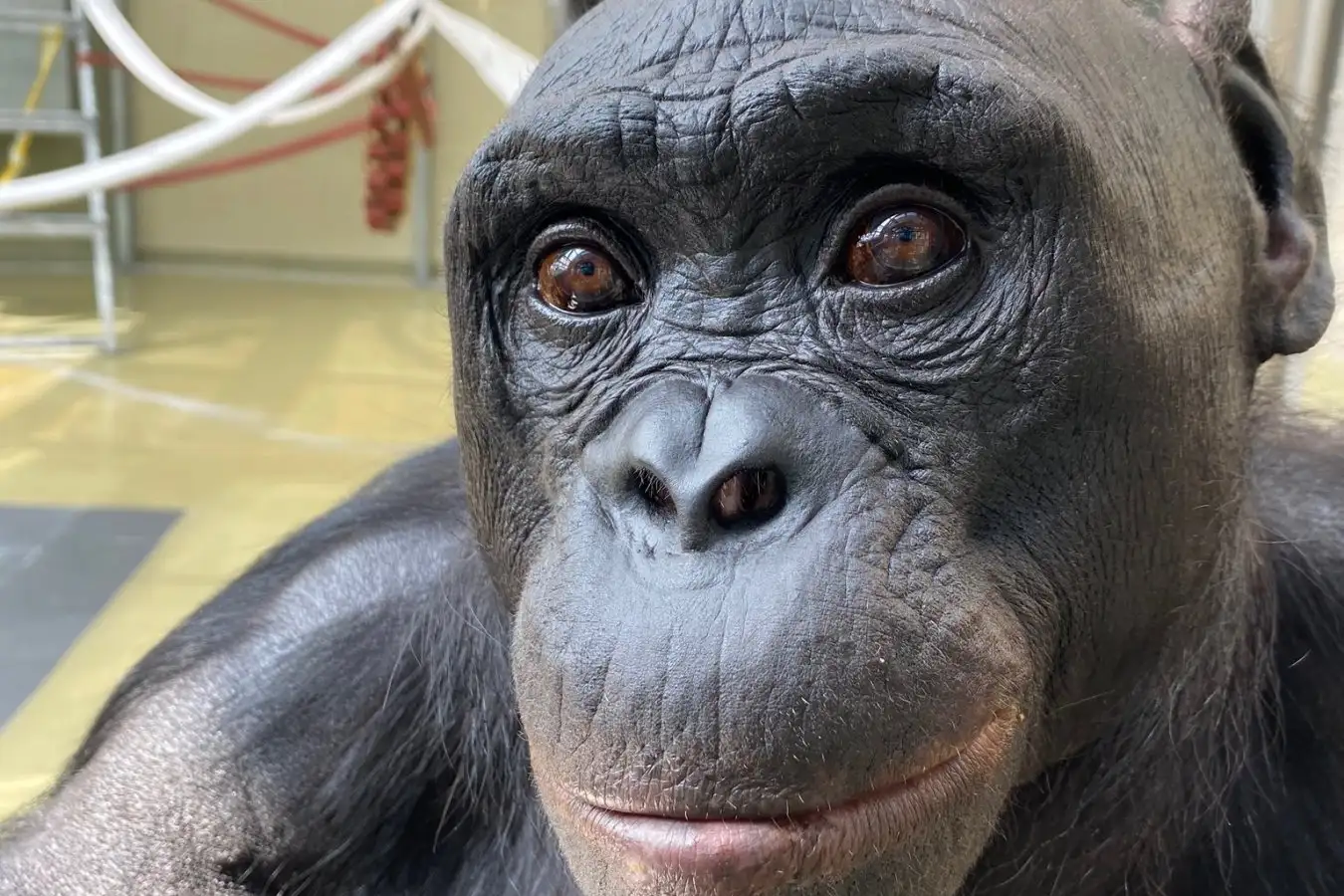
Kanzi the bonobo at the age of 43
Ape Initiative
A bonobo that took part in a pretend tea party like those acted out by young children has shown that our closest primate relatives have the capacity for make believe.
Kanzi the bonobo (Pan paniscus) was born in the US in 1980 and died at age 44 in March last year. He spent most of his life at the Ape Initiative in Des Moines, Iowa, where he was renowned for being able to communicate by pointing at symbols on a board.
In the year before he died, Amalia Bastos at the University of St Andrews, UK, and her colleagues ran a series of experiments aiming to understand whether, along with his superior language skills, Kanzi was also able to engage in what researchers describe as “secondary representations”. This is the ability to imagine an alternative reality and, in some situations, share that pretense with another individual – a skill that humans develop at an early age.
At 2 to 3 years old, children can follow the movement of imaginary liquid between containers and keep track of where the “tea” is or isn’t, says Bastos. “That’s exactly the sort of context we presented to Kanzi to test this ability in a non-human animal.”
In the first stage of the experiment, researchers pretended to pour non-existent juice into two empty cups before pretending to empty one of the cups and then asking Kanzi which one he wanted. More than two thirds of the time, Kanzi chose the cup that hadn’t been emptied and still contained the pretend juice.
“If Kanzi hadn’t conceived of ‘imaginary juice’ in the cups throughout the study, he should have picked between the two cups at chance – after all, they were both empty,” says Bastos.
Then the researchers placed an empty cup and one containing juice on a table in front of Kanzi. He chose the cup containing juice more than three quarters of the time. This test was to ensure the bonobo could differentiate between real and fake juice.
For the third test, the team started by placing a real grape into one of two cups; Kanzi selected the real grape every time. Then a pretend grape was placed in each of two cups before one was emptied. Again, in over two-thirds of attempts, Kanzi correctly chose the cup that still contained a pretend grape.
Bastos says all of the team’s studies with great apes are fully voluntary. “The fact that Kanzi stuck around and continued to engage even in trials where he knew there would be no reinforcement says to me that he must have at least enjoyed it a little bit.”
Gisela Kaplan at the University of New England in Armidale, Australia, says the experiment is “unambiguous that the bonobo has understood the pretense and is entering into the game”.
“This experiment is clean and simple and mimics child play with doll houses, kids serving cups of tea to each other in tiny cups and pretending to drink or offering pieces of cake that do not exist,” she says.
Miguel Llorente at the University of Girona, Spain, describes Kanzi as the “Einstein of his species” and he now wants to understand how and why such imaginative capabilities emerged in the first place.
“His lifelong exposure to symbolic language and human interaction has likely acted as a powerful cognitive scaffold, allowing him to externalise and sharpen mental tools that might remain latent in wild bonobos,” he says. “While Kanzi represents the cognitive ceiling of his species, his performance suggests that the raw biological hardware for imagination was already present in our common ancestor 6 to 9 million years ago.”
Topics:
Source link : https://www.newscientist.com/article/2514366-bonobos-pretend-tea-party-shows-capacity-for-imagination/?utm_campaign=RSS%7CNSNS&utm_source=NSNS&utm_medium=RSS&utm_content=home
Author :
Publish date : 2026-02-05 19:00:00
Copyright for syndicated content belongs to the linked Source.