


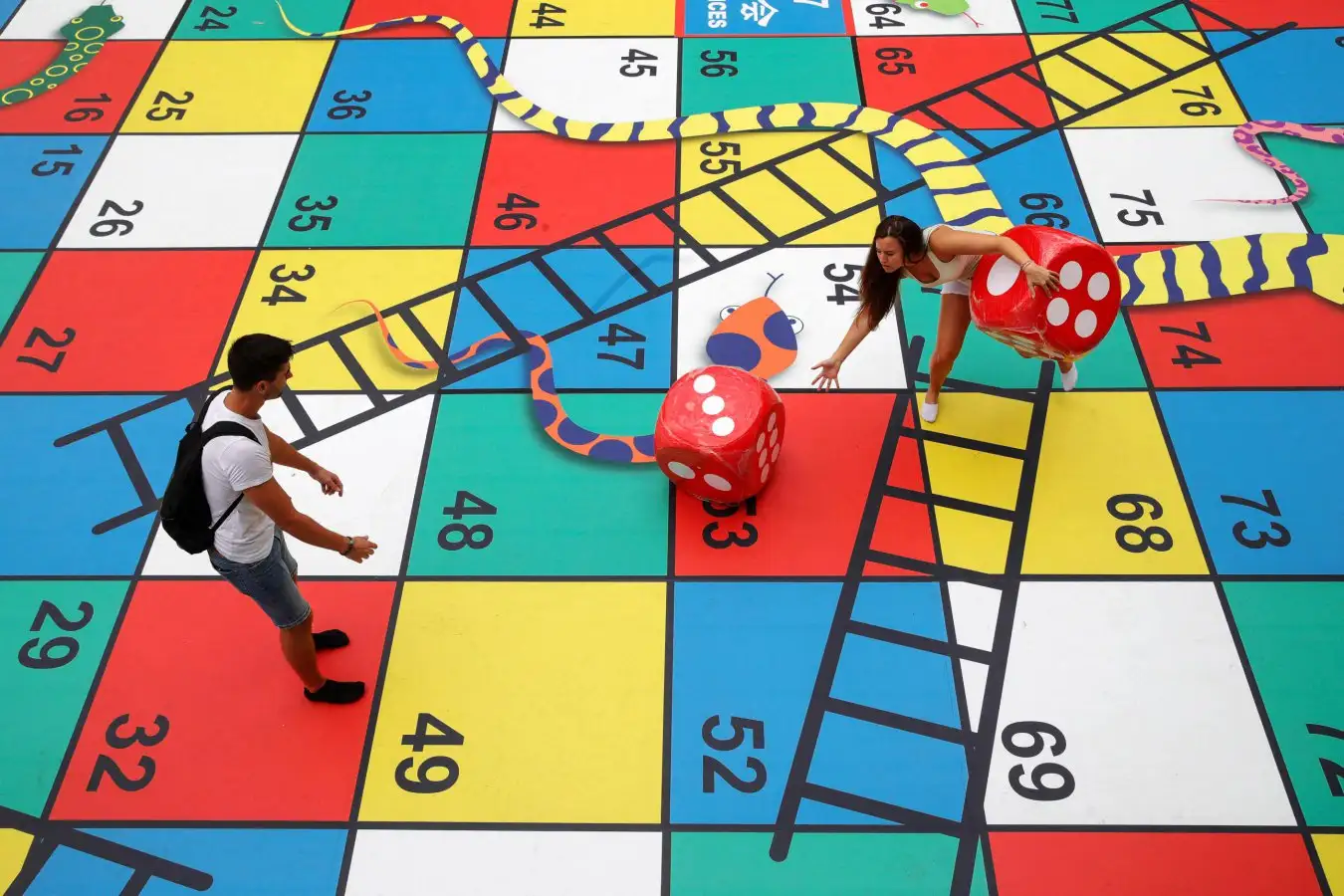
Does skill have any influence on the outcome when playing Snakes and Ladders?
Sipa US/Alamy
Have you ever played snakes and ladders (also known as Chutes and Ladders)? Are you sure?
This game has its origins in ancient Indian games in which players roll dice to progress across a board of squares, such as Pachisi. While Pachisi mixes luck and skill, early forms of snakes and ladders used pure chance to teach players a spiritual lesson about accepting their fate. Players climbed the board, liberating the soul from earthly desires to reach the goal of spiritual enlightenment, with versions associated with Hindu, Jain and Sufi philosophies. On the way, they might exhibit virtues, shown as ladders lifting them to a higher position, but must avoid vices, represented by snakes.
The game travelled with families returning from the British Raj to the UK. From 1892, UK versions appeared with more simplistic morals and lacking the spiritual journey. Over time, the moral lessons vanished and just the snakes and ladders remained.
I would define playing a game as having a role in making decisions that affect the outcome. In games like snakes and ladders, where you don’t make choices, you aren’t really playing a game. If you left the room and someone took your turn while you were gone, would the outcome be any different?
Gameplay involving pure chance can be studied using probability theory. A Markov chain is a model where each step in a sequence is determined by the probabilities of moving to it from the previous steps. For snakes and ladders, we can work out the probabilities of landing on various spaces after a dice roll (taking account of any ladders or snakes). From each of those positions, we can find the probabilities after a second roll, and so on. Doing this across the whole board, we can obtain the likely positions of a player after a given number of rolls, the expected length of the game and other statistics. Markov chains have applications across almost all areas of applied maths, including thermodynamics and population modelling.
Some games, such as chess, involve no chance at all. Many sit in between, combining elements of chance and skill, and their exact balance might affect how invested you feel in the gameplay. This may be why some people prefer a game like Catan, in which you decide how to use resources allocated by chance, to Monopoly, where you only occasionally make decisions.
For older children who are bored of snakes and ladders, try this twist: after rolling, decide whether to move the number of spaces shown up or down the board. This simple change makes you a much more active player, boosting engagement.
When you next play a new board game, see whether you are making decisions that affect the outcome. If not, perhaps leave the game to a Markov chain and try switching to one that actually involves you.
These articles are posted each week at
newscientist.com/maker
Peter Rowlett is a mathematics lecturer, podcaster and author based at Sheffield Hallam University in the UK. Follow him @peterrowlett
Topics:
Source link : https://www.newscientist.com/article/mg26935801-100-bored-of-snakes-and-ladders-some-maths-can-help-bring-back-the-fun/?utm_campaign=RSS%7CNSNS&utm_source=NSNS&utm_medium=RSS&utm_content=home
Author :
Publish date : 2026-01-28 18:00:00
Copyright for syndicated content belongs to the linked Source.