[ad_1]
- Older adults who ate the most ultraprocessed foods had a high risk of cognitive impairment, a large longitudinal study showed.
- A high intake of minimally processed foods was associated with a lower risk of cognitive impairment.
- The study was observational and diet was self-reported, but the findings were consistent with other research about ultraprocessed foods and brain health.
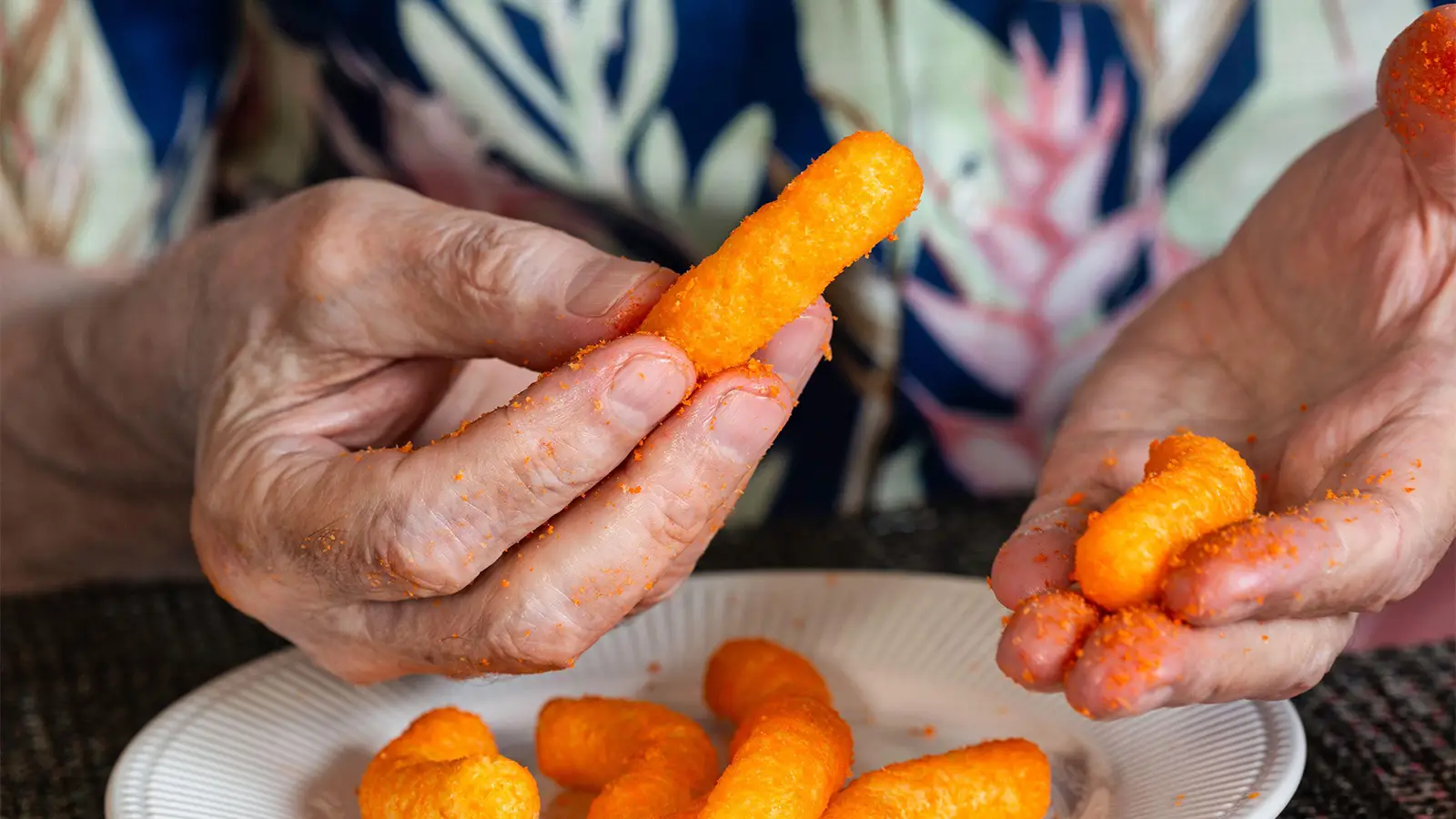
People who consumed the most ultraprocessed foods — sugar-sweetened drinks, packaged snacks, or processed meats, for example — were more likely to develop a composite outcome of dementia or cognitive impairment compared with those who ate the least, a large longitudinal study of older U.S. adults showed.
Compared with the lowest quintile of ultraprocessed food consumption, those who ate the most ultraprocessed foods were 58% more likely to develop dementia (HR 1.58, 95% CI 1.00-2.48) over nearly 9 years, although the linear trend across quintiles was not significant, reported Heejin Lee, PhD, of the Harvard T.H. Chan School of Public Health in Boston, and co-authors.
People who ate the most ultraprocessed foods were 46% more likely to have incident mild cognitive impairment (HR 1.46, 95% CI 1.13-1.88, P for trend=0.03), and 47% more likely to develop either one of those outcomes (HR 1.47, 95% CI 1.16-1.87, P for trend=0.02), Lee and colleagues reported in the American Journal of Public Health.
“We already know that ultraprocessed food intake is associated with increased risks for cardiovascular disease, diabetes, cancers, and obesity. Our study adds that ultraprocessed food consumption matters for brain health, and specifically that the rise of ultraprocessed foods in the American diet may contribute to cognitive decline as we age,” co-author Cindy Leung, ScD, MPH, also of the Chan School of Public Health, said on a press call.
The analysis was observational and diet was self-reported, Leung noted. “We cannot say that ultraprocessed foods cause these outcomes. However, our study does add a strong association to this growing body of work,” she said. “It’s biologically plausible, and it fits with what we know about ultraprocessed foods and chronic disease risk,” she observed.
“The good news is that we found the opposite effect with minimally processed whole foods,” Leung pointed out. “In our study, those older Americans who ate the most minimally processed foods — like fruits and vegetables, whole grains, and unprocessed meats — had a 41% lower risk of developing dementia, 24% lower risk of developing mild cognitive impairment, and 26% lower risk of either of those outcomes.”
The paper was one of more than a dozen on ultraprocessed foods published in a special issue of the American Journal of Public Health. Among them was research led by Jeff Niederdeppe, PhD, of Cornell University in Ithaca, New York, that showed support for efforts to reduce ultraprocessed foods based on a survey of 2,000 Americans. “Ultraprocessed foods have entered public consciousness as a major health hazard,” Niederdeppe said.
“The convergence of public belief, bipartisan support, and scientific evidence creates a critical window for policy action,” he added. “Americans appear ready for stronger safeguards and holding the food industry accountable, ranging from additive testing to marketing restrictions.”
In their analysis, Lee and colleagues followed 5,370 Health and Retirement Study (HRS) participants. The researchers assessed ultraprocessed food intake with a semiquantitative food frequency questionnaire from the 2013 HRS Health Care and Nutrition Study and classified cognitive impairment outcomes based on test results from biennial assessments until 2020. Mean baseline age was 64.5 years; 55.2% of participants were women, and 81.7% were white.
Ultraprocessed food classifications followed the Nova system. On average, ultraprocessed foods (Nova 4) made up 21.5% of participants’ total food intake by weight, while minimally processed foods (Nova 1) accounted for 71.8%. The biggest sources of ultraprocessed foods were sugar-sweetened beverages (31.2%), followed by other beverages (22.2%), dairy products (11.2%), snacks and sweets (9.7%), and grains and grain-based products (6.2%).
Over a median follow-up of 8.7 years, 266 new cases of dementia and 1,191 cases of cognitive impairment with no dementia (mild cognitive impairment) emerged. Relationships between ultraprocessed foods and cognitive outcomes were adjusted for demographic data, lifestyle factors, and baseline chronic disease history.
The findings supported earlier work, including a study from Australia that questioned whether food processing itself might influence brain health and research from the U.K. Biobank that suggested swapping ultraprocessed for unprocessed or minimally processed food may lower dementia risk.
“There is a reason why ultraprocessed foods dominate our food environment. Telling older adults to just eat better ignores the reality of what their food environment could look like, particularly for those who are socially isolated, who are food insecure, who have fixed incomes,” Leung noted.
“We don’t have a cure for dementia, but if we can pinpoint a structural factor that contributes to the rise in dementia that we’ve seen in the United States and we can do something to change that, then we absolutely should,” she said.
[ad_2]
Source link : https://www.medpagetoday.com/neurology/dementia/121610
Author :
Publish date : 2026-06-04 21:16:00
Copyright for syndicated content belongs to the linked Source.