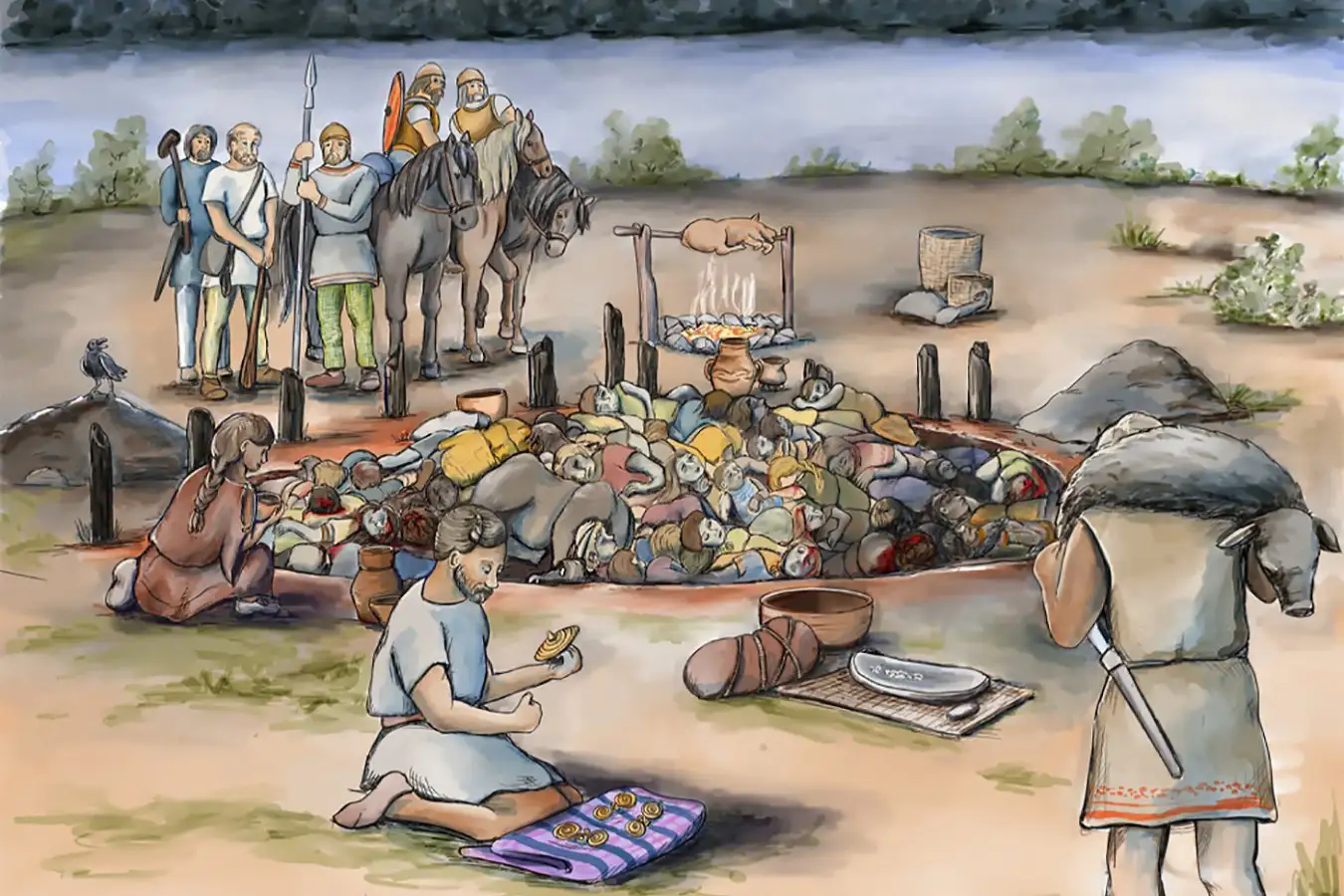
Illustration of the Iron Age mass grave at Gomolava
Sara Nylund
Women and children may have been deliberately targeted in one of the largest prehistoric mass killings discovered in Europe. Buried together in one grave more than 2800 years ago, most of the 77 victims suffered violent deaths in what seems to have been an intentional act.
The mass grave was found at Gomolava, an early Iron Age site in the Carpathian basin in what is now Serbia. The place is an artificial mound known as a tell, formed by the accumulation of debris from thousands of years of human habitation from the late 6th millennium BC, including collapsed mud-brick structures, pottery and organic material.
Linda Fibiger at the University of Edinburgh, UK, and her colleagues have looked at the bones from the grave, stored at the Museum of Vojvodina in Novi Sad, Serbia, and gathered evidence from DNA and isotopes to investigate what happened.
Of the 77 individuals, 51 were children and adolescents. Biological sex could be determined for 72 individuals, and 51 of these were female.
A 1976 analysis of the bones had attributed the deaths to a pandemic, but the new skeletal analysis found unhealed injuries consistent with violence, as well as evidence for defensive wounds and some injuries from projectiles.
“A lot of the injuries are to the head and most seem to be close-contact injuries. The size of the injuries speaks of uninhibited force, so intentional killing, not accidental killing,” says Fibiger. “I think it was quite a brutal event.”
The team analysed DNA from the bones of 25 individuals and looked at the ratios of isotopes of strontium, oxygen and carbon in the dental enamel of 24 people, which can be used to reconstruct environmental conditions in childhood. This showed that most sampled individuals weren’t closely related to one another and had different diets when young.
“Most weren’t even related going back 12 generations,” says team member Barry Molloy at University College Dublin in Ireland. He suggests the people were part of a widespread society who would have shared common cultural practices, but who weren’t necessarily pairing up with people from the other groups.
The massacre took place in the 9th century BC at a time when mobile pastoralists who used lands seasonally had come from the Eurasian steppe on the other side of the Carpathian mountains. At the same time, people in the area were reoccupying old tell sites, establishing enclosed settlements and farming the lands around, says Molloy.
“You’ve got these two conflicting ways of using landscape,” he says, adding that staking claims over land may have sparked conflict between groups and displaced people from their homes.
“That it was women and children suggests to us that something quite different was happening here from our usual reading of violent warfare. It’s normally focused on the battlefield,” says Molloy.
The perpetrators could have taken younger children away as slaves, he says, so killing them instead may have been intended to send a message to nearby peoples to subdue resistance and assert dominance over the land.
“It is difficult to interpret the massacre,” says Pere Gelabert at the University of Vienna in Austria. “The Iron Age was a period of extreme instability across Europe, a period of multiple armed conflicts, or wars as we would call them nowadays.” The mass grave could have resulted from a ritualistic massacre in which women and children were selected to be killed, or it could be that only these people died because the men were elsewhere, he says.
However, the story gets more complicated because the bodies were buried alongside personal possessions, such as bronze jewellery and ceramic vessels for drinking and storing food. The remains of animals, including a butchered calf, were also interred with them, and broken stones for grinding grain and burnt seeds were placed on the grave. “It’s the entire food cycle, all deposited alongside them,” says Molloy.
This suggests the burial was careful and symbolic. The killers and those giving the funeral rites may have been different groups, says Molloy.
Topics:
Source link : https://www.newscientist.com/article/2516527-brutal-iron-age-massacre-may-have-targeted-women-and-children/?utm_campaign=RSS%7CNSNS&utm_source=NSNS&utm_medium=RSS&utm_content=home
Author :
Publish date : 2026-02-23 16:00:00
Copyright for syndicated content belongs to the linked Source.