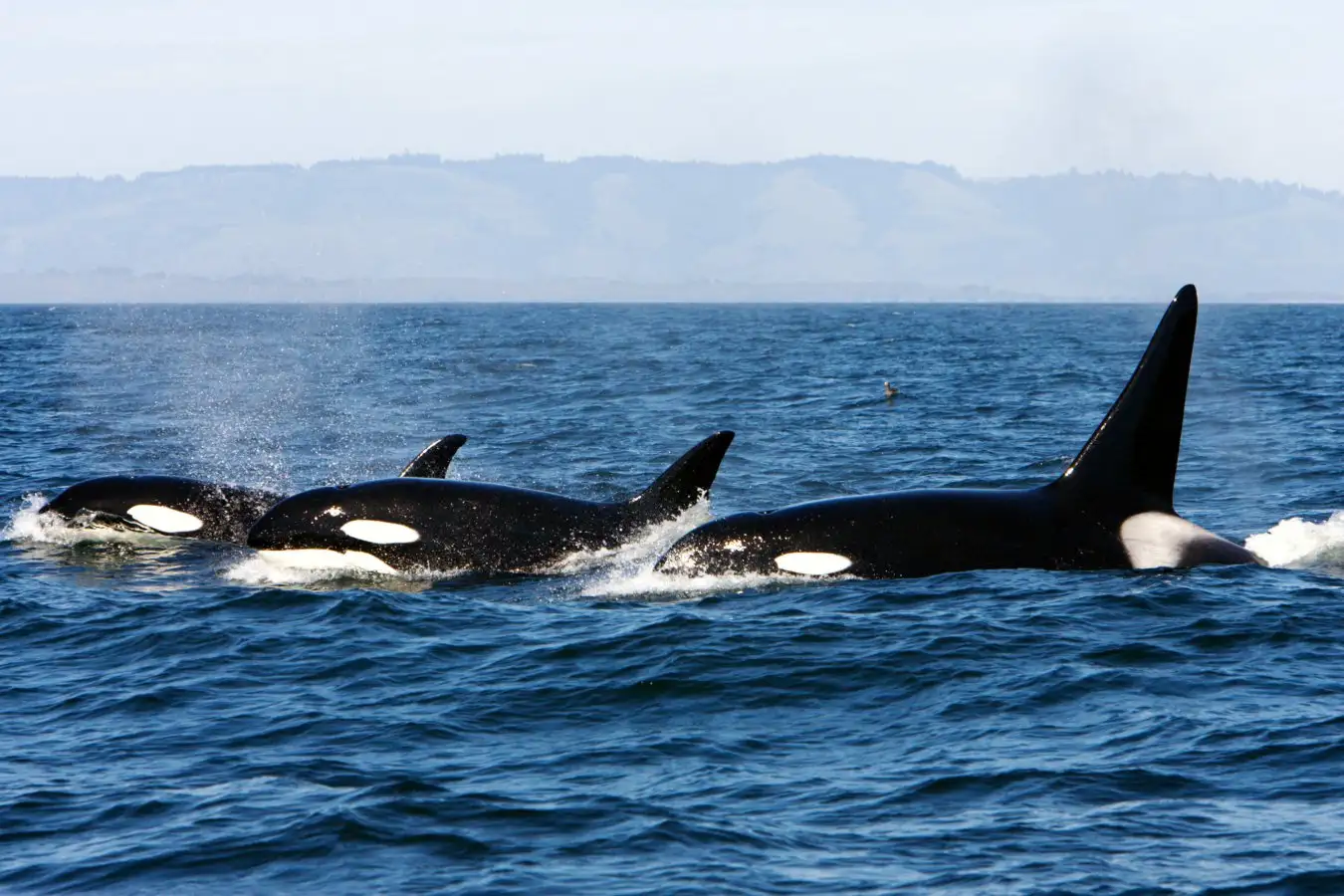
Orcas may be at risk of predation by other orcas
Francois Gohie/VWPics/Alamy
Biologists have seen signs of orca-on-orca predation in the North Pacific, and such cannibalism may explain why some orcas travel in large family groups.
Two distinct subspecies of orcas, also called killer whales (Orcinus orca), are found in the North Pacific. Transient or Bigg’s orcas, as their name suggests, are nomadic and congregate in fluid hunting pods to hunt seals, dolphins and other whales. In contrast, resident orcas live in large groups based on maternal ties, staying with the same family their whole lives. Residents will disperse and feed on fish individually and come back together again when resting or travelling.
It’s thought that the two subspecies seldom interact, but Sergey Fomin at the Pacific Institute of Geography in Russia has seen evidence of violent encounters. While strolling along the beach on Bering Island in eastern Russia, he sometimes finds the gnawed-off dorsal fins of Baird’s beaked whales and minke whales — animals that have fallen prey to voracious orcas. In the summer of 2022, however, he was surprised to find an orca fin on the beach, bloodied and covered with tooth marks. Two years later, he found another.
Genetic testing revealed that the fins came from southern resident orcas. Fomin and his colleagues surmise that the whales were probably eaten by Bigg’s orcas.
Most toothed whales are organised like transient orcas, forming pods that can change over time. Why southern residents form large family groups has been a scientific conundrum. “I was wondering about the social structure for a while because it’s quite unique, and there are not that many species that have something like this,” says Olga Filatova at the University of Southern Denmark.
Once she learned about the two dorsal fins and the likely cannibalism, it clicked: perhaps resident orcas stay in large groups for safety in numbers. Together with Fomin and her colleague Ivan Fedutin, she has published a paper outlining this idea.
As top predators, orcas are seldom bullied, but they have been known to be chased away by mobbing groups of smaller pilot whales. And they can be aggressive towards each other: in 2016, Jared Towers at marine research firm Bay Cetology in Canada witnessed a pod of Bigg’s orcas chase down and kill a newborn. This was probably to force the mother to become sexually receptive, explains Towers, as the calf was not eaten.
Towers agrees that the residents’ unique social structure is probably for defence, though he’s less certain the whales on Bering Island were cannibalised. Researchers can’t rule out that the fins were ripped off by sparring podmates, or that the whales died and were snacked on post-mortem. This is less likely though, as orcas sink once deceased.
Researchers can only speculate on why orcas may turn to cannibalism, but Filatova guesses it could just be a matter of circumstance. On Bering Island, common food sources are fur seals and sea lions, but when the rookeries are empty, the whales might turn to other prey. “If they can’t find any food, and there’s a young tasty resident killer whale alone, why not?” she says.
Topics:
Source link : https://www.newscientist.com/article/2516860-cannibalism-may-explain-why-some-orcas-stay-in-family-groups/?utm_campaign=RSS%7CNSNS&utm_source=NSNS&utm_medium=RSS&utm_content=home
Author :
Publish date : 2026-02-24 18:00:00
Copyright for syndicated content belongs to the linked Source.