


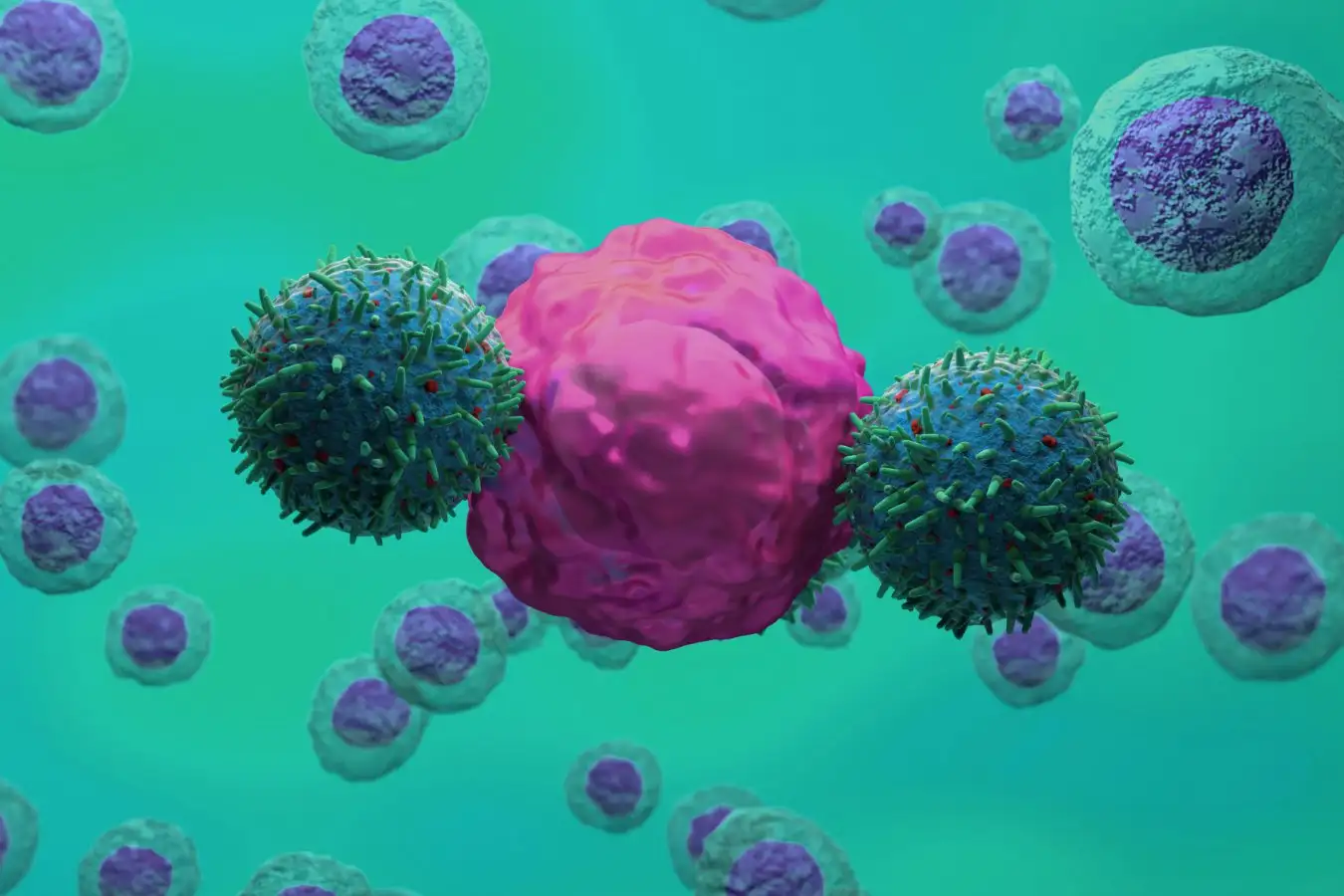
Illustration of CAR T-cell therapy (green) attacking a cancer cell (pink)
NEMES LASZLO/SCIENCE PHOTO LIBRARY
Genetically engineered immune cells known as CAR-T cells might be able to slow the progress of the neurodegenerative condition amyotrophic lateral sclerosis (ALS) by killing off rogue immune cells in the brain.
“It’s not a way to cure the disease,” says Davide Trotti at the Jefferson Weinberg ALS Center in Pennsylvania. “The goal is slowing down the disease.”
The life expectancy of people diagnosed with ALS is just two to five years, so slowing the condition’s progression would make a big difference, says Trotti. It’s possible that the same approach could help slow other neurodegenerative conditions too.
Also known as Lou Gehrig’s disease, ALS is caused by the loss of motor neurons, the nerve cells that control voluntary muscles. Physicist Stephen Hawking had ALS, but his case was exceptional because he lived so long. Fewer than 10 per cent of people diagnosed with the condition survive more than a decade.
There has been some progress in developing treatments for forms of ALS caused by genetic mutations, says Trotti, but these account for only 5 to 10 per cent of cases. For the sporadic forms of ALS whose causes are unknown, there are no treatments.
However, there is evidence that inflammation in the brain contributes to the death of motor neurons. In particular, some of the immune cells known as microglia seem to flip into an overactive state.
Microglia usually defend the brain from infections, clean up any debris and help prune excess connections, or synapses, between neurons. But if some of them become overactive, they can remove too many synapses and contribute to the loss of neurons. “They become out of control,” says Trotti.
In a series of experiments that included studying brain and spinal cord tissue from people with ALS, Trotti’s team has shown that these damage-amplifying microglia, as they are known, have lots of a protein called uPAR protruding from their surface. “So they are tagged, and knowing the tag, we can go after them and remove them from the central nervous system,” says Trotti.
To do this, his team turned to CAR-T cells, immune cells genetically engineered to kill cells with specific proteins on their surface. CAR-T cells have proved very effective at treating certain kinds of cancer, and are now being trialled for treating a much wider range of conditions, such as the autoimmune condition lupus.
In studies of cells growing in culture, the team has shown that CAR-T cells targeting uPAR can kill rogue microglia without damaging neurons. So while this treatment cannot replace lost motor neurons, the hope is that it will greatly slow further losses.
Trials are now under way in mice with a mutation that makes them develop a form of ALS, with the results expected within a year or so. The seriousness of ALS and its lack of treatments means regulators may help expedite trials in people if these results are promising.
“The evidence for immune dysfunction in ALS is mounting,” says Ammar Al-Chalabi at King’s College London, whose team has tested immune-related therapies for ALS. “This seems a very promising and interesting approach to me.”
It is likely that damage-amplifying microglia contribute to other neurodegenerative conditions too, perhaps including types of dementia, so this treatment might turn out to have wider applications beyond ALS. “It could be a way of slowing down those kind of neurodegenerative conditions,” says Trotti.
CAR-T cells do have some big drawbacks as a therapy: they can trigger serious side effects and, because they are usually derived from a person’s own cells, they are very expensive to manufacture. But many teams around the world are working on ways of making them safer and cheaper, such as by generating them inside the body so cells don’t have to be extracted.
Source link : https://www.newscientist.com/article/2515099-car-t-cell-therapy-may-slow-neurodegenerative-conditions-like-als/?utm_campaign=RSS%7CNSNS&utm_source=NSNS&utm_medium=RSS&utm_content=home
Author :
Publish date : 2026-02-13 12:00:00
Copyright for syndicated content belongs to the linked Source.