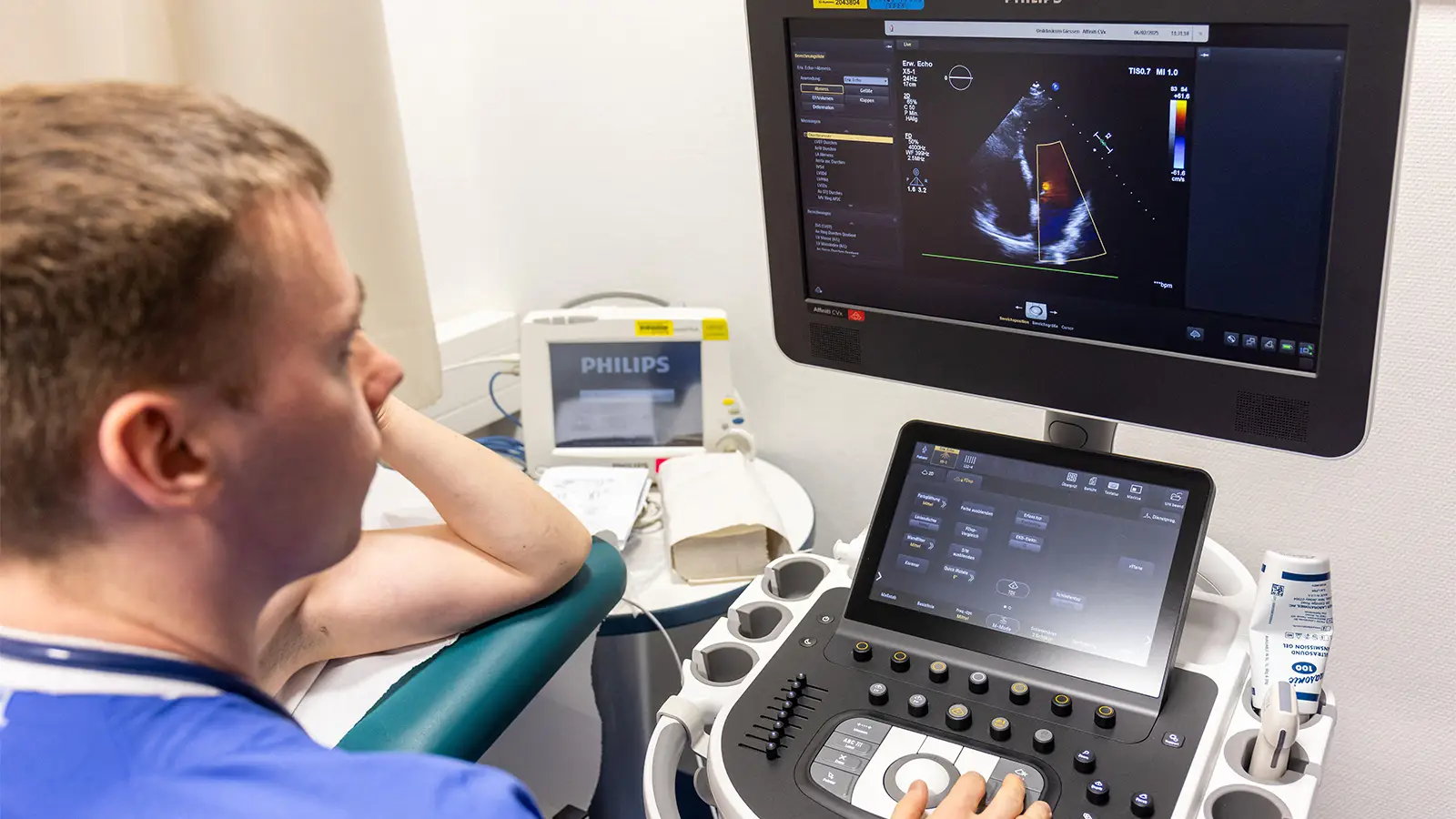
- Researchers sought to show the incremental value of adding clinical and laboratory features to a transthoracic echocardiography-only AI model for cardiac amyloidosis (CA) diagnosis.
- The new model, dubbed AI-ECM, showed improved model performance in an internal validation study based on registry data.
- The ultimate goal is to improve early CA detection so patients can receive earlier treatment.
Researchers unveiled a new multimodal artificial intelligence (AI) algorithm for cardiac amyloidosis (CA) diagnosis, a tool showing promise for greater accuracy and sensitivity in the real world.
The AI echo-clinical model (AI-ECM) — incorporating demographics, laboratory biomarkers, and transthoracic echocardiography (TTE) parameters — performed better than the previously validated, FDA-cleared, TTE-only deep-learning model Us2.Ca, according to Federico Asch, MD, of MedStar Health Research Institute in Washington, D.C., and colleagues.
This was based on an internal validation study using multiethnic registry data, in which AI-ECM showed significant improvements in accuracy (area under the curve 0.94 vs 0.89) and sensitivity (93% vs 76%) compared with the older model. The one drawback was a drop in specificity (85% vs 91%), however.
“A multiparametric AI model integrating basic clinical, laboratory, and TTE data with the deep learning Us2.Ca improved performance for CA detection over Us2.Ca alone. This approach represents a step toward scalable, AI-guided precision diagnostics for CA in diverse populations,” study authors nevertheless concluded in Circulation: Cardiovascular Imaging.
“Our work aligns with a growing body of evidence supporting the use of TTE-based AI models for CA detection and further expands upon this area by demonstrating the potential for integration of multimodal clinical, laboratory, and TTE biomarkers to augment AI model accuracy,” they wrote.
CA is an increasingly recognized, albeit still underdiagnosed, cause of heart failure due to deposition of misfolded proteins within the myocardium.
Notably, Asch’s group reported that there was no more indeterminate classification using the AI-ECM model. The AI-ECM model improved sensitivity for light chain-CA detection in particular, and it maintained high accuracy across subtypes and control groups.
Thus, “while the specificity is modestly decreased, the increased sensitivity is more meaningful for a screening tool aiming to reduce missed and delayed diagnoses,” commented Arielle Abovich, MD, MPH, and Sarah Cuddy, MBBCh, MSc, both of Brigham and Women’s Hospital and Harvard Medical School in Boston.
“With appropriate refinement and prospective validation, this approach has the potential to improve detection rates in a disease where early diagnosis is increasingly consequential,” the duo wrote in an accompanying editorial.
The hope is that a better CA detection method would reduce the diagnostic delay currently associated with the disease, and ultimately facilitate timelier treatment. Currently, the delay is about a year between clinical suspicion and confirmed diagnosis of CA. Part of the issue is the lack of a good frontline test for CA screening; even TTE is limited in its sensitivity due to CA’s phenotypic overlap with other cardiomyopathies.
Asch and colleagues emphasized that AI-ECM relies on routine metrics collected in the early diagnostic evaluation for CA.
“In patients with echocardiographic findings suspicious for CA, current guidelines recommend obtaining serum and urine light chain testing before pursuing nuclear scintigraphy or endomyocardial biopsy. Demographic data and renal function are typically available in all patients at the time of TTE,” they wrote. “As such, the AI-ECM is designed to operate early within the diagnostic evaluation.”
Study authors performed model training and internal validation of AI-ECM using the Amyloidosis Imaging International Consortium, a global multiethnic registry covering nine academic medical centers across the U.S., Japan, Brazil, and Argentina.
Included were 727 patients with CA and 316 controls (the latter split between 202 with suspected transthyretin-CA with negative diagnostic evaluation and 114 patients with biopsy-proven extracardiac light chain amyloidosis without cardiac involvement).
CA cases and controls averaged 70 years of age. There were significantly more men (73.6% vs 57.6%) in the CA group, which also showed higher NT-proBNP (median 2,492 vs 826 pg/mL) and BNP (505 vs 87 pg/mL) at baseline.
Asch’s team acknowledged the lack of external validation in this report. Additionally, comprehensive light chain testing was available in the majority of patients in the cohort.
“[I]n routine clinical practice, pyrophosphate imaging is sometimes performed before complete serum and urine light chain evaluation. As such, the high rate of light chain testing in our data set may not fully reflect real-world practice,” the investigators cautioned.
“The dependence of the model on light chain studies that are not consistently available at the time of screening is a limitation, but one that may be addressable through surrogate markers or by targeting deployment to clinical populations where these data are already obtained,” Abovich and Cuddy noted.
Source link : https://www.medpagetoday.com/cardiology/chf/121505
Author :
Publish date : 2026-05-29 21:30:00
Copyright for syndicated content belongs to the linked Source.