
[ad_1]
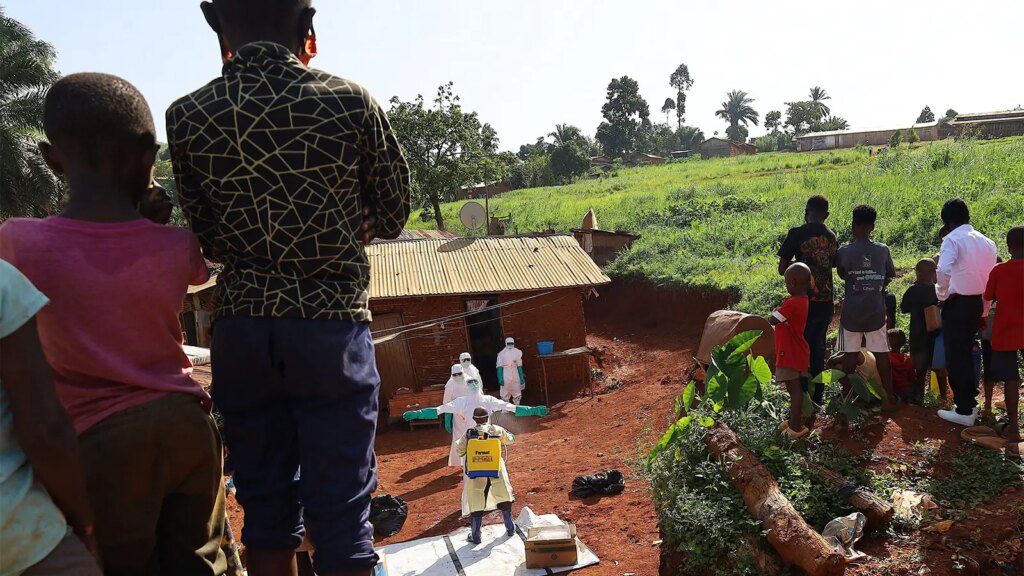
The Ebola outbreak in Congo could rival the largest on record, according to CDC models of possible trajectories over the next 3 months.
In scenarios that had 70% of Ebola patients entering isolation and 50 Ebola deaths as of May 24, only about one in 20 simulations projected an outbreak exceeding 10,000 cases. But low levels of isolation (20%) and without other interventions found a 65% likelihood that cases would exceed 20,000, reported researchers led by Eric Mooring, ScD, of the CDC’s Center for Forecasting and Outbreak Analytics.
“If large-scale and sustained public health interventions are not rapidly implemented to reduce disease transmission, this outbreak could become as large as the 2014-2016 West Africa Ebola virus disease outbreak, which resulted in more than 28,000 cases and more than 11,000 deaths,” they warned in Morbidity and Mortality Weekly Report (MMWR).
The findings were detailed at a press briefing on Friday.
The CDC built its models on three different numbers of cumulative deaths by May 24, 2026 — 50, 100, and 200 — to account for uncertainty about the number of deaths caused by the Bundibugyo virus. Four scenarios were evaluated for each death total, with each scenario using different percentages of symptomatic infected persons detected, isolated, and treated. The isolation scenarios were 20% (poor), 50% (moderate), 70% (high), and 95% (extremely high). The model assumed a May 24 start.
“Based on the trajectory and based on the conditions on the ground, I would believe that the percentages are on the lower end of the scenarios,” said Satish Pillai, MD, the leader of the CDC’s Ebola response.
In scenarios assuming 50 deaths by May 24 and that only 20% of infected people were successfully isolated, 69% of simulations predicted at least 4,000 cumulative deaths by August 2026.
With 100 deaths and 20% isolation, “very large outbreaks were likely,” the CDC researchers cautioned, with 76% of simulations projecting at least 20,000 cases and 87% projecting at least 4,000 deaths by August.
“Although the worst outcomes (higher numbers of cases and associated deaths) in these projections were less likely when a larger proportion of patients were identified, isolated, and treated, this outbreak could, within 3 months and under low-isolation scenarios, become the second largest Ebola outbreak in history,” they added.
The Bundibugyo virus driving the current outbreak in the Democratic Republic of the Congo and Uganda has no specific vaccines or treatments. As of June 2, there are 378 confirmed cases — 363 in Congo and 15 in Uganda — and 63 confirmed deaths — 62 in Congo and one in Uganda, the CDC said.
Despite the high risks in Africa, another MMWR published on Friday suggested the chance for potential spread from Congo to the U.S. is “very low,” and predicted that secondary transmission would likely be minimal if Bundibugyo virus did make its way here.
“For Americans going about their daily lives, including those with travel plans that do not involve the affected countries, there’s no recommended change in behavior at this time,” Pillai said.
Please enable JavaScript to view the comments powered by Disqus.
[ad_2]
Source link : https://www.medpagetoday.com/infectiousdisease/ebola/121633
Author :
Publish date : 2026-06-05 21:45:00
Copyright for syndicated content belongs to the linked Source.