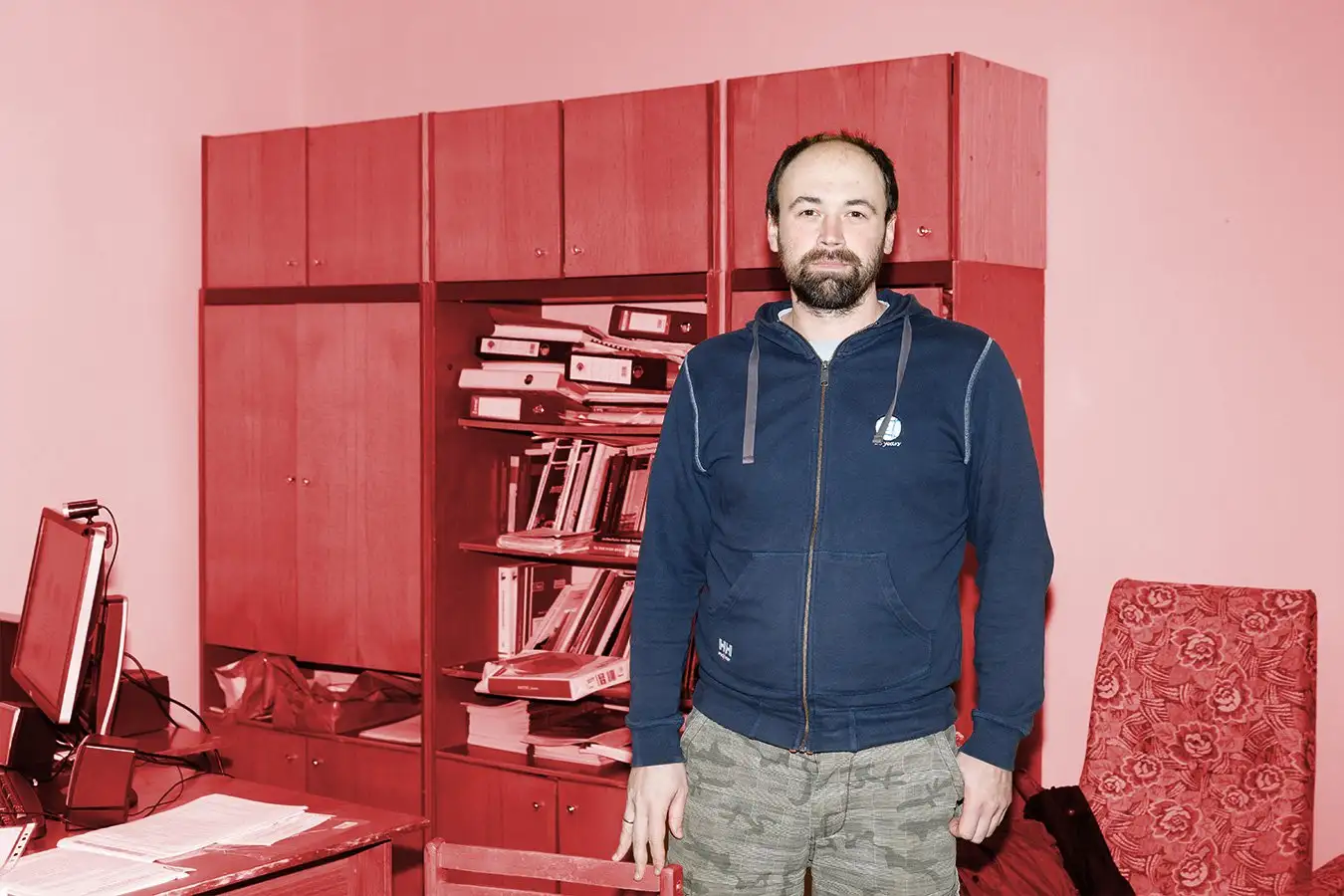
Anatoly Doroshenko is tasked with entering Chernobyl’s reactor 4 to take vital radioactivity readings
Mykhaylo Palinchak
The shattered remains of Chernobyl’s reactor 4 are one of the most inhospitable places on Earth. Not only are the ruins physically dangerous, but they are highly irradiated, pitch black and shrouded by a crumbling, concrete sarcophagus, which is, in turn, covered by the New Safe Confinement structure.
But it is vital that scientists understand what is going on inside. And that task falls to Anatoly Doroshenko, a young scientist at the Institute for Safety Problems of Nuclear Power Plants (ISPNPP). He has what could be considered to be the most dangerous job on the planet: crawling deep within the ruins of the reactor to take readings and samples, getting within 8 metres of the core, sometimes as often as once a month.
“It’s not scary,” Doroshenko tells me, as he stands next to a scale model of Chernobyl at the institute’s laboratory in the exclusion zone around the plant. “I got ready for it for a long time. You just have to be in this moral state to accept it and the necessity of doing it.”
“It is indeed a strange feeling. I think it can be compared to the feeling of conquering Everest, flying into space or exploring the ocean floor. A certain adrenaline rush is always present.”
He has a list of tasks to accomplish with each delve inside the reactor, but a limited time to do them, so he needs to balance haste and care. “You should acquire the knowledge about what you’re going to do, where you’re going to go. You should control yourself,” says Doroshenko. He repeats that second part twice, almost as a reminder to himself.
“You should be aware that everything is contaminated. And if you’re touching something, you need to know what you’re touching, because you don’t want to contaminate your clothes or yourself,” he says. “The main part is you should be aware of your plans, because there is not that much time that it’s safe to be there. You want to do the work, and you also want to see something [interesting], but it’s not an excursion. You’re working there, so you should be aware of everything you need to do and keep it in your head.”
If Doroshenko is visiting the less dangerous parts of the reactor, he will wear a hat, protective gloves and a respirator. For the areas with worse contamination, he will add a full-body suit to keep dust off, or even a third layer of a polythene suit. He also has lead aprons that can be put on top, but the weight and bulk make negotiating the tight spaces inside difficult.
As a younger scientist, he was taken by an older employee to the main circulation pumps, which normally cooled reactor 4 and were part of the safety test that led to the 1986 disaster. “It’s a very important place to see and it’s very well known. We’ve been looking at all the destruction caused by the explosion.”
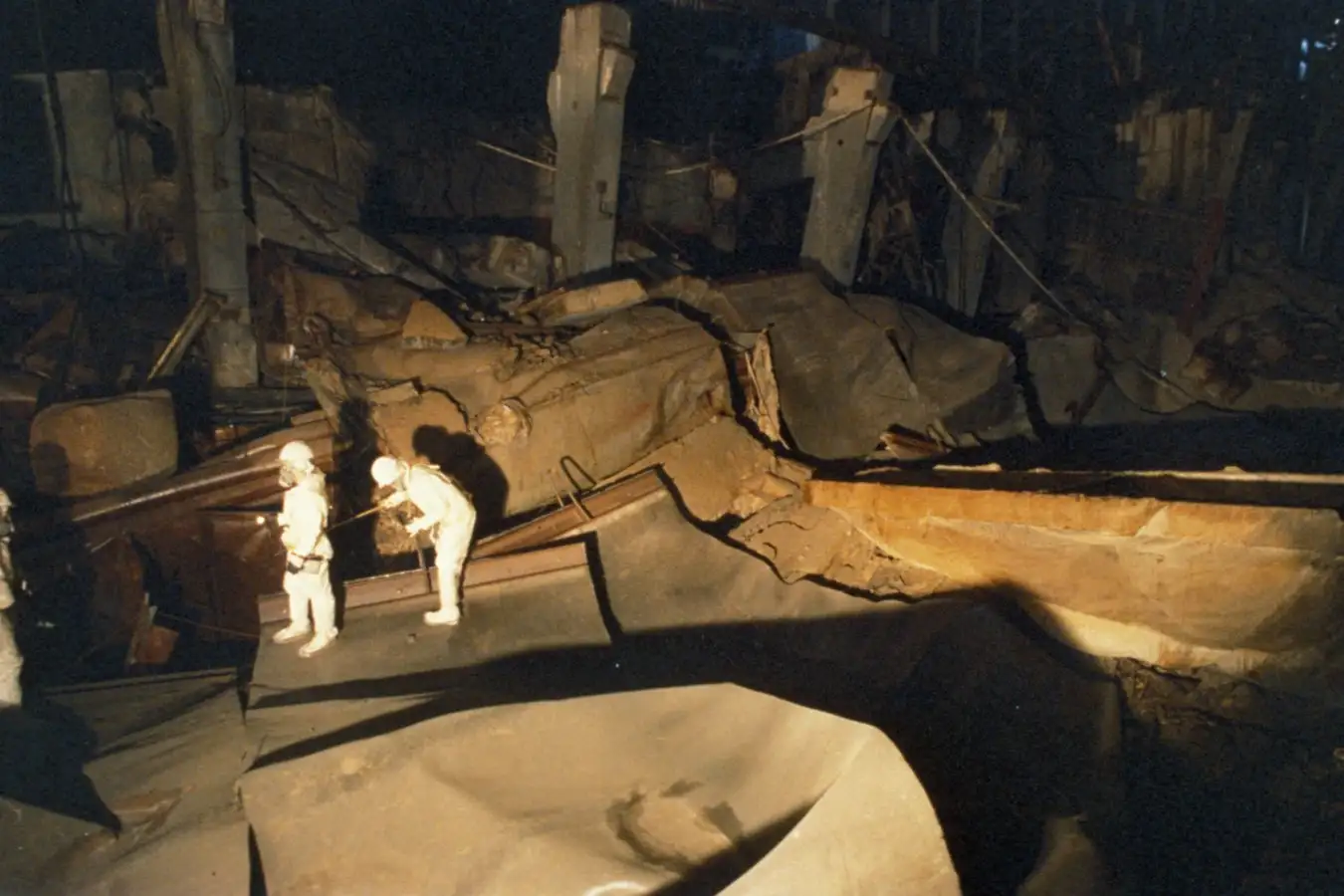
Inspections inside the sarcophagus containing reactor 4 at Chernobyl, in 1991
Images Group/Shutterstock
“The main protection for us is knowledge, it’s not the suits,” says researcher Olena Pareniuk at the ISPNPP. “Anatoly is one of our key employees, and he looks tired and a bit depressed, as all of us are, but he’s doing a great job. We don’t have that many young people who are good with dosimetry measurements.”
Doroshenko’s boss, Viktor Krasnov, acting director for science at the ISPNPP, says that generations of scientists have gone inside the reactor since 1986 to take measurements and install sensors. There, they are met with confined spaces, pipes full of radioactive water and large sections of corium – a mix of melted fuel, concrete and metal formed in the 2500°C heat following the disaster, which has dripped and oozed its way through the ruins to form unusual shapes.
“The very first people who actually got inside there made these slang names for all these objects: the elephant’s foot, the cat’s house, the dog’s house, the octopus beam, the mammoth beam,” says Krasnov. “Everything is destroyed inside, so all the routes are quite challenging.”
The risks are almost endless. One is the 2200-tonne Upper Biological Shield that once sat on top of reactor 4, and is now nicknamed Elena. It was flipped like a coin in the explosion and today sits at a 15-degree angle, propped up on rubble. If it were to collapse, it could dislodge the precarious ruins and stir up vast quantities of radioactive dust.
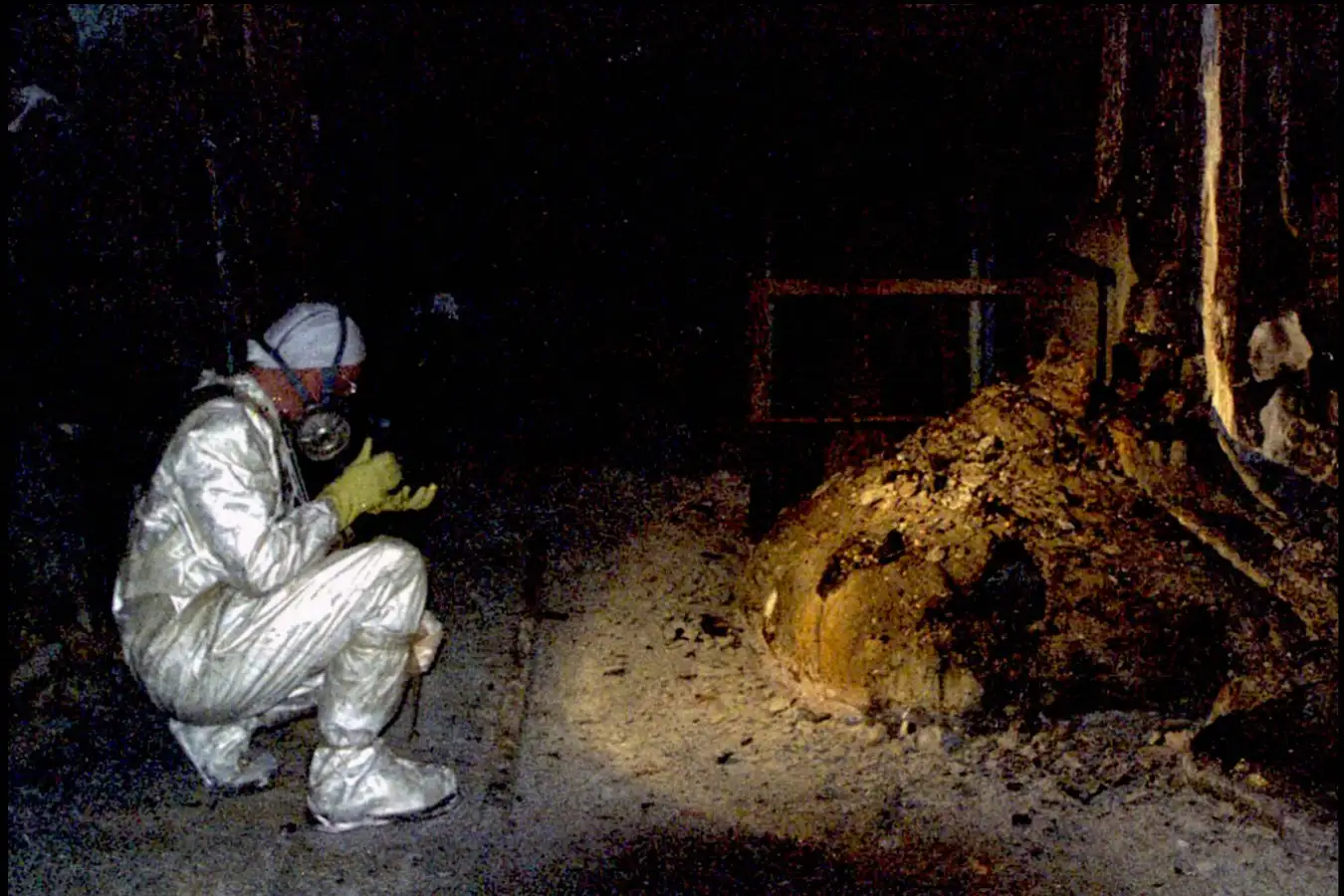
A 1986 image of the “elephant’s foot” inside Chernobyl’s reactor 4, a melted mass of nuclear fuel and other material
Photo 12/Alamy
A longer-term risk, and part of the need for regular, accurate readings, comes from the occasional spikes of nuclear activity. Nobody knows exactly where all the fuel material is inside the reactor, and it occasionally becomes active.
When uranium or plutonium fuel decays radioactively, it emits neutrons, which can promote a fission reaction if the neutrons are captured by another radioactive nuclei. However, large amounts of water slow these neutrons down, preventing them from being captured. Immediately after the disaster, the sarcophagus created dry conditions inside the reactor, prompting a neutron spike.
Later, there was more water, partly because the concrete shelter was riddled with holes that allowed birds and weather in, so the humidity got higher and neutron flux went down. “Right now, as the New Safe Confinement is installed, the humidity is lower, so we’re expecting some accidents might occur and we need to know in advance,” says Krasnov. That’s why it is vital that Doroshenko continues to clamber inside to better understand the conditions.
Despite the rigorous safety processes followed at Chernobyl, crawling inside an exploded reactor will never be safe. “I know about the risks,” says Doroshenko. “And so I am worried about my health, because if I don’t worry about it, I can make mistakes. I don’t know if I will have health problems in the future, but I know that if I follow radiation safety standards, I can minimise these risks.”
Topics:
Source link : https://www.newscientist.com/article/2520435-chernobyl-at-40-the-man-with-the-most-dangerous-job-on-earth/?utm_campaign=RSS%7CNSNS&utm_source=NSNS&utm_medium=RSS&utm_content=home
Author :
Publish date : 2026-04-13 14:00:00
Copyright for syndicated content belongs to the linked Source.