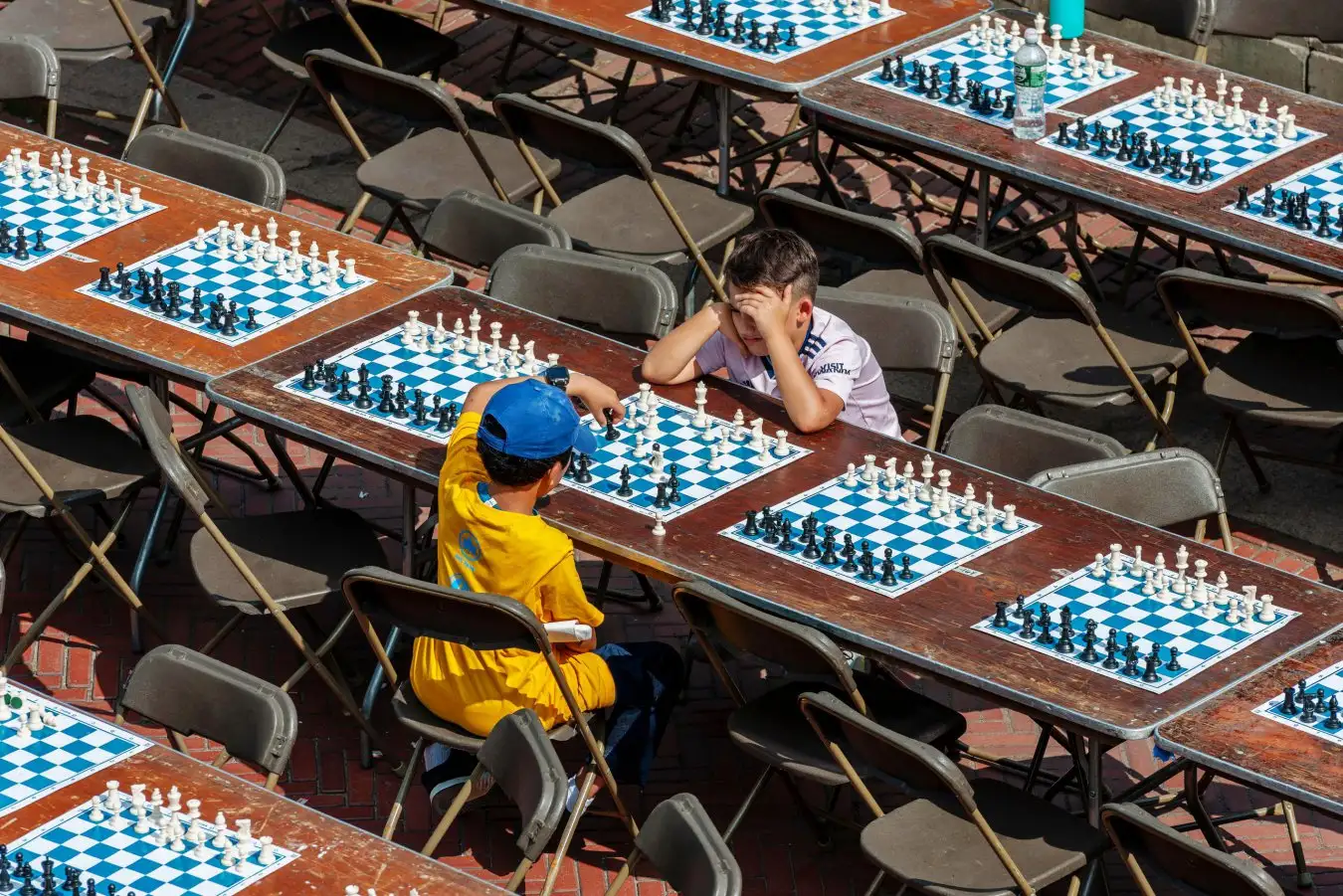
Changing the rules of chess can make the game more complex
Richard Levine/Alamy
Chess can be improved by rearranging the positions of the starting pieces to produce a more difficult or fairer game, a physicist has found.
A standard game of chess always starts with the pieces at the back of the board arranged with an element of symmetry. Starting from the outside, for both white and black, are pairs of rooks, knights and bishops, with a king and queen in the middle. But because this arrangement is fixed, top chess players can memorise the best moves to open a game of chess, which can lead to predictable and boring matches.
In the 1990s, the late chess grandmaster Bobby Fischer proposed a variant of the game that reduced this reliance on memory. Fischer suggested effectively randomising the starting positions of the pieces at the back of the board – apart from basic rules dictating where the bishops, rooks and kings must be relative to each other – with both white and black pieces taking on the same random arrangement. This format, called Chess960 for the number of possible starting positions, has recently ballooned in popularity, with players including former world champion Magnus Carlsen taking part in tournaments to better test their chess skills.
Because the pieces are randomised, Chess960 appears to be fair to both players. But after analysing all 960 possible starting positions, Marc Barthelemy at Paris-Saclay University has discovered this is an illusion.
White, which moves first, always has a slight advantage in standard chess. But Barthelemy found that some Chess960 configurations gave white a much greater advantage, and a few actually gave black a small advantage. “Not all positions are equivalent,” he says.
Barthelemy reached these conclusions by using an open source chess computer, Stockfish, to analyse each starting position and measure how difficult it is for both black and white to decide on a move. To do this, Barthelemy compared how easy it is to find the best and next best moves, according to the computer. If one of the two moves is much easier to find than the other, then the player faces an uncomplicated situation and should have little trouble deciding on a move. But if both moves are similarly easy to find, then the situation is more complex and the player faces a tougher decision when selecting a move. Using this approach, Barthelemy could rate each starting position for complexity, and evaluate whether any complexity favoured black or white.
He found that a starting opening of BNRQKBNR, with each letter standing for a piece (knight being “N” and king being “K”), was the most complex, whereas QNBRKBNR was the most balanced between white and black for difficulty. Positions like these could be useful for tournament organisers to ensure that games between players are fairer, says Barthelemy.
But Vito Servedio at the Complexity Science Hub in Austria argues that the randomness ensures an inherent level of fairness, and that prejudicing certain Chess960 configurations over others could lead to players overpreparing. “It’s more fair because you start with your opponent on the same foot,” says Servedio. “A grandmaster knows thousands of opening lines in standard chess, but cannot know the opening lines in all the [Chess960] positions.”
Barthelemy also found that the standard game of chess isn’t particularly extreme, compared with some of the other 959 positions, in both fairness and complexity. “Very surprisingly, the standard chess position is not particularly remarkable,” says Barthelemy. “It’s not especially balanced or asymmetric, it’s very average. It’s unclear to me why history decided on this position.”
“In the zoo of positions, it’s in the middle,” says Servedio. “Is it a coincidence or not? This we cannot say.”
Barthelemy’s measure of complexity isn’t the only possible way to analyse how difficult a game of chess is, says Giordano de Marzo at the University of Konstanz in Germany. “In many situations, the difficulty of a position is when you only have one move and you have to find it,” says de Marzo, rather than deciding on the best move between the best and next best options.
It’s unclear whether a higher complexity of the kind Barthelrmy measured actually corresponds to people experiencing the game as more difficult, says de Marzo – although he speculates that it may. “If you see that more complex positions result in longer thinking times, then I would say that’s a very strong argument for supporting this measure.”
Topics:
Source link : https://www.newscientist.com/article/2509800-chess-can-be-made-fairer-by-rearranging-the-pieces/?utm_campaign=RSS%7CNSNS&utm_source=NSNS&utm_medium=RSS&utm_content=home
Author :
Publish date : 2026-01-01 19:00:00
Copyright for syndicated content belongs to the linked Source.