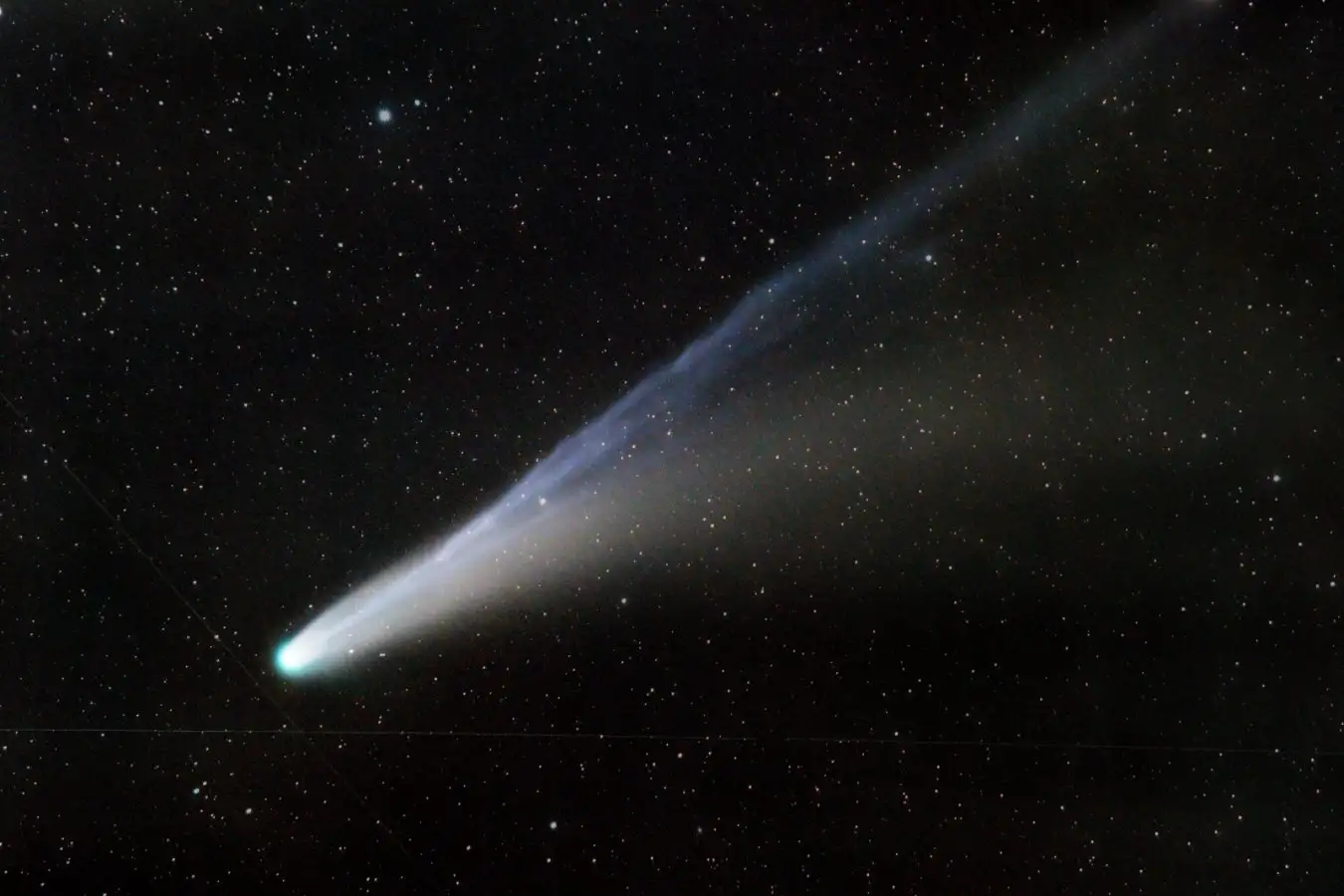
Comet Lemmon, photographed from northern Italy on 26th October 2025
Marcel Clemens/Alamy
I don’t think anyone declared it, but 2025 was a big year for comets. There was comet Lemmon, which was discovered in January and stayed in the news for a good nine months. The images of Lemmon’s long and beautiful tail, created by solar heating of the comet, stopped me in my tracks every time.
Then there was the September discovery of C/2025 R2 (SWAN), a comet so bright that even when it was near the moon on Halloween, it was still quite visible to observers. And there was comet 3I/Atlas, which became famous because an astronomer at Harvard University whose main area of expertise is cosmology declared it was an alien probe.
As a cosmologist who knows she isn’t an expert on comets, I believe all of the experts who say that, without a doubt, comet 3I/Atlas isn’t an alien object. This shouldn’t be disappointing. The comet is still scientifically fascinating. It is different from Lemmon and SWAN because it has origins outside of our solar system. Comet 3I/Atlas is, by definition, interstellar.
Its arrival in our solar system makes it an exciting opportunity. By studying its composition, we can learn a lot about its home star, even though it is impossible to reverse engineer its exact trajectory. In other words, we can learn about a mystery star’s composition, even if we don’t know which star we are studying.
Our journey with comets this year is only the latest in a long arc of human reactions to mysterious celestial objects appearing in the sky. Perhaps most famously, the passage of Halley’s comet in 1066 was depicted in the Bayeux Tapestry as signalling the start of the Norman invasion of England. Today, we know that humanity isn’t the centre of the universe – and that the universe doesn’t have a centre – but I could forgive someone for momentarily thinking that 2025’s comets are trying to tell us something.
As we look back on the year, so many scary and disappointing things happened that it can be easy to think these comets might have heralded the end of the world as we know it. US science is up against the ropes as the current administration cancels grants and programmes (see page 20). In both the US and the UK, attacks on immigrants have become more mainstream.
As a Black and Jewish queer scientist and child of immigrants, keeping heart is a daily challenge for me. I am aware there are people who want me silenced. Against all my scientific training, I could choose to read the comets as a sign that I should give in. But there is another option: I can witness, as a scientist, the way that the comets hold hope for me. They are a beautiful visual sanctuary. The quest to see them has also brought people together. I delight in the posts about them in my astrophotography groups. While I find all of the “Is it an alien?” misinformation in various publications deeply frustrating, I love that people are looking up.
Going forward into 2026, my wish list is long. Scientifically, I really want a paradigm-shifting dark matter observation. Socially, I want all children to have the food, housing, education and medical care they need in identity-affirming communities. These are big dreams that probably won’t happen by the end of the year. But the comets are a reminder that the universe is full of big, wonderful surprises. Just as we do the work of seeking out comets, we should also build the better world we need.
Topics:
Source link : https://www.newscientist.com/article/2507738-comets-were-on-fire-this-year-for-better-or-worse/?utm_campaign=RSS%7CNSNS&utm_source=NSNS&utm_medium=RSS&utm_content=home
Author :
Publish date : 2025-12-10 18:00:00
Copyright for syndicated content belongs to the linked Source.