
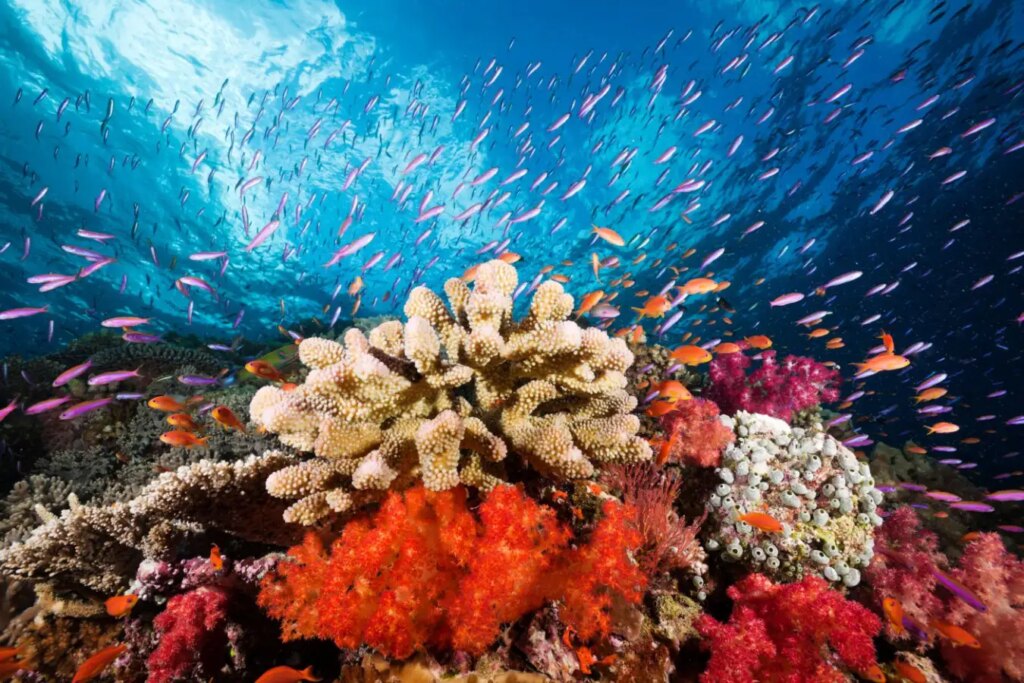

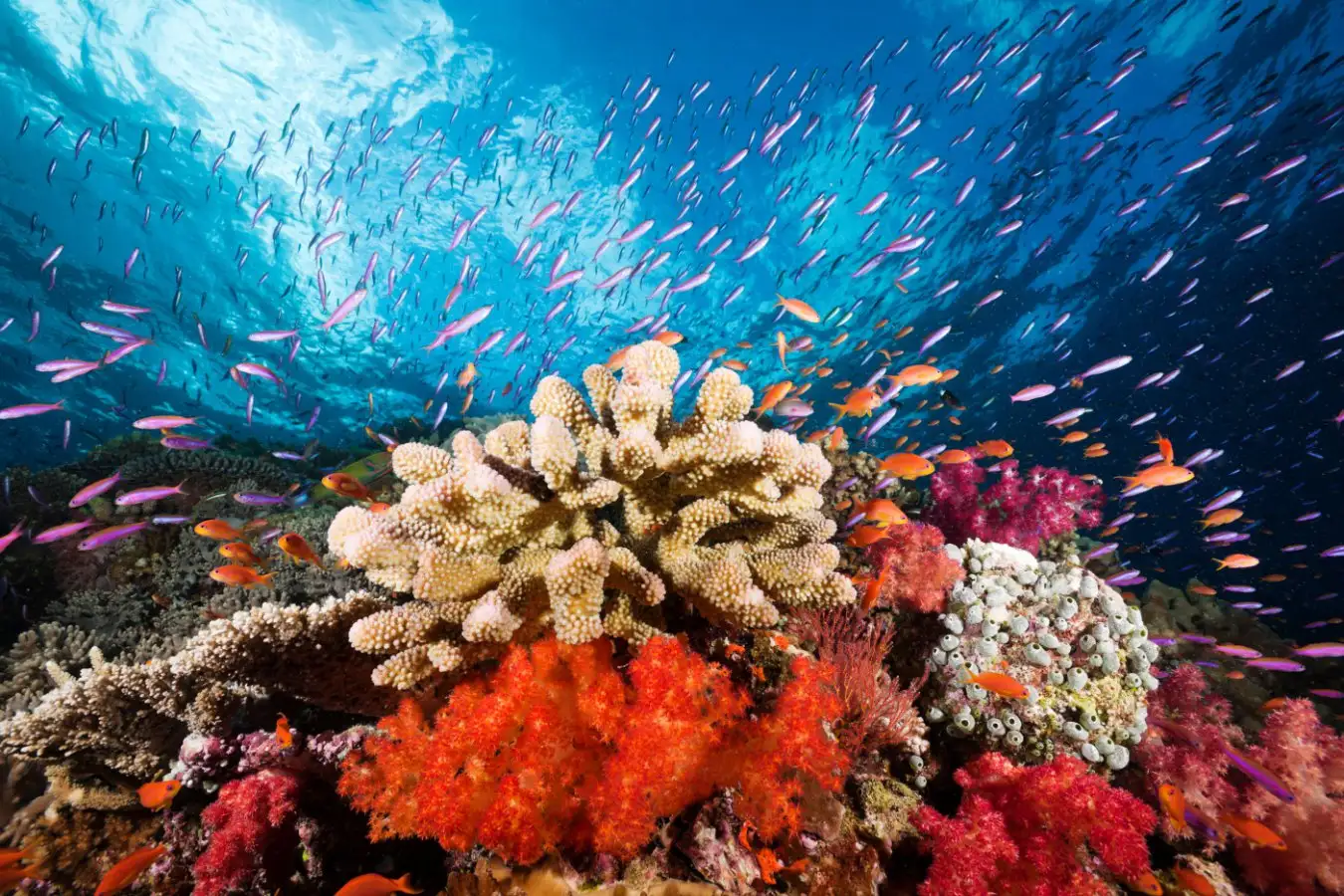
Corals build their skeletons out of calcium carbonate, emitting carbon dioxide as a by-product
Reinhard Dirscherl/Alamy
The extent of coral reefs worldwide has played a key role in Earth’s climate in the past 250 million years – but not in the way you might expect.
Coral reefs are net producers of carbon dioxide because the greenhouse gas is a by-product of the formation of calcium carbonate, which makes up corals’ skeletons.
Some types of plankton also build shells out of calcium carbonate, and when they die, this mineral is buried in the seabed. When large areas of shallow marine environments are covered in coral, calcium and carbonate ions that would normally be taken up by deep-sea plankton is no longer available.
Tristan Salles at the University of Sydney, Australia, and his colleagues modelled the interplay between shallow-water corals and deep oceanic plankton over the past 250 million years by integrating reconstructions of plate tectonics, climate simulations and changes in sediment flowing into the sea.
They found that the balance between corals and plankton has been disrupted when plate tectonics and geomorphology lead to periods when there are extensive areas of shallow continental shelf, which is the ideal habitat for reef-building corals.
When coral reefs are less extensive, calcium and alkalinity build up in the ocean, plankton become more productive and more carbonate is buried in the deep sea, which helps to lower CO2 levels and bring temperatures down.
There were three major periods when the carbon cycle was severely disrupted in the past 250 million years, the researchers found. These events, in the mid-Triassic, the mid-Jurassic and the late Cretaceous, involved extensive coral reefs using huge amounts of calcium carbonate, leading to big rises in sea temperatures.
When the balance between shallow-water coral reefs and deep-sea plankton breaks down, says Salles, it can take hundreds of thousands to millions of years to re-establish equilibrium.
“So, even if the system manages to recover from a huge crisis, the rebalancing is going to happen over a really long time period that is much longer than human timescales,” says Salles.
On the positive side, says Salles, if planktonic nutrient blooms are ever out of control, corals are great at taking up excess nutrients to build coral reefs.
Now, human CO2 emissions are causing global warming and ocean acidification at an unprecedented rate, which is killing both corals and plankton, says Salles. The consequences are unknown, but are likely to be ecologically catastrophic, he says.
“The deep-time feedbacks we modelled do not apply today – the pace of modern change is far too rapid for carbonate-platform feedbacks to matter in any comparable way.”
Alexander Skeels at the Australian National University in Canberra says the study shows there is a “deeply intertwined feedback cycle between life and climate”.
He says people often think that species evolve and adapt in response to Earth’s climate, which is governed by “immutable physical and chemical processes”.
“However, more and more often we are seeing examples where biological species directly influence the climate itself, creating a co-evolving feedback loop,” says Skeels. “Not just corals, but also more ancient microbial colonies like stromatolites have played a key role in modulating atmospheric carbon.
“We know that carbon warms our climate, as it is doing so rapidly today, and reefs may have contributed to this process over very deep timescales, explaining oscillating warm and cold intervals.”
Topics:
Source link : https://www.newscientist.com/article/2506525-coral-reefs-have-fuelled-severe-global-warming-in-earths-past/?utm_campaign=RSS%7CNSNS&utm_source=NSNS&utm_medium=RSS&utm_content=home
Author :
Publish date : 2025-12-01 20:00:00
Copyright for syndicated content belongs to the linked Source.