
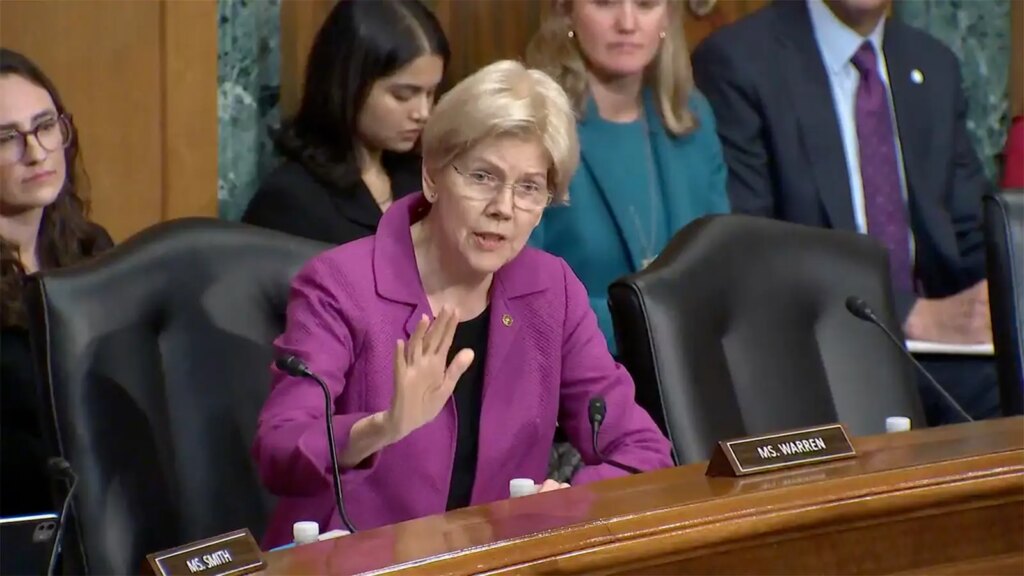
While brand-name pantoprazole (Protonix) costs $200 for a 30-day supply on TrumpRx, the same generic prescription costs just $16.99 at Costco, Sen. Elizabeth Warren (D-Mass.) said during a hearing on the proposed HHS budget.
The same was true for the antiarrhythmic dofetilide (Tikosyn), with the branded drug ringing up at $336 on TrumpRx compared with under $10 for the generic on Cost Plus Drugs.
“If you’re buying a drug on TrumpRx, there is a more than one-in-four chance that Trump’s discount is actually a price hike,” Warren said during the Senate Finance Committee hearing on Wednesday, at which HHS Secretary Robert F. Kennedy Jr. was the sole witness. “For an anti-big-pharma guy, you sure don’t seem worried about steering patients to more expensive drugs that are gonna pad big pharma’s profits.”
Kennedy said his agency directs Americans to generics when they can, but “a lot of doctors prescribe the brand,” and insisted that HHS is “giving them a 600% reduction on brands.”
Warren noted that a 600% reduction is mathematically impossible and would mean “companies should be paying you to take their drugs.” Kennedy, however, was insistent that “Trump has a different way of calculating percentage” — that if “you have a $600 drug and reduce it to $10 that’s a 600% reduction.”
Warren continued that in exchange for giving discounts on branded drugs to TrumpRx, the Trump administration has exempted pharmaceuticals from massive tariffs.
“Big pharma makes billions of dollars in tariff relief by listing their drugs on TrumpRx, and then they don’t even lower the costs on many of these drugs,” she said. “That is a great deal for big pharma.”
Warren and the Democrats on the committee pushed hard to get Kennedy to pledge to release details of those so-called “most favored nation” deals, simultaneously introducing legislation that calls for releasing details of the deals struck between manufacturers and the Trump administration. The legislators argued that the deals benefit pharmaceutical companies while offering little to no savings to patients and their families.
Kennedy said he wouldn’t release those details because they contain “proprietary information and trade secrets.”
Another key theme was preventive care, with Senators asking about Kennedy’s planned changes to the U.S. Preventive Services Task Force (USPSTF), and where he stands on other preventive services.
Sen. John Barrasso (R-Wyo.) asked Kennedy about his earlier comments that USPSTF has been “lackadaisical,” questioning his plans for reform and asking specifically about what the task force has been getting wrong.
Kennedy admitted he has “not done a good job getting those meetings out there” and has issued a call for applicants to replace members who he said are rotating out. He said that “a number of specialties” were not well represented on the task force, and that he plans to increase the number of meetings and the transparency of those meetings.
“We’re not going to undermine any of those functions,” Kennedy said. He added that as for the task force’s procedures for reviewing evidence, he said there are “some limitations we are trying to address.”
There were concerns about how the task force would be revamped given what happened with the CDC’s Advisory Committee on Immunization Practices (ACIP). Sen. Maggie Hassan (D-N.H.) pressed Kennedy on whether he discussed his plans to fire all 17 ACIP members last year with the president, as well as whether he discussed plans with Trump to rework the current ACIP charter.
He said he talked with the White House’s Domestic Policy Council on those decisions, but “I don’t know if it was elevated to the presidential level.”
“You’re making extraordinary changes to the vaccine charter so you will be able to bring on quacks and conspiracy theorists to guide vaccine policy in this country, and you haven’t discussed it with the president,” Hassan said.
Sen. Tina Smith (D-Minn.) also painted a picture of a lack of prioritization for preventive services in Kennedy’s HHS, noting that it has cut breast cancer screening programs, depression screening, smoking prevention, and other preventive programs through various mechanisms. Specifically, cutting Title X funding would cut cervical cancer screens and would result in more unintended pregnancies, she said.
“This is not a record that matches with saying that preventive care is important,” Smith said. “I do not understand the contrast here by what you say you want to do, and what is actually happening in this administration.”
Sen. Bill Cassidy (R-La.), who cast the key vote allowing Kennedy to become HHS Secretary, did not clash with Kennedy as he has during past hearings. Instead, he pushed for finalizing aspects of the working families tax cuts, providing funding to address fraud in Affordable Care Act plan enrollment, and fixing Medicare Advantage rate calculations.
Please enable JavaScript to view the comments powered by Disqus.
Source link : https://www.medpagetoday.com/washington-watch/washington-watch/120911
Author :
Publish date : 2026-04-22 20:15:00
Copyright for syndicated content belongs to the linked Source.