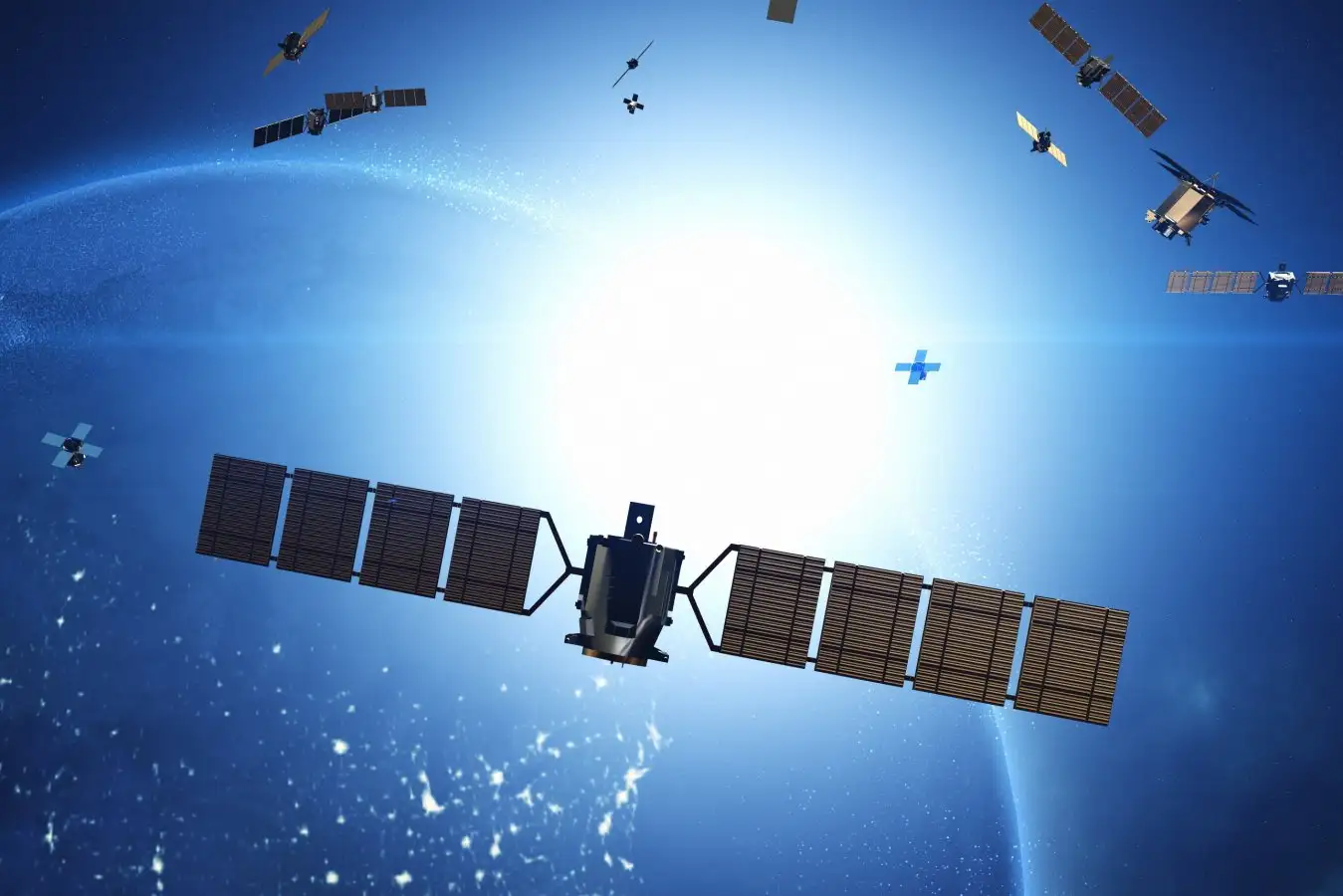
An artist’s representation of satellites in orbit around Earth
yucelyilmaz/Shutterstock
A collision would occur in just 2.8 days if all satellites lost their ability to dodge each other, highlighting how crowded Earth’s orbit is becoming.
In the past seven years, the number of satellites has more than tripled from 4000 to nearly 14,000. The main cause of this growth has been SpaceX’s Starlink constellation, which now numbers more than 9000 satellites in low Earth orbit between 340 and 550 kilometres above Earth.
This large increase means satellites must constantly dodge out of the way of each other, known as a collision avoidance manoeuvre, to prevent crashes that would generate thousands of pieces of metal and potentially render parts of Earth’s orbit unusable.
From 1 December 2024 to 31 May 2025, SpaceX performed 144,404 collision avoidance manoeuvres, equivalent to one every 1.8 minutes across its constellation, according to a report by the company. Only one collision in orbit has ever occurred. In 2009, an active satellite run by Iridium Communications hit a defunct Russian Kosmos satellite. Hundreds of pieces of debris from the event still orbit Earth.
Sarah Thiele at Princeton University and her colleagues used public positional data of satellites to model how their increased number has affected the collision risk. They came up with a new metric, called the Collision Realization And Significant Harm (CRASH) Clock to quantify the risk. The name invites comparisons with the infamous Doomsday Clock that charts humanity’s threat of nuclear war. “We definitely talked about that a lot,” says Samantha Lawler at the University of Regina in Canada, another member of the team.
They found that if all the satellites in orbit in 2018 – prior to SpaceX’s first Starlink launch in 2019 – had suddenly lost their ability to manoeuvre, there would have been a collision in 121 days. However, today the number is just 2.8 days because of the large number of satellites in orbit.
“We were shocked it was that short,” says Thiele.
The 2.8-day figure presumes that some event, such as a powerful solar storm, has rendered all satellites unable to change course. In May 2024, a strong solar storm caused some Starlink satellites to ripple in a giant wave in response to the event. A repeat of the most powerful solar storm on record – the Carrington Event of 1859 – could cause significant problems, although Wineed Vattapally at SES Satellites in Luxembourg says it probably wouldn’t render all satellites inoperable. “It’s unlikely to knock them all out at the same time,” he says.
The world capital of astronomy: Chile
Experience the astronomical highlights of Chile. Visit some of the world’s most technologically advanced observatories and stargaze beneath some of the clearest skies on earth.
A metric like the CRASH Clock is useful to highlight how crowded Earth’s orbit is becoming, says Hugh Lewis at the University of Birmingham, UK. “Can we keep adding to that house of cards?” he says. “The more cards that get added, the bigger the collapse is when things go wrong.”
Tens of thousands more satellites are set to be launched in the coming years by SpaceX, Amazon and several Chinese companies for their own mega constellations. That means it is likely that the CRASH Clock will decrease further, raising the potential for collisions. “It’s scary to think about,” says Thiele.
Topics:
Source link : https://www.newscientist.com/article/2508752-crash-clock-says-satellites-in-orbit-are-three-days-from-disaster/?utm_campaign=RSS%7CNSNS&utm_source=NSNS&utm_medium=RSS&utm_content=home
Author :
Publish date : 2025-12-16 11:30:00
Copyright for syndicated content belongs to the linked Source.